
Derry/Londonderry – A City Within a City
How Many Cities Can You Find in One Derry?
Some cities can be explored in a single walk. You follow the main street, visit the central square, admire the most important landmarks and stop somewhere for a coffee. After a few hours, you feel you’ve seen at least the highlights.
Derry is a little different.
We arrived on Friday, with almost three days ahead of us to explore the city. Our plans included the historic city walls, Bogside, a few interesting places in the centre and the Foyle Maritime Festival, which was one of the reasons we’d come in the first place.
Surely three days would be enough.
As so often happens on our travels, reality had other ideas.
Derry turned out to be rather like a Russian nesting doll. Open one layer and another appears underneath. Then another. Each has its own history, its own character and sometimes a completely different atmosphere.
Along the River Foyle, we discovered a modern city, with its distinctive Peace Bridge and revitalised waterfront. A few minutes later, we were standing outside the Guildhall, whose interiors took us back to the world of London’s merchant companies and events from four centuries ago.
Behind the historic walls, narrow streets, old buildings, little shops and hidden passageways awaited us. In some corners, it was almost possible to forget we were living in the 21st century.
And then there was Bogside.
Here, history suddenly felt much closer. It was no longer simply about events that had taken place centuries earlier. It confronted us through murals, memorial plaques and the names of people whose lives had ended only a few decades ago.
Just when we thought Derry had shown us all its different faces, music began to fill the air along the Foyle. Crowds gathered, colourful stalls appeared, street performers entertained visitors and yachts lined the waterfront.
The same city.
A completely different story.
What makes Derry particularly fascinating is that these different worlds are not separated by miles. Sometimes all that lies between them is a single street, a flight of steps or a passage through an old gateway.
That is why we decided to tell our Derry story in four connected articles rather than one enormous travelogue.
In this first one, we’re inviting you to explore the city itself. We’ll step inside the Guildhall, wander through the historic centre, discover hidden corners, visit St Columb’s Cathedral and see Derry beyond its most famous landmarks.
Whenever we encounter a place whose history deserves a story of its own, we’ll open another layer of our nesting doll.
Because Derry has a remarkable habit of making you feel that turning a single corner can take you into an entirely different century.
1. Across the Foyle – Our First Encounter with Derry
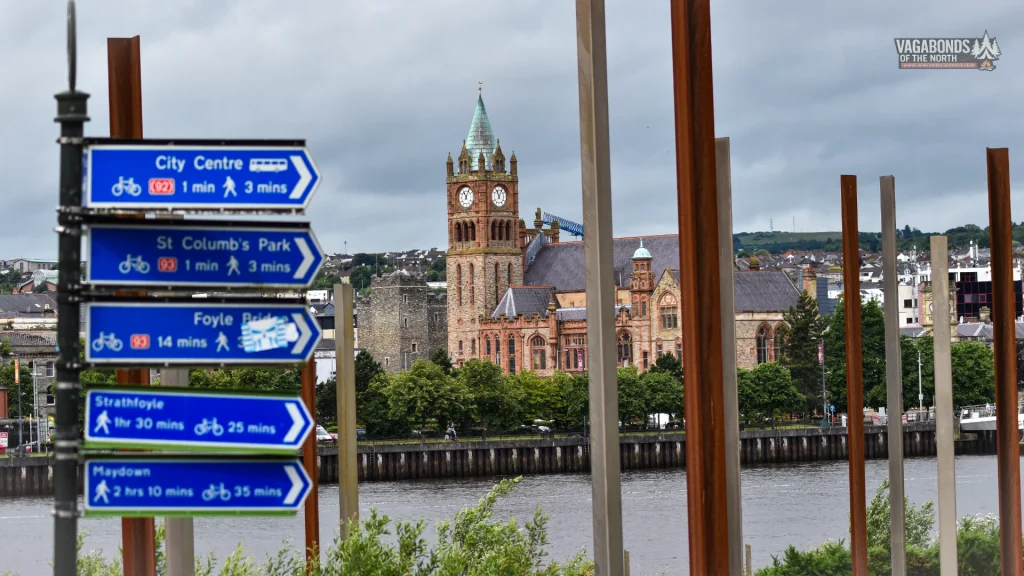
Our introduction to Derry began near the railway station, on the eastern side of the River Foyle.
It’s a wonderful way to approach the city for the first time. Instead of finding yourself immediately among historic buildings and narrow streets, you have a chance to admire Derry from a distance.
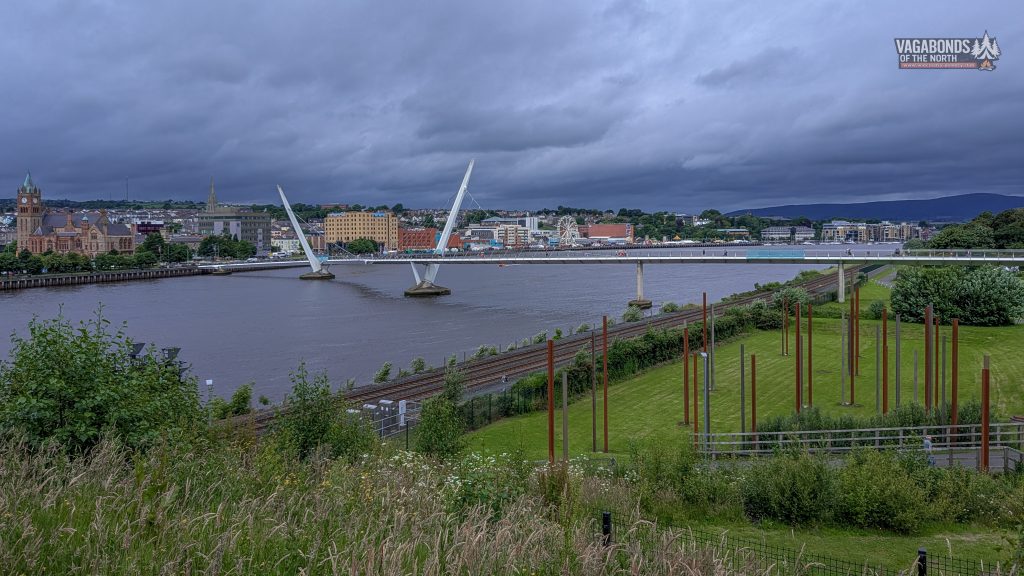
The river stretched out before us, with the city centre rising on the opposite bank. Above the waterfront stood the distinctive clock tower of the Guildhall, while the buildings of old Derry spread out behind it.
Connecting the two banks was the Peace Bridge, a modern pedestrian and cycle bridge whose gently curving structure stands out against the surrounding architecture.
And it’s difficult to imagine a more appropriate symbol of modern Derry.
For many years, the city was associated primarily with division and conflict. Today, a bridge whose very name refers to peace connects its two sides.
There is plenty to say about its architecture, engineering and history. But for someone crossing it for the first time, the most striking thing is much simpler.
The bridge takes you from one Derry into another.
And on the far side, our story begins.
2. Guildhall – Our First Big WOW!
After crossing the Foyle, we began making our way towards Derry’s historic centre.
And that was when a building appeared before us that was simply impossible to ignore.
The Guildhall.
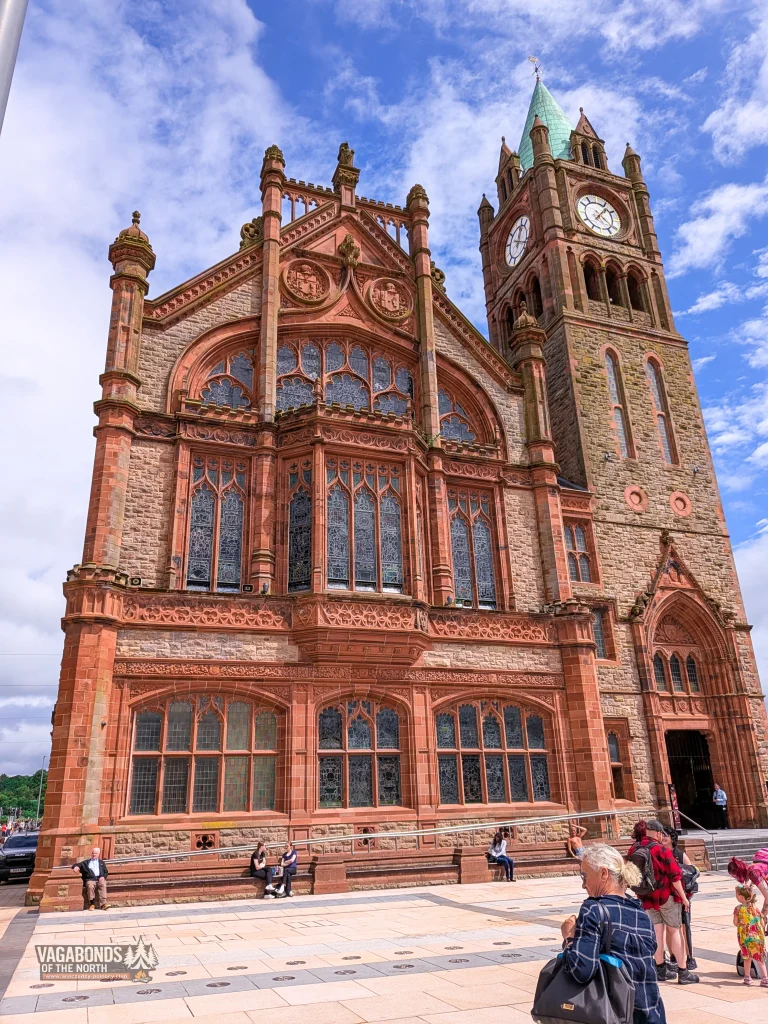
Even from a distance, its tall clock tower, pointed windows and distinctive red brickwork immediately catch your attention. The whole building looks rather like a cross between a Gothic castle and a grand Victorian town hall.
Get a little closer, and the impression becomes even stronger.
It may not be the largest building in Northern Ireland, but there is something about it that makes you stop, look up and simply admire what you’re seeing.
And there it was.
Our first great WOW!
The exterior is impressive enough, but the real surprise was waiting for us inside.
When a Door Opens onto Another Story
We expected the interior of a grand civic building.
Perhaps a few commemorative plaques, a historical exhibition and a council chamber.
Instead, we discovered a place where almost every room and every detail had something to tell us about Derry’s past.
The main hall made the greatest impression.
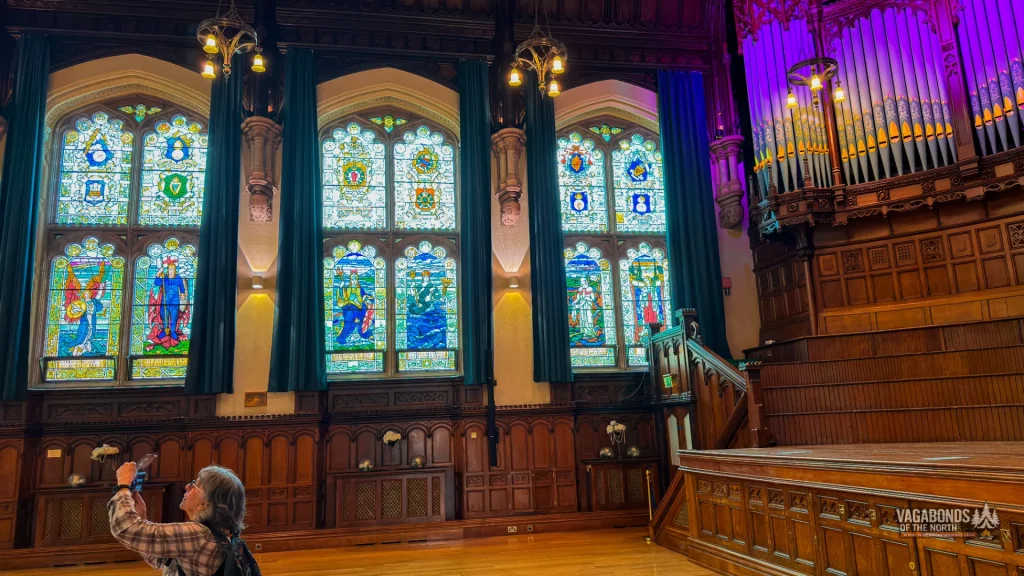
A magnificent, spacious room with wooden galleries, an ornate ceiling and an enormous pipe organ dominating one end.
We had barely taken a few steps inside before we found ourselves looking in every direction.
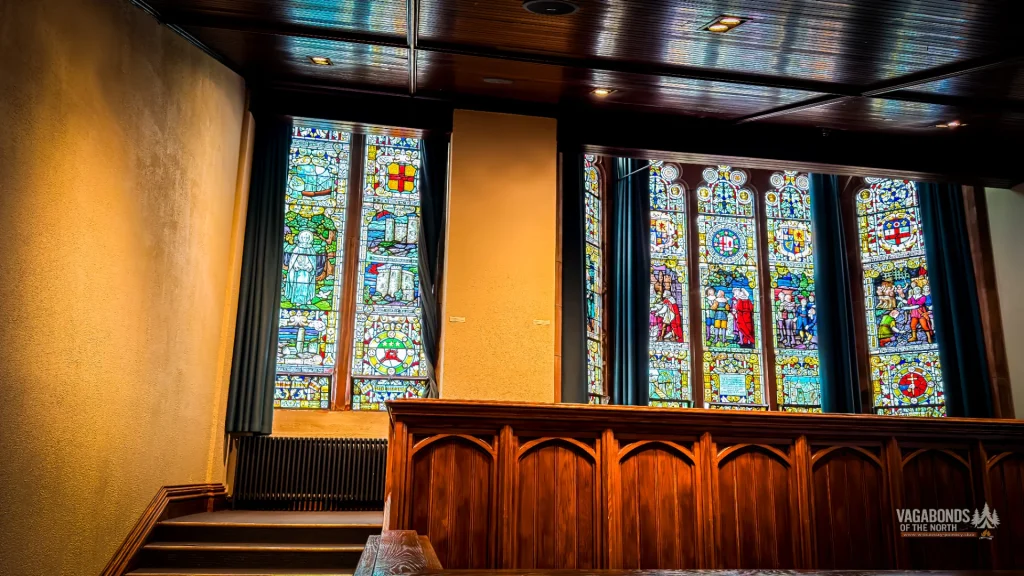
And then our eyes turned towards the windows.
The stained glass!
Not just one or two decorative windows, but entire compositions filled with figures, coats of arms, symbols and historical scenes.
This was where the Guildhall revealed something that could never be appreciated from the outside.
Its interior is not simply an impressive ceremonial space. It is also a story of the city, told through glass, wood and stone.
History Written in Coloured Glass
The Guildhall’s stained-glass windows deserve special attention, and not only because of their size or craftsmanship.
They illustrate aspects of the city’s history, its connections with London’s merchant companies and events that helped shape Derry.
And here, another layer of our nesting doll begins to open.
To understand why the symbols of London guilds appear in a city in Northern Ireland, we need to travel back to the early 17th century.
This was the period of the Plantation of Ulster, a programme of organised settlement supported by the English Crown that profoundly changed this part of Ireland.
London’s merchant companies became involved in the development of the city, which acquired the name Londonderry.
We won’t attempt to tell that entire story here. We explored it in much greater detail during our walk around Derry’s historic walls.
Derry City Walls: The Story of a City That Survived a Siege
Inside the Guildhall, however, the stained glass alone is enough to show how deeply the past remains woven into the city’s identity.
A Building with a Story of Its Own
The Guildhall we see today is not quite the same building that originally stood here.
The original hall was constructed towards the end of the 19th century. In 1908, it was badly damaged by fire and subsequently rebuilt.
Commemorative plaques inside the building tell part of that story.
Interestingly, the Guildhall is not simply a historic attraction preserved for visitors.
It continues to serve civic and ceremonial purposes, and visitors can also see the Council Chamber.
That combination is particularly fascinating.
On one hand, centuries of history are represented in stained glass and commemorative inscriptions. On the other, the building remains part of the city’s present-day civic life.
It is not a museum frozen in the past.
It is a place where the past and present continue to exist side by side.
One Last Look
Before leaving, we couldn’t resist taking another look around.
The tall windows, colourful glass, wooden galleries and magnificent organ…
The Guildhall is impressive from the outside, but only once you step inside do you begin to appreciate how much history lies behind those red-brick walls.
And we had barely begun exploring Derry.
Beyond the doors, more streets, passageways and hidden corners were waiting.
We had no idea just how surprising they would turn out to be.
3. A City That Doesn’t Take Much Notice of Levels
From the outside, everything seems fairly straightforward.
Derry’s historic centre is surrounded by walls that can be walked in approximately forty minutes.
It isn’t an enormous area.
Looking down from the walls, you might even imagine that the streets and buildings inside would be easy enough to navigate.
You would be wrong.
All it takes is a turn into a side street, a walk through an old gateway or a few steps away from the main road to discover that Derry has not only several layers of history, but several different levels of height as well.
Quite literally.
Another City Beyond the Gate
Passing through Magazine Gate was one of those moments when we felt we were opening yet another layer of our nesting doll.
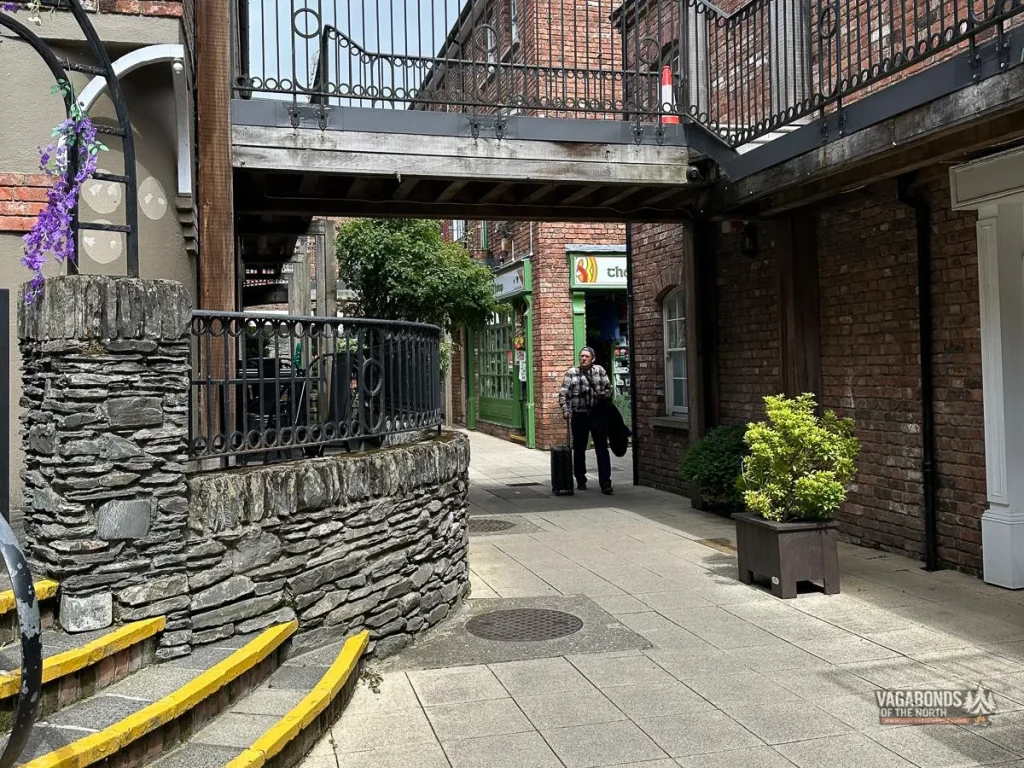
On the other side, we found narrow streets, small pubs, little shops, tailoring workshops and ice-cream parlours.
Buildings stood close together, creating passageways that sometimes felt more like corridors than ordinary streets.
Within a few steps, the noise of the busier roads was behind us.
But before continuing, let’s return briefly to our first hours in Derry.
Because one of our earliest discoveries happened before we’d even checked into our accommodation.
A Museum? Why Bother Dropping Off the Luggage First?
Not all our discoveries in Derry happened during carefully planned walks.
The Tower Museum was a perfect example.
We had only just arrived in the city.
We still had our luggage with us, and it wasn’t yet time to check in.
Then Dana noticed that the museum was open.
There wasn’t much discussion.
If it’s open, we’re going in!
And so, instead of dropping off our bags and beginning our sightseeing in a sensible, organised fashion, we found ourselves exploring a museum with all our travelling belongings in tow.
Inside was an exhibition dedicated to Derry Girls.
The television series follows a group of teenagers growing up in Derry during the 1990s, when everyday life was still shaped by the conflict in Northern Ireland.
Yet it approaches that world through humour, absurd everyday situations and characters for whom school problems can seem every bit as important as the history unfolding around them.
The exhibition offered a chance to explore the world of the series, see memorabilia connected with the production and revisit some of its most recognisable elements.
During our visit, this was the only exhibition remaining at the Tower Museum. The other exhibitions had been moved to different locations.
And that was how our Derry adventure began.
Meeting the city’s television heroines.
With our luggage.
Before we’d even checked in.
A fairly typical start for the Vagabonds of the North!
Architecture That Has to Negotiate with a Hill
But let’s return to those narrow streets, because the greatest surprise wasn’t the buildings themselves.
It was the ground beneath our feet.
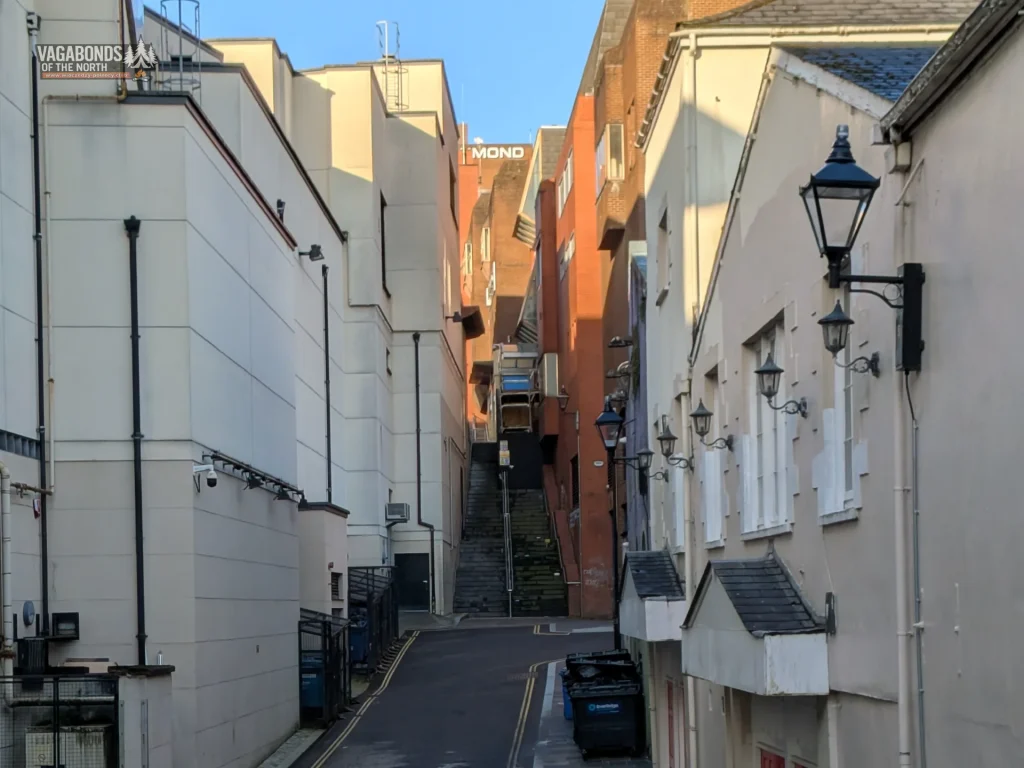
You’re walking along an ordinary pavement, passing shop windows, when you turn a corner and suddenly find yourself facing a staircase.
Not three or four steps.
A staircase dropping the equivalent of roughly two storeys!
And when you finally reach the bottom, you’re still in the same compact city centre, within the historic walls.
Only when you begin exploring on foot do you realise just how strongly the landscape has shaped the city.
Buildings stand side by side, yet the street level can change dramatically.
What appears to be the ground floor at one end of a building may be considerably higher above the pavement at the other.
Facades follow the slope, entrances appear at different heights, and staircases connect places that seem almost next door to one another on a map.
At times, you get the impression that the architects built the houses first and only afterwards remembered that somebody would need to fit a few streets between them.
Of course, it was the other way around.
The buildings had to adapt to the terrain.
But the result is remarkable.
And that’s one of the reasons walking around Derry is so interesting.
Looking straight ahead simply isn’t enough.
You need to look up, look down, peer through gateways and explore the spaces between buildings.
Hidden Corners Where Everyday Life Goes On
Among all those steps, passageways and old buildings lies another Derry.
Not monumental.
Not a museum.
And not necessarily the sort of place that appears on tourist postcards.
Small pubs, workshops, shops, ice-cream parlours, colourful decorations and shop windows that invite you to slow down for a moment.
This is where you realise that the old city is much more than a collection of historic landmarks.
It is a living place.
People work here, shop here, meet friends and go about their daily lives.
The historic walls, which seem so dominant when viewed from outside, become simply another part of the surroundings.
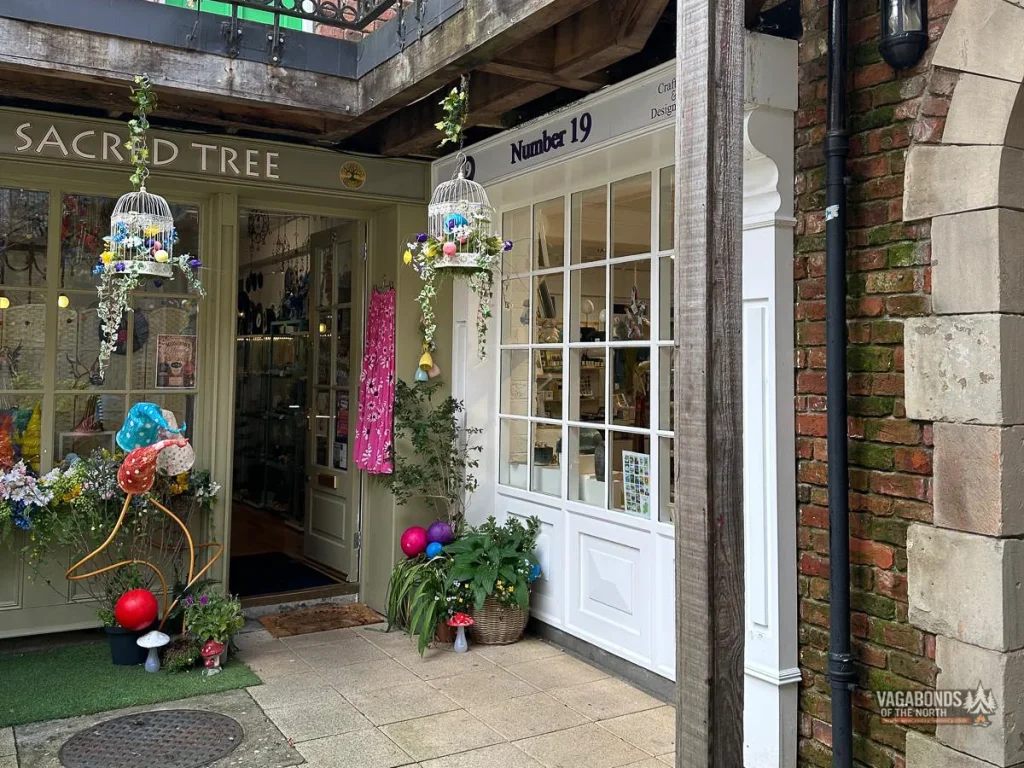
And to think that you can walk around this entire area on the walls in less than an hour.
From above, everything looked so simple.
Down at street level, Derry turned out to have far more hidden corners than its size would suggest.
4. St Columb’s Cathedral – A Moment of Calm in the Urban Maze
As we wandered between buildings, climbed and descended yet more steps and explored narrow side streets, we gradually approached one of historic Derry’s most important landmarks.
St Columb’s Cathedral.
And once again, the city had a surprise waiting for us.
Only moments earlier, we’d been surrounded by little shops, pubs, colourful decorations and narrow passages.
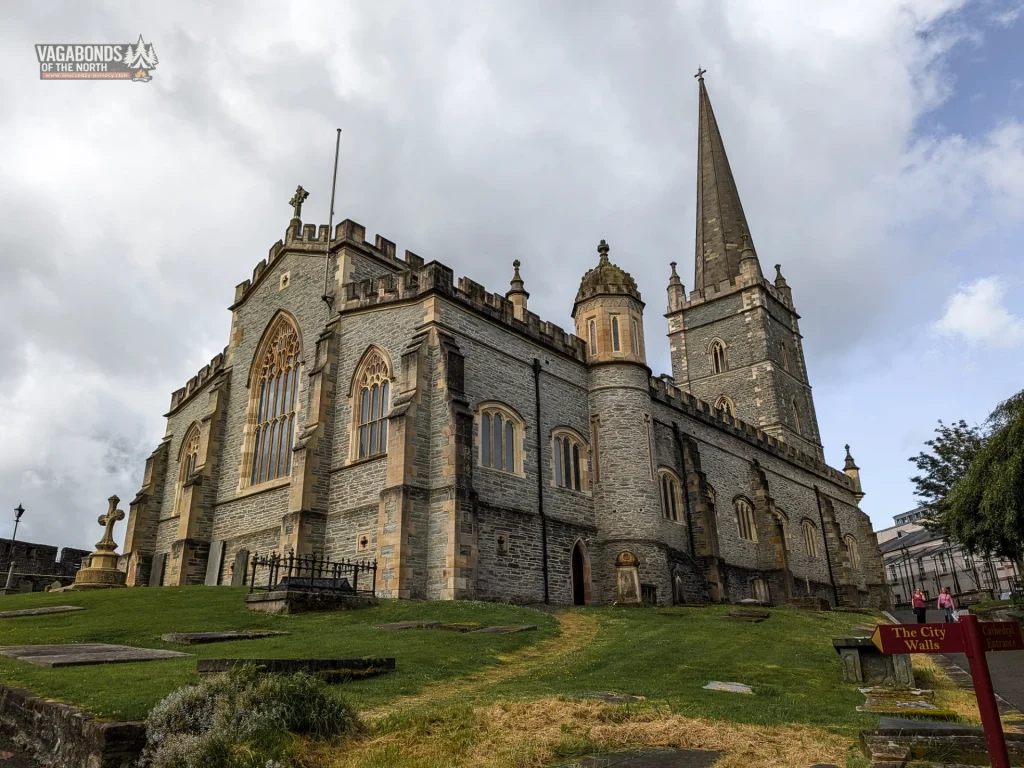
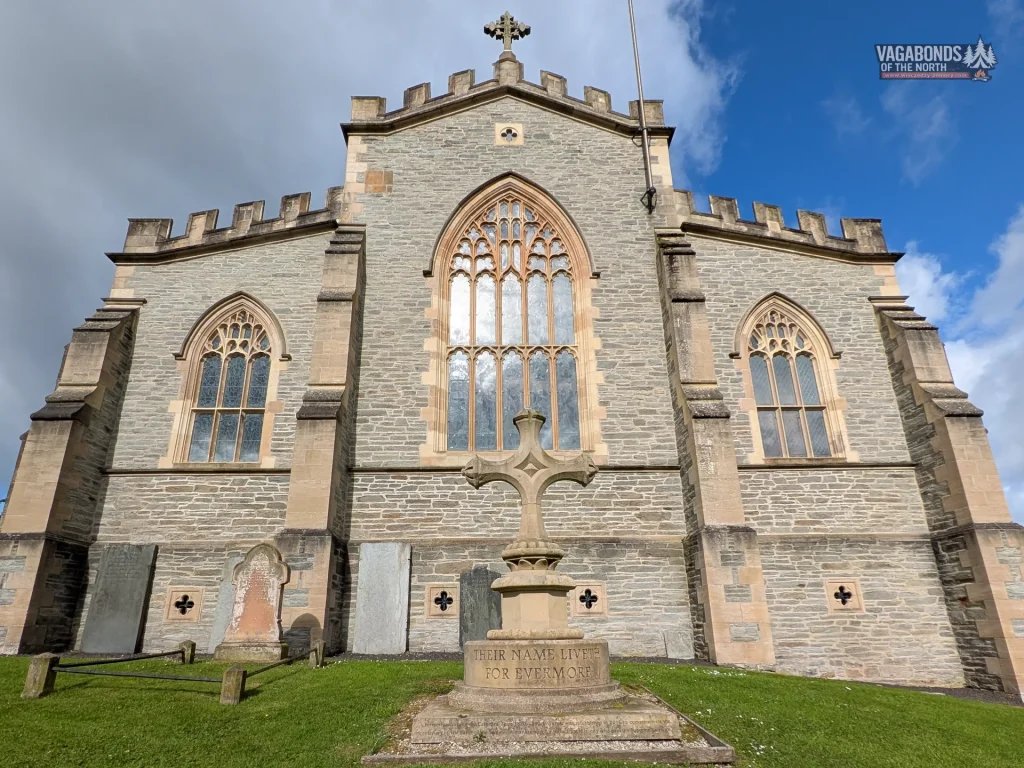
Now, almost without warning, we found ourselves standing before a magnificent stone cathedral.
Its tall tower, substantial walls, pointed windows and historic architecture immediately reminded us that we were in one of the oldest parts of the city.
You don’t need to be an expert in church architecture to appreciate the sight.
A Cathedral with Centuries of History
St Columb’s Cathedral is one of Derry’s most significant historic buildings.
Completed in 1633, it dates from the period when the city was developing following the Plantation of Ulster.
Its construction was connected with the London companies that played an important role in the development of Londonderry.
The cathedral belongs to the Church of Ireland, part of the Anglican tradition.
It is dedicated to St Columba, the sixth-century monk and missionary whose story is deeply connected with Derry.
And once again, another layer of our nesting doll opens.
Long before the 17th-century walls were built, before the London companies arrived and before the city acquired the name Londonderry, there was an older story associated with St Columba.
Around the Cathedral
We didn’t simply admire the building from the front.
We decided to walk all the way around it, exploring the surrounding grounds and graveyard.
And it was during this walk that the cathedral began to reveal its full character.
From each side, it looked slightly different.
The perspective changed, revealing new details in the stonework, windows, buttresses and walls.
And among them stood old gravestones.
Stones That Remember
The graveyard surrounding the cathedral is one of those places where you instinctively slow down.
Gravestones of different shapes, weathered inscriptions and old stone slabs.
Each one marks the memory of somebody who once lived in this city.
Some names can still be read.
Others have almost disappeared beneath the effects of time and weather.
It’s difficult not to wonder how many generations of Derry residents have walked these same streets.
People who remembered the siege.
People who lived through the growth of industry.
People who watched the city change during the 19th and 20th centuries.
To us, they are part of history.
To them, Derry was simply home.
One Cathedral, Three Different Perspectives
Interestingly, St Columb’s Cathedral had already appeared several times during our exploration of Derry.
We’d seen it from the historic city walls, where it formed one of the most recognisable features of the skyline.
Later, we’d looked up towards it from Bogside, seeing it from an entirely different perspective.
Now we were standing beside it.
Moments like these reveal just how close together Derry’s different stories really are.
The same cathedral belongs to the history of the 17th-century city, forms part of the landscape overlooking Bogside and stands along our ordinary walk through modern Derry.
Back into the Streets
After walking around the cathedral, we headed back into the narrow streets of the old centre.
For a while, we’d enjoyed a quieter atmosphere.
But Derry had no intention of letting us remain in the same mood for long.
Somewhere nearby, another mystery was waiting.
This time, it wasn’t a centuries-old monument, a historic church or an impressive civic building.
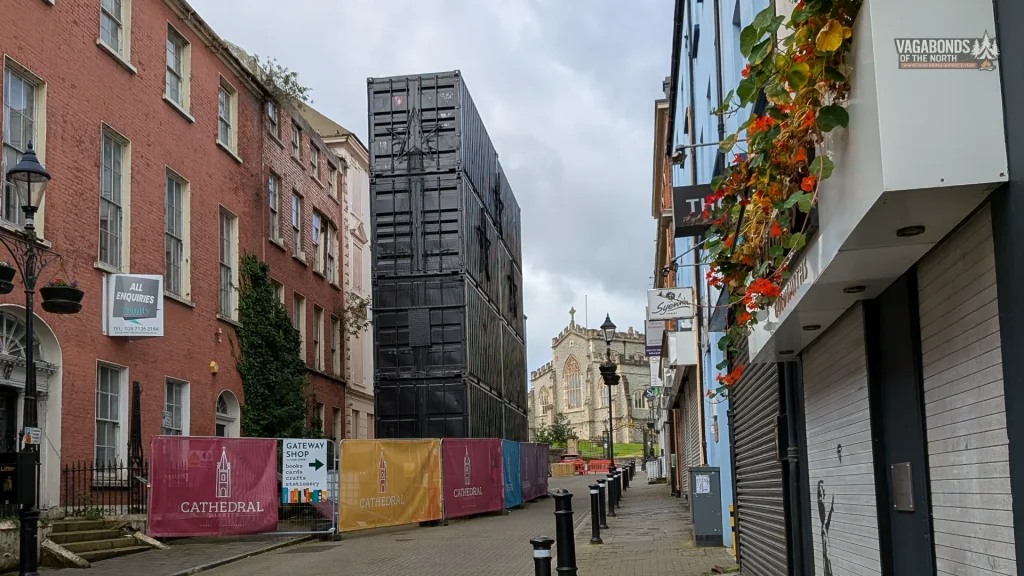
It was black, surprisingly tall and looked as though somebody had stacked several enormous shipping containers on top of one another.
And because we were in an area associated with contemporary art, one explanation immediately came to mind.
Could this be an art installation?
5. Contemporary Art? Not Quite!
By now, Derry had taught us to expect the unexpected.
Near Pump Street, we encountered something that looked completely out of place.
Three enormous black shipping containers stacked on top of one another.
Not small boxes or decorative objects.
Proper, full-sized containers forming a tall, dark structure beside an old building.
Our first thought?
An art installation!
After all, we were exploring an area where contemporary art was hardly unusual.
And if somebody had gone to the trouble of stacking three shipping containers and painting them black, perhaps they were trying to communicate some profound artistic message.
Where Exactly Is the Exhibition?
I started examining the structure.
Perhaps there was a plaque with the artist’s name?
An explanation?
Some graphics?
Anything that might reveal the meaning behind this unusual creation?
Nothing.
I walked along the containers once.
Then a second time.
And because I don’t particularly enjoy leaving mysteries unsolved, I went back for a third look.
Still nothing.
No artist’s name.
No exhibits.
No information about an exhibition.
I was beginning to suspect that I’d encountered contemporary art in its most demanding form — the kind where the visitor has to invent the meaning of the work for themselves.
Mystery Solved
Only later did we discover that the explanation was considerably less artistic, although no less interesting.
The containers were not an installation or part of an exhibition.
They formed part of a temporary safety arrangement around a neighbouring damaged building.
Their purpose was practical rather than artistic.
I have to admit that discovering the truth made me laugh.
I’d walked past the same containers three times, searching for a work of art, while somebody had simply been trying to solve a building-safety problem!
But there is something rather characteristic of Derry in that little story.
The city isn’t made up entirely of beautifully restored historic buildings.
There are also properties awaiting repairs, neglected corners and places where preserving the past is clearly more complicated than it appears in tourist photographs.
And details like these help you discover the real city rather than simply its postcard image.
Derry Without the Make-up
Those black containers reminded us of something that became increasingly noticeable as we continued exploring.
Derry can astonish you with the magnificent architecture of the Guildhall, beautiful stained glass and historic churches.
But walk a few dozen yards and you may find yourself somewhere completely different.
Closed shops.
Weathered facades.
Narrow backstreets where time seems to have stood still for decades.
Some places looked as though the builders had gone out for a tea break and had been struggling to decide when to return ever since.
Yet none of this made the city less interesting.
Quite the opposite.
It allowed us to see Derry without the make-up.
Because Derry is not a stage set created for tourists.
It’s a city that lives, changes, grows older and continually tries to balance its extraordinary past with the demands of the present.
And sometimes, that requires three black shipping containers.
6. History in the Square and Along the Street – Derry Through the Decades
After our adventure with the not-quite-art installation, we continued through the old centre.
Once again, Derry reminded us of its unusual relationship with height.
Distances may be short, but changes in level can be surprisingly dramatic.
Streets rise and fall, buildings stand at different heights, and a walk that looks perfectly harmless on a map can turn into a respectable bit of exercise.
This time, we reached the heart of the historic city.
The Diamond.
A Monument at the Heart of Derry
Despite its name, The Diamond has little to do with precious stones.
It is the central square of old Derry, where the four main streets of the historic city meet.
For centuries, this has been an important focal point of urban life.
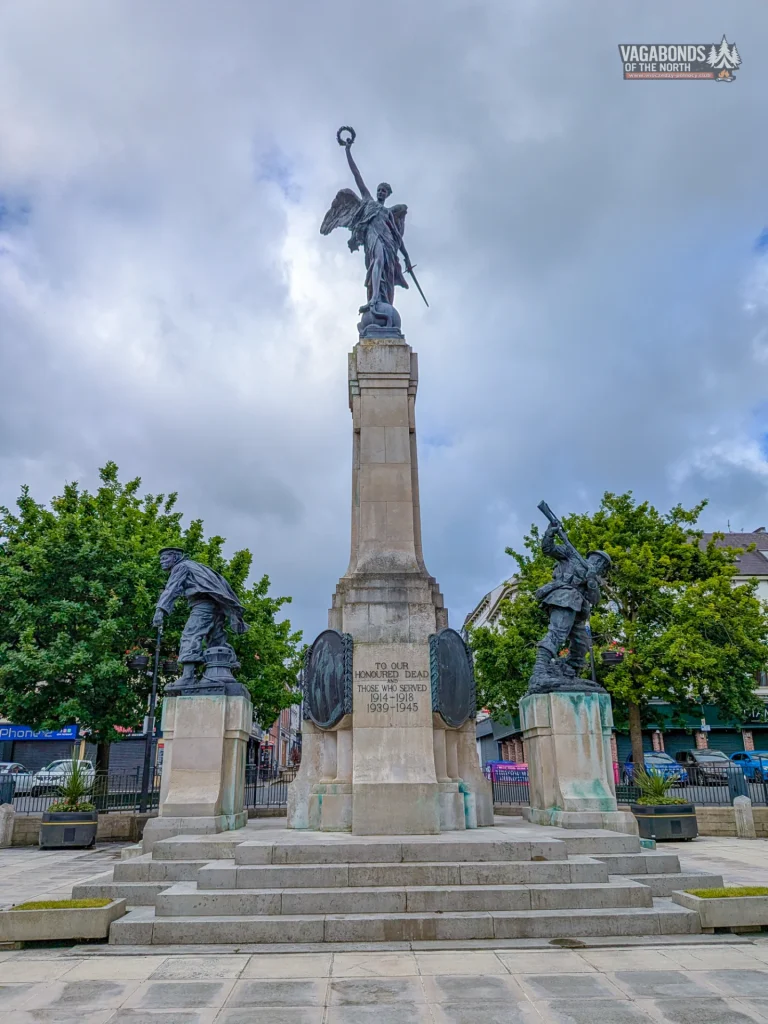
And standing in the middle is a monumental war memorial.
It’s difficult to miss.
A tall stone structure crowned by a winged figure, with sculptures of a soldier and sailor at its base.
The monument stands prominently against the surrounding buildings.
This is the Diamond War Memorial, commemorating local people who lost their lives during military service in the First World War.
It was unveiled in 1927.
Names That Cross Divides
For many years, the memorial was a subject of controversy.
Some residents associated it primarily with British military tradition, something with which not everyone in Derry identified.
Later research, however, helped reveal a more complex story.
Among those commemorated were people from both of the city’s main communities, including nationalist and unionist backgrounds.
People who may have differed in their politics, religion or hopes for Ireland’s future nevertheless lost their lives on the same battlefields.
Over time, the memorial also became the focus of projects seeking to explore and share that complicated history.
And to think that only a short while earlier, I’d been searching for hidden artistic meaning in three black shipping containers.
Here, history really was hiding in plain sight — in names carved into stone.
A Street That Heads Downhill Again
From The Diamond, you can head towards the Guildhall and the River Foyle.
One look down Shipquay Street is enough to remind you why we described Derry as a city that doesn’t take much notice of levels.
The street slopes so sharply that the perspective immediately catches your eye.
Buildings stand close together, shopfronts follow the gradient, and the view opens towards another part of the city below.
It’s one of those places where it’s worth stopping simply to look.
But something else caught our attention.
An enormous street graphic showing how Derry had changed through the decades.
A History You Can Walk Along
This wasn’t a small information board or a single mural.
It was a long visual composition presenting different periods in the city’s history.
You could walk alongside it, following changes in the streets, buildings and everyday life of Derry.
Rather than looking at one historical image, we found ourselves following something like a story told through a sequence of pictures.
And this was where a still camera became a slightly awkward tool.
How do you fit such a long story into a single photograph?
The answer was simple.
You walk along it with a video camera.
And that’s exactly what I did.
The resulting footage lets us follow the artwork almost as we experienced it on the street.
Austins – Another Story at The Diamond
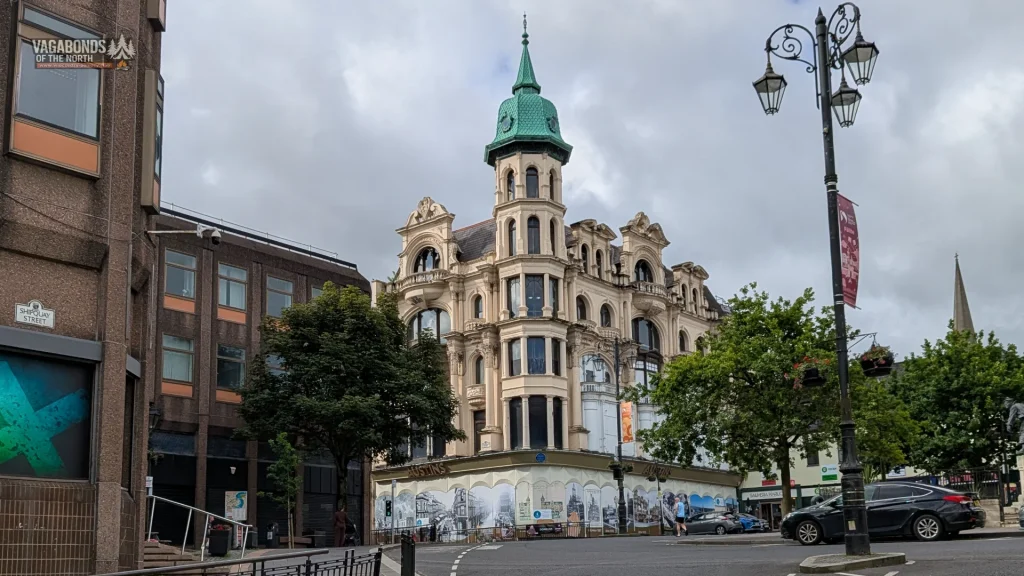
Nearby stands the building of the former Austins department store.
Its distinctive architecture recalls an era when large department stores were not simply places to shop, but symbols of a city’s commercial importance.
The business dates back to 1830.
For generations, Austins was one of Derry’s best-known shopping destinations.
Today, the building remains a distinctive part of the historic city centre.
And there is something rather symbolic about this little corner of Derry.
A monumental memorial commemorates people who lost their lives in war.
Nearby, a former department store recalls the everyday lives of generations of residents.
And along the street, a vast graphic illustrates how the city has changed over time.
Three different ways of telling history.
All within a short walk of one another.
A City That Tells Its Own Story
We began our exploration at the Peace Bridge, a symbol of modern Derry.
Then came the magnificent Guildhall, the maze of narrow streets, the 17th-century cathedral and our mysterious stack of shipping containers.
Now we had reached a place where the city’s history was recorded in stone, architecture and street art.
All within an area you can walk around on the city walls in about forty minutes.
The longer we explored Derry, the more misleading its compact size seemed.
Because here, distance isn’t measured only in yards or metres.
Sometimes it’s much better measured in centuries.
7. The Golden Teapot, Little Pubs and Derry Beyond the Guidebooks
After The Diamond and its stories of the past, we returned to the ordinary life of the city.
Although the word ordinary can be a little misleading when you’re talking about Derry.
Even during a quiet walk, you can stumble upon something that immediately distracts you from the historic landmarks.
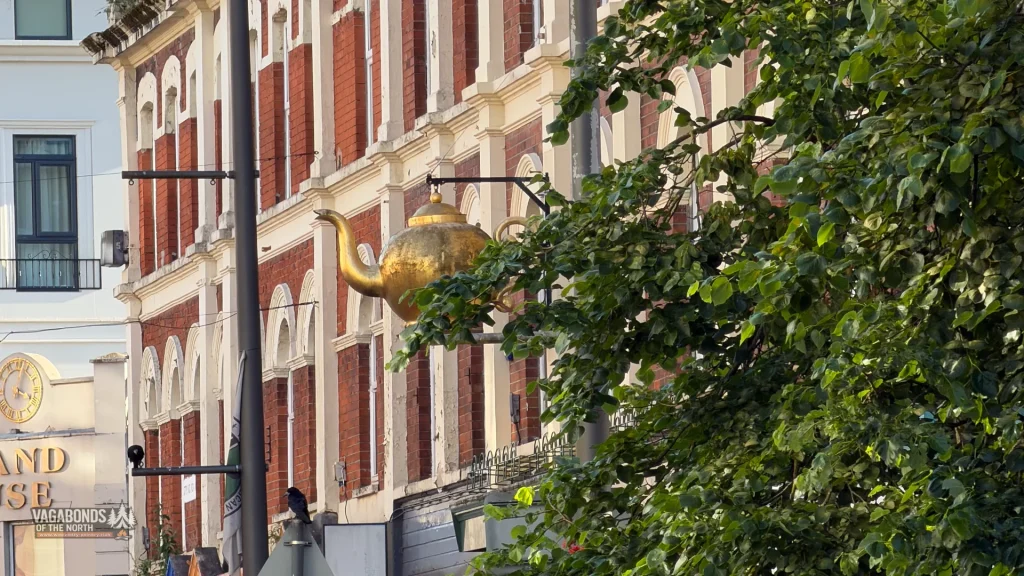
For example, an enormous golden teapot.
Yes.
A teapot.
Not a fountain, a monument or an installation commemorating some great historical event.
A huge golden teapot mounted high on a building.
Whether it was more effective at encouraging people to drink tea or take photographs is difficult to say.
In our case, the camera definitely won.
A City of Little Discoveries
Sometimes the best thing to do in Derry is put away the map and allow yourself to wander.
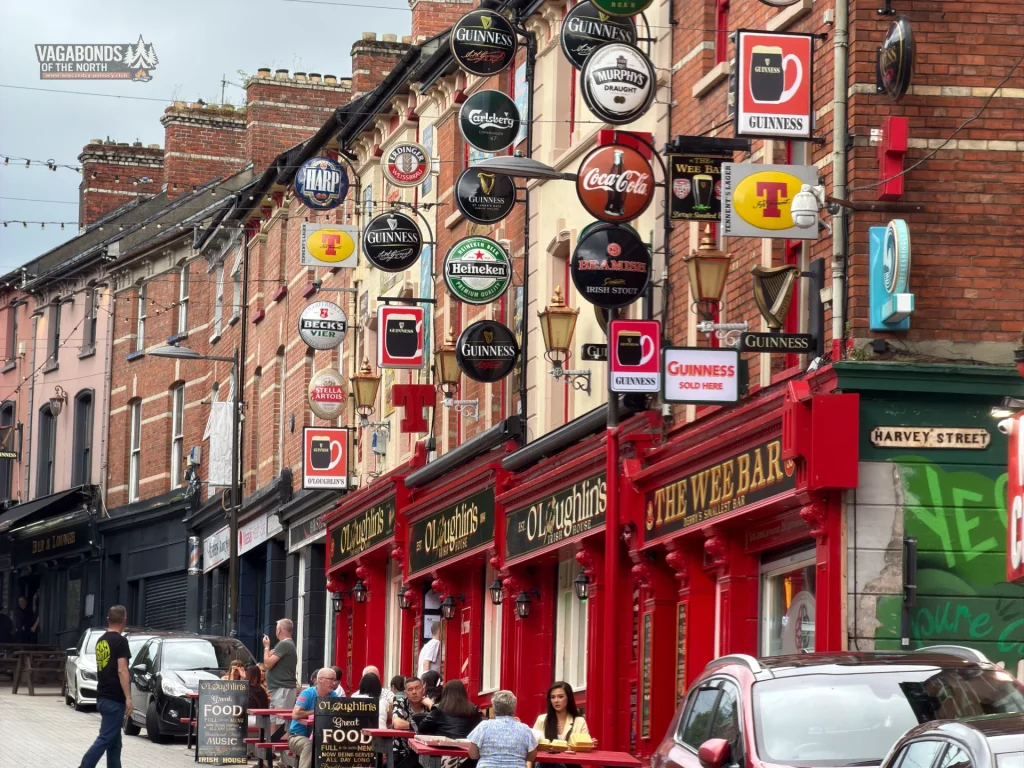
One street leads to a small pub.
Another takes you past a shop window that seems to belong to a different era.
Somewhere there’s a tailoring workshop, elsewhere a little café or ice-cream parlour.
Some premises have elegant, freshly restored facades.
Others look as though their signs haven’t changed in decades.
And that isn’t necessarily a bad thing.
Places like these give a city a character that no uniform regeneration scheme could ever reproduce.
We particularly enjoyed the little passageways and hidden courtyards.
Sometimes, descending a few steps was enough to find yourself surrounded by buildings whose existence you would never have suspected from the main street.
Once again, Derry was opening another layer of its nesting doll.
Not Everything Has to Be Beautiful
There were also places where the city revealed a less polished side.
Closed businesses, neglected facades, graffiti, empty shop windows and stretches of street that seemed to be waiting for better days.
We have no intention of pretending they weren’t there.
After all, we didn’t come to Derry simply to photograph freshly painted buildings.
We wanted to see the city as it really is.
With its magnificent architecture, difficult history, everyday life and imperfections.
And that is the Derry we’ll remember.
8. One More Coffee Before We Go
Our three days in Derry passed surprisingly quickly.
There were walks along the historic walls, our exploration of Bogside, the magnificent Guildhall, countless streets and passageways, and the colourful Foyle Maritime Festival.
Some places we discovered by accident.
Others had been on our list from the beginning.
And there were places we never quite managed to visit.
The Siege Museum, for example, will have to wait until another time. We ran out of time, and when we returned on Sunday, it was closed.
But we didn’t see that as a disappointment.
Quite the opposite.
Derry had given us plenty of reasons to come back.
Guildhall Taphouse, 1:00 PM
We ended our wanderings with a stop at the Guildhall Taphouse.
It was one o’clock in the afternoon.
After all those miles of walking, photographing buildings and exploring every tempting little side street, sitting down with a coffee felt like more than a well-earned break.
For once, we could put the camera aside and stop rushing from one discovery to the next.
Behind us were magnificent buildings, historic walls, steep staircases and hidden corners that had been completely unfamiliar only a few days earlier.
Ahead of us was the journey home.
And in our heads?
A collection of images, memories and stories that would take quite some time to sort through.
It was probably at that moment that we fully appreciated just how mistaken we’d been to think three days would be enough to get to know Derry.
Three days had been enough to fall in love with the place.
But nowhere near enough to discover everything.

Derry – A City Worth Returning To
At the beginning of our story, we compared Derry to a Russian nesting doll.
After three days of exploring, the comparison seems even more appropriate.
We kept discovering new layers, and beneath each one there was another.
Behind the modern waterfront stood the historic city walls.
Beyond them lay old streets, remarkable buildings and stories stretching back centuries.
Then there was Bogside, where the past remains part of the city’s living memory.
And woven through it all was ordinary everyday life.
Shops, pubs, cafés, people heading to work, families out for a walk and visitors trying to find their way through streets that don’t always take much notice of levels.
Derry isn’t a city that can be contained within a single article.
That’s why we’ve divided our experience into several connected stories.
The Historic City Walls take us back to the 17th century and the great siege.
Bogside reveals a much more recent history, whose traces can still be found on the streets today.
The Foyle Maritime Festival shows another side of Derry — filled with music, colour and people enjoying themselves beside the river.
And this story?
This is simply our Derry.
A city we discovered step by step, sometimes with admiration, sometimes with surprise and occasionally with a smile at something we never expected to find.
And although our visit was coming to an end, one thing was already certain.
We’ll be back.
Because we have a feeling there are still a few unopened layers left inside this particular nesting doll.
Explore Derry/Londonderry with us:
| Derry/Londonderry – A City Within a City | City Walls | Derry Bogside | Foyle Maritime Festival |
Discover with us: