Derry – Bogside. A History That Did Not Stay Behind the Walls
There are places you visit with their history already prepared in your head. And there are places where it is better to simply let the story reveal itself.
Bogside turned out to be one of those places for me.
Only a few dozen minutes earlier, I had been walking along the Walls of Derry. Four centuries of history: bastions, gates, cannons and the story of a besieged city. Up there, curiosity dominated. I wanted to look around every corner, search for traces of the past and try to imagine the city as it had been hundreds of years ago.
Then we came down.
And it took only a short walk to the other side of the Walls for history to suddenly stop feeling quite so distant.
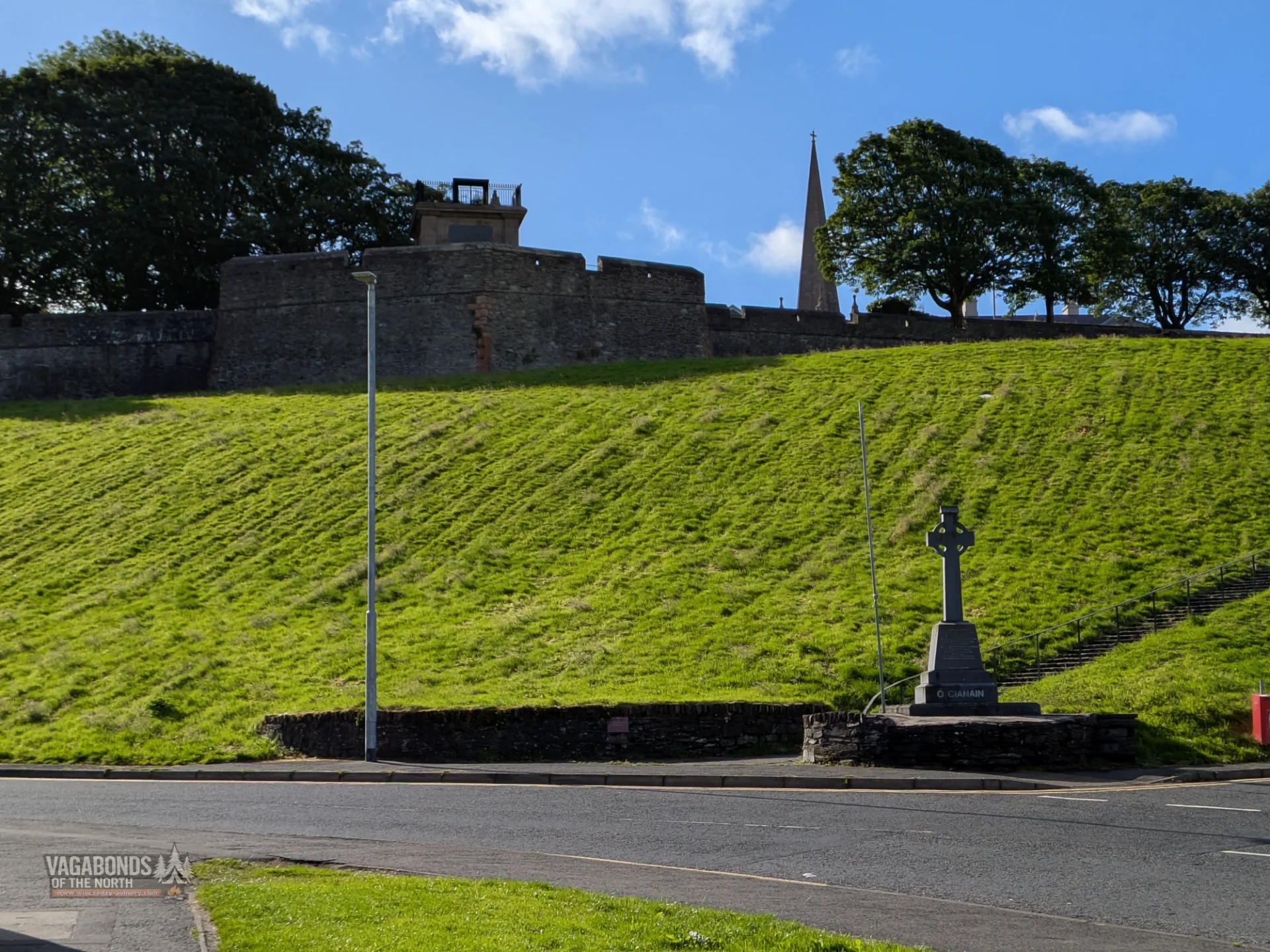
The same fortifications we had just been walking along were now above us. The tower of St Columb’s Cathedral was still visible in the background.
Only the perspective had changed.
And so had the story.
A Sunday Morning in Bogside
It was early. Sunday morning.
Bogside was almost empty.
For a moment, I even had the impression that we had the place to ourselves. A jogger appeared. Later, we passed a man with a little boy, perhaps four or five years old, whom we would encounter several more times during our walk. They seemed to be exploring the area, just as we were.
Apart from them, very little was happening.
Cars stood outside houses. The streets were nearly empty. From time to time, crows called from the trees, apparently having appointed themselves the Sunday commentators for our walk.
No tour groups.
No crowds.
Nothing to suggest that this was a place anyone should be afraid of.
Just a quiet neighborhood waking up to another day.
And today I am very glad that this was how I first experienced Bogside.
Because its history began to emerge slowly.
Everything Looks Different from Above
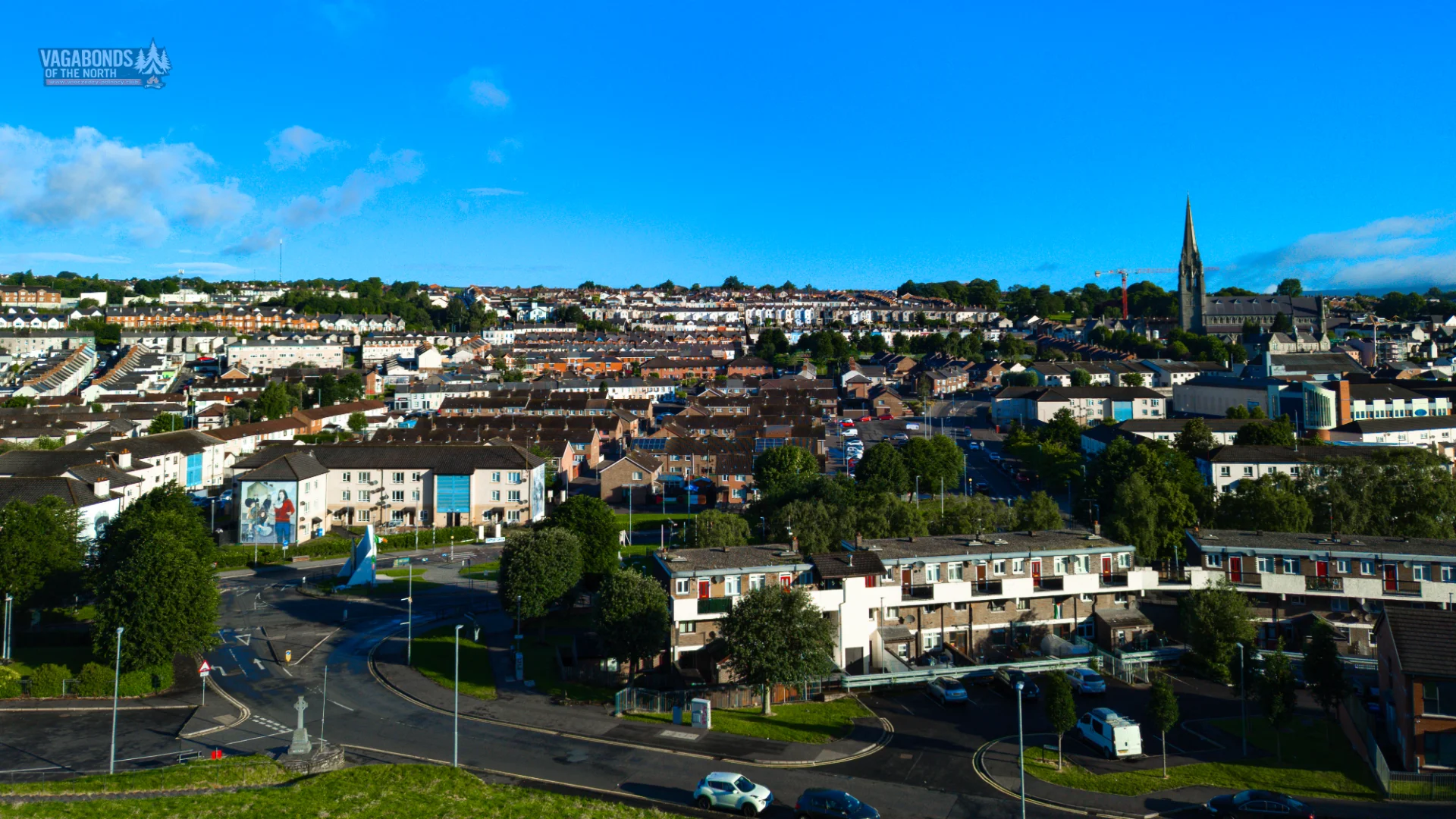
From the Walls, Bogside looks like an ordinary part of Derry.
Houses. Streets. Churches. A few larger buildings. Somewhere among them, you can pick out the distinctive white wall of Free Derry Corner.
Only when you come down to street level do the proportions begin to change.
The murals stop being patches of colour seen from above.
The memorials stop being points on a map.
Street names begin to connect with events previously encountered in books or documentaries.
And you quickly realise that a remarkable amount of this history unfolded across an area that today can be comfortably walked in a matter of minutes.
But to understand Bogside, you cannot begin with the IRA, bombs and soldiers.
You have to go back a little further.
Before the Troubles
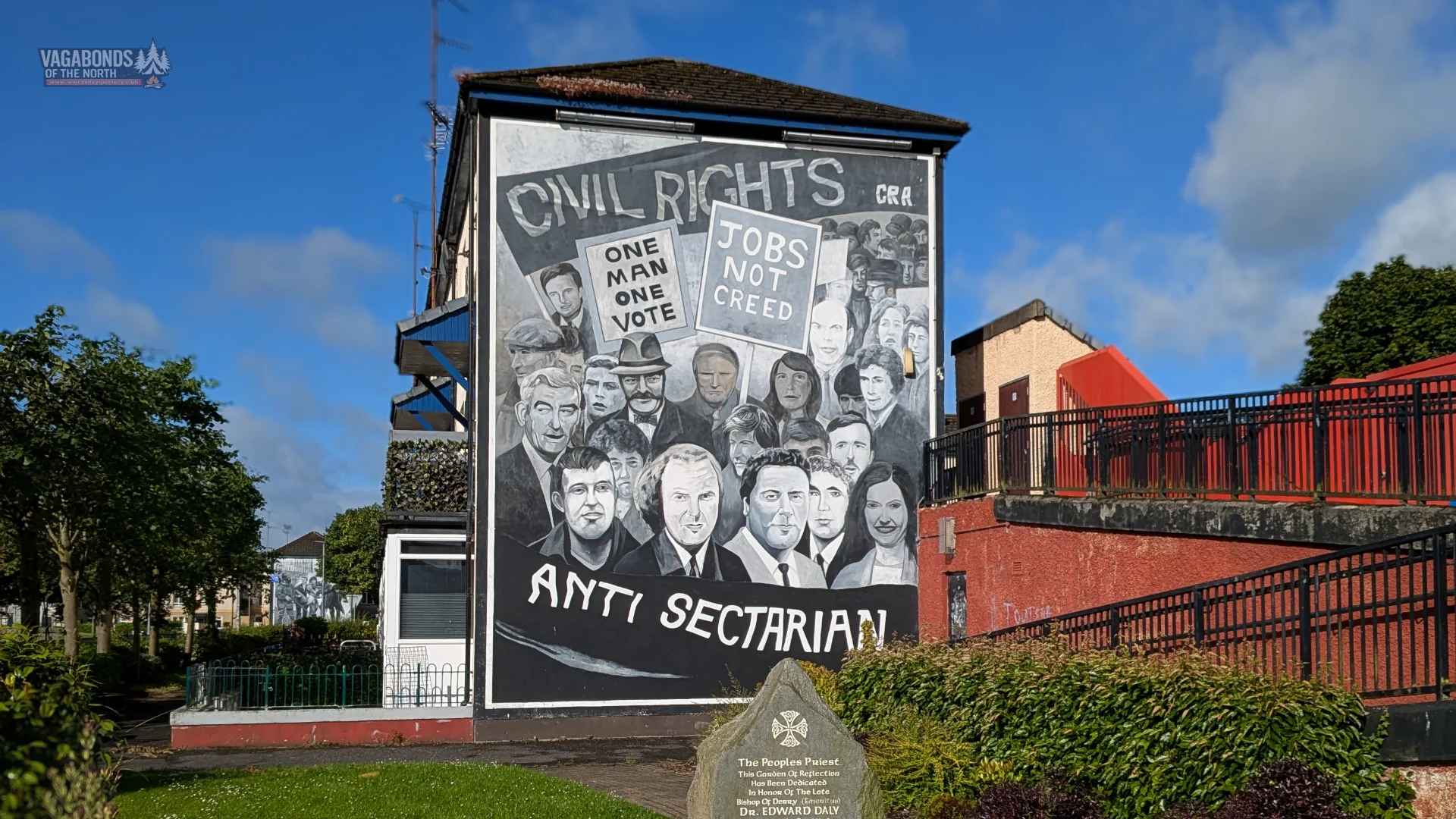
CIVIL RIGHTS.
ONE MAN ONE VOTE.
JOBS NOT CREED.
ANTI SECTARIAN.
A few words painted on a wall remind us of something that can easily disappear from accounts of the conflict in Northern Ireland.
Among the forces shaping the events that would soon transform Derry was the civil rights movement.
Its demands included reform of local voting rights, fairer electoral boundaries, fair allocation of public housing, equality in employment and reform of the security system.
On 5 October 1968, a civil rights march was organised in Derry. The authorities banned the planned route, but the demonstrators decided to march. The Royal Ulster Constabulary broke up the demonstration using batons; the scenes were filmed and broadcast on television far beyond Northern Ireland.
For many, that day became one of the symbolic beginnings of the period later known as the Troubles.
And yet, at the time, nobody knew where that road would lead.
The People’s Gallery – When the Walls Begin to Speak
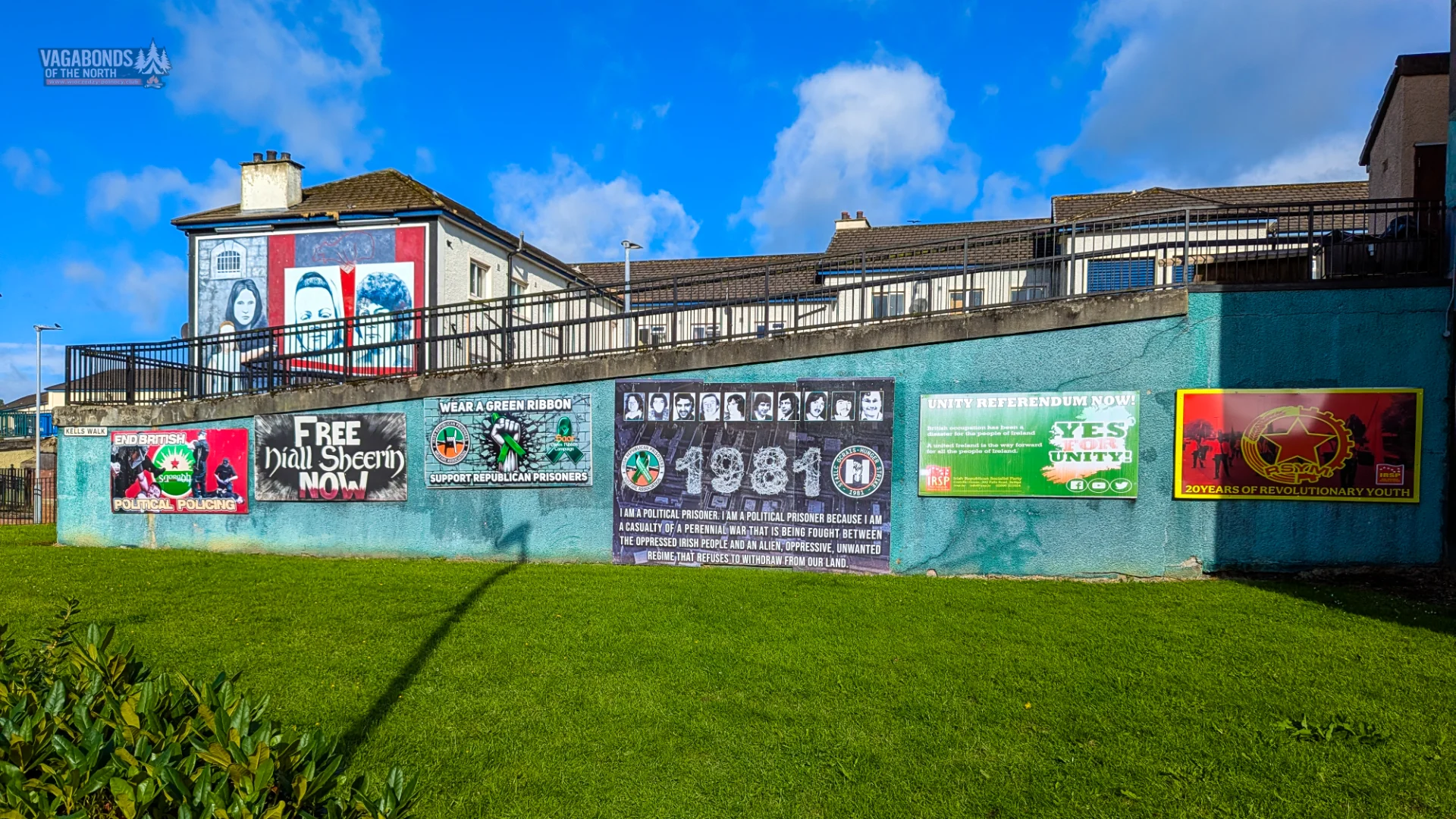
As we walk on, there is really no need to search for history.
It appears by itself on one wall after another.
A series of twelve large-scale murals created by the Bogside Artists is known as the People’s Gallery. They depict, among other subjects, the civil rights movement, the Battle of the Bogside, Bloody Sunday, the hunger strikes and Operation Motorman.
They are not, however, a neutral history textbook.
Nor should they be treated as one.
They are a story rooted in local memory and in the experiences of the Bogside community.
And that is precisely what makes them so interesting.
We are not looking at history written decades later by someone sitting behind a desk.
We are looking at the way a place remembers itself.
And one of these images is almost impossible to mistake for anything else.
The Boy in the Gas Mask
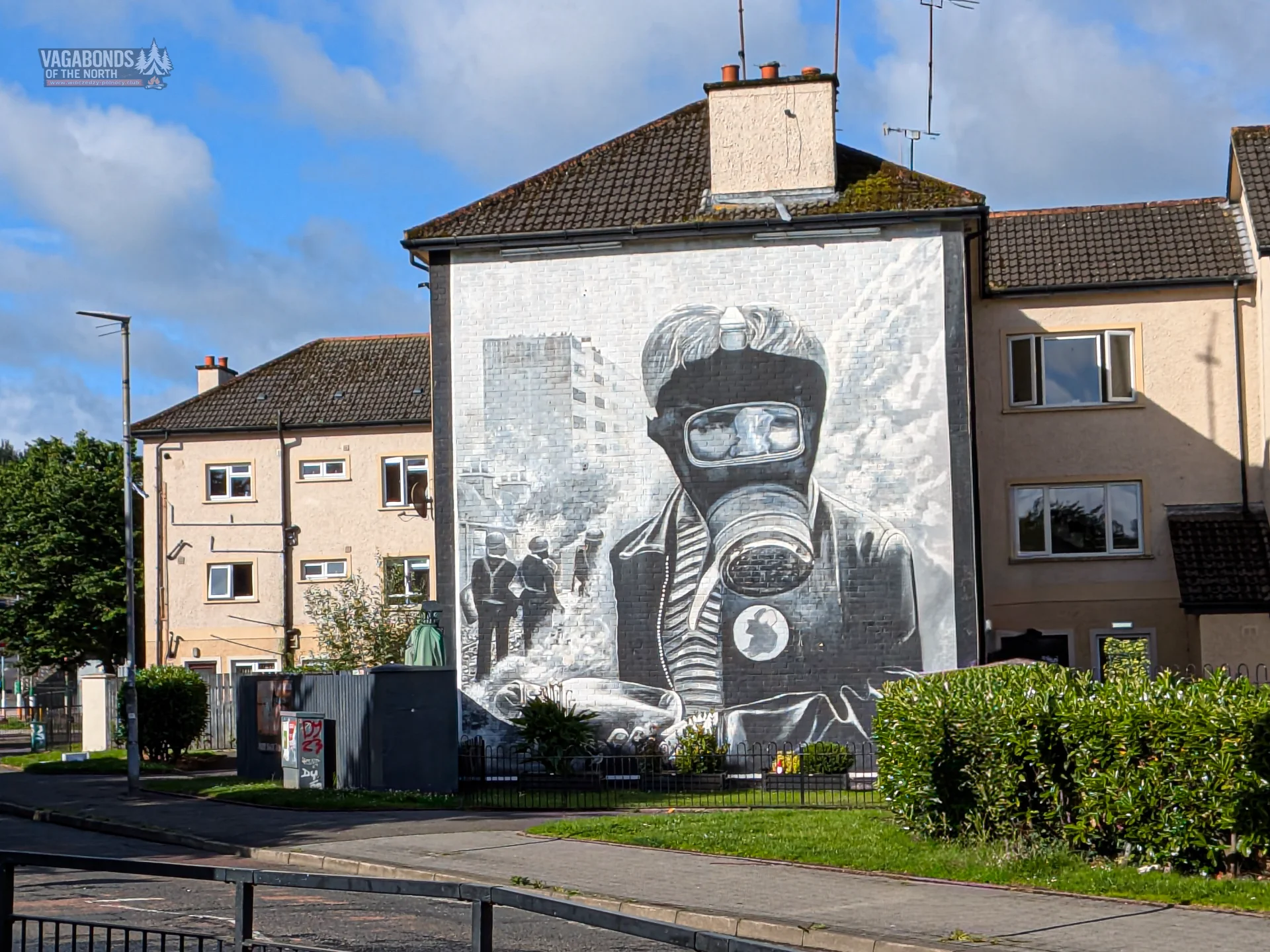
A young boy.
A gas mask.
A petrol bomb in his hand.
This is The Petrol Bomber, one of Bogside’s most recognisable murals. It refers to the Battle of the Bogside in August 1969.
On 12 August, during the annual Apprentice Boys parade, tension at the edge of Bogside erupted into open confrontation. The RUC attempted to enter the district, residents strengthened barricades, stones and petrol bombs were thrown at the police, and the police used CS gas.
The confrontation continued for three days.
On 14 August, British troops were deployed in Derry.
What may seem surprising from today’s perspective is that many Bogside residents initially greeted their arrival with relief. The soldiers separated the district from the police and brought the immediate fighting to an end. Only later did the relationship between much of the local community and the British Army deteriorate dramatically.
And here I was, standing in front of The Petrol Bomber more than half a century later.
Silence all around.
Cars parked outside houses. Neatly cut grass. An empty street.
The boy in the gas mask looks out from the mural at a very different Bogside.
I would leave this video without music.
For a moment, let it simply show the place.
Because this is where something becomes visible that will stay with us for the rest of the walk.
Bogside is not an open-air museum of the Troubles.
It is a normal, living neighbourhood.
History just happens to be written across its walls.
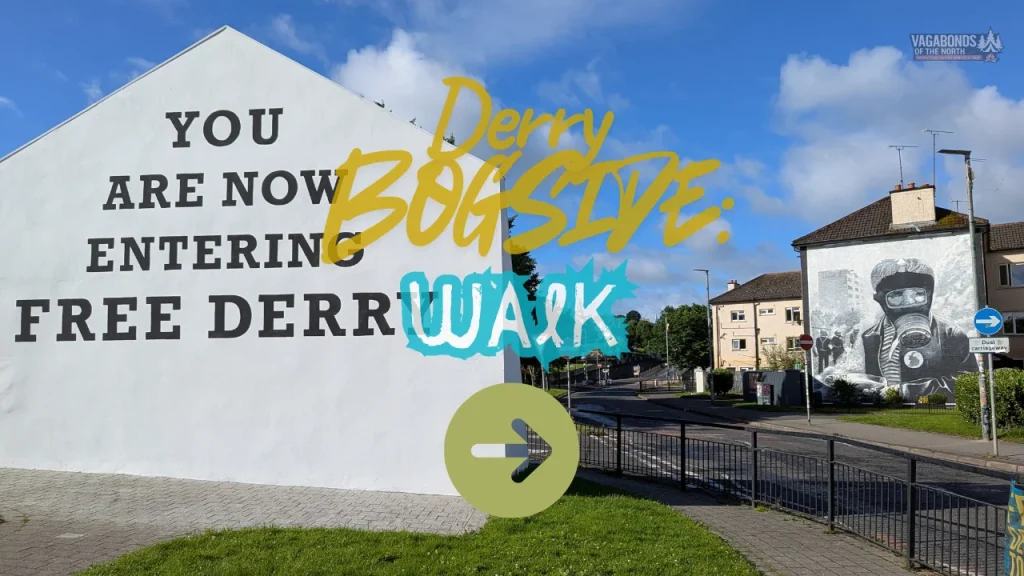
You Are Now Entering Free Derry
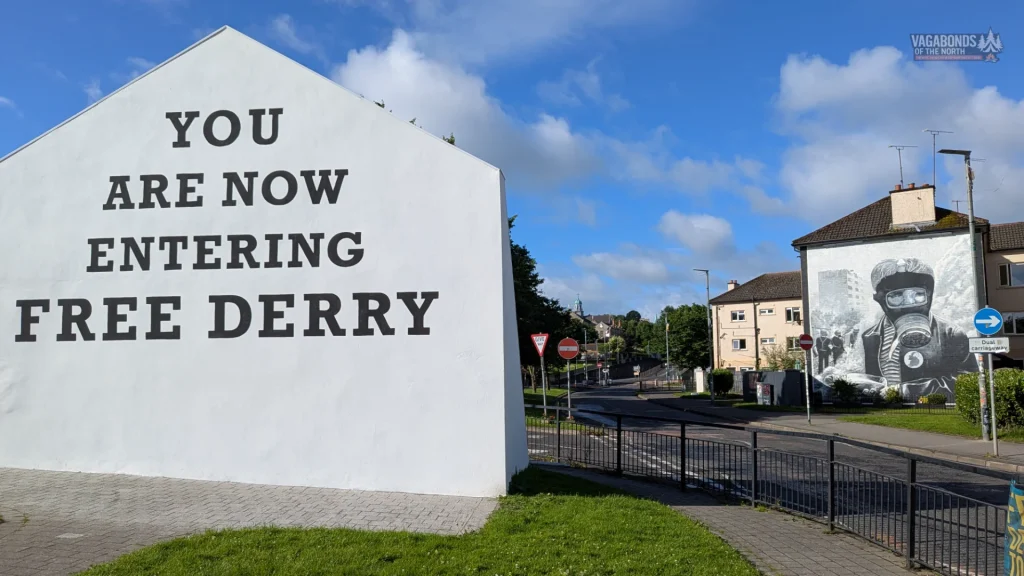
A few steps further on is an image familiar to almost anyone with even a passing interest in the history of Northern Ireland.
A white wall.
Black letters.
YOU ARE NOW ENTERING FREE DERRY.
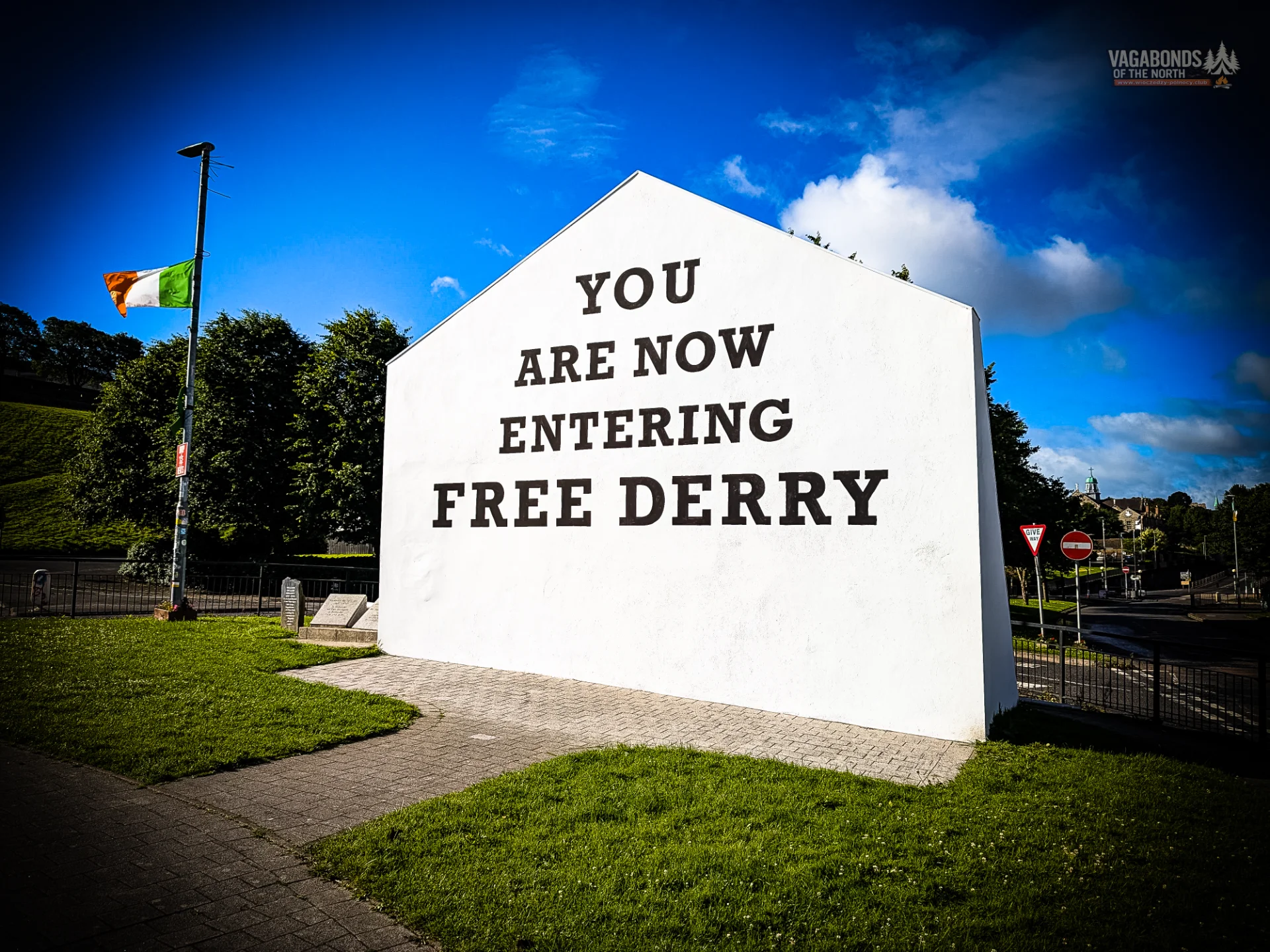
Today, Free Derry Corner is one of the symbols of the city.
But the inscription was not created as a tourist attraction.
The first version of the message appeared on the wall in early January 1969. Barricades were being erected around Bogside, and the term Free Derry came to describe an area which, for periods of time, the police effectively did not enter.
The houses that once stood beside it are long gone.
The wall remains.
Today there is grass around it, a road and passing traffic.
No barricades.
No CS gas.
No crowd throwing stones.
And yet it is difficult to simply walk past.
Especially because it is here that I begin to realise just how extraordinarily dense the history of this place is.
A Few Hundred Metres of History
Before coming here, photographs of the individual memorials had given me the impression that they were scattered across Bogside.
Only on the ground did I realise how close together they actually are.
Free Derry Corner and several republican memorials are concentrated around a small triangular area bordered by Rossville Street, Lecky Road and Fahan Street.
We are talking about roughly 150–200 metres.
A few minutes on foot.
Yet within those few hundred metres, events separated by decades of twentieth-century history meet one another.
The first thing to catch the eye is a distinctive stone H.
The H-Blocks and the Hunger Strikes
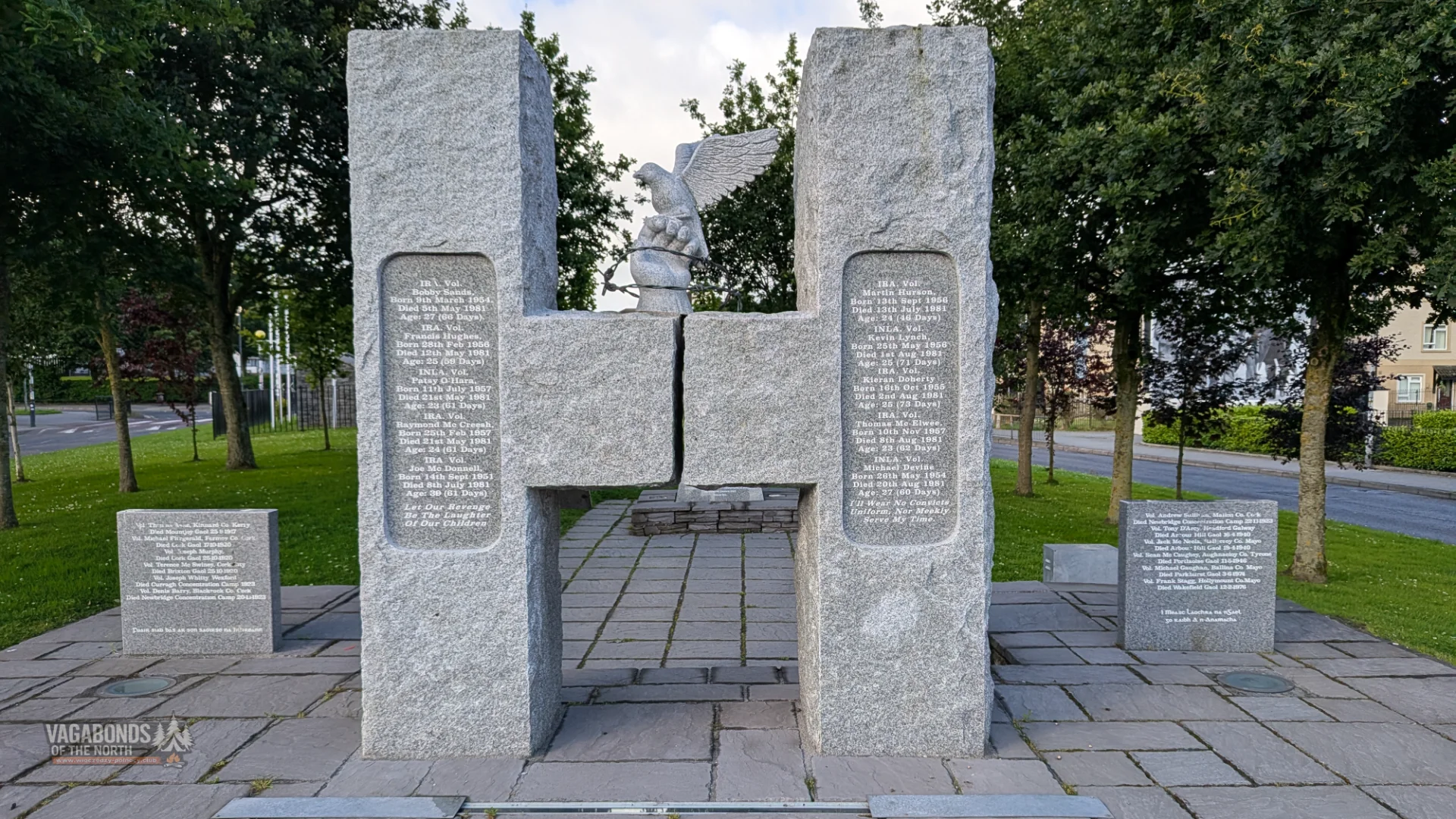
The shape of the memorial is no accident.
The letter H refers to the H-Blocks of the Maze Prison, also known as Long Kesh.
The memorial was unveiled in 2000. It commemorates republican prisoners who died during the 1981 hunger strike, while inscriptions around it also remember earlier republican prisoners who died as a result of hunger strikes during the twentieth century.
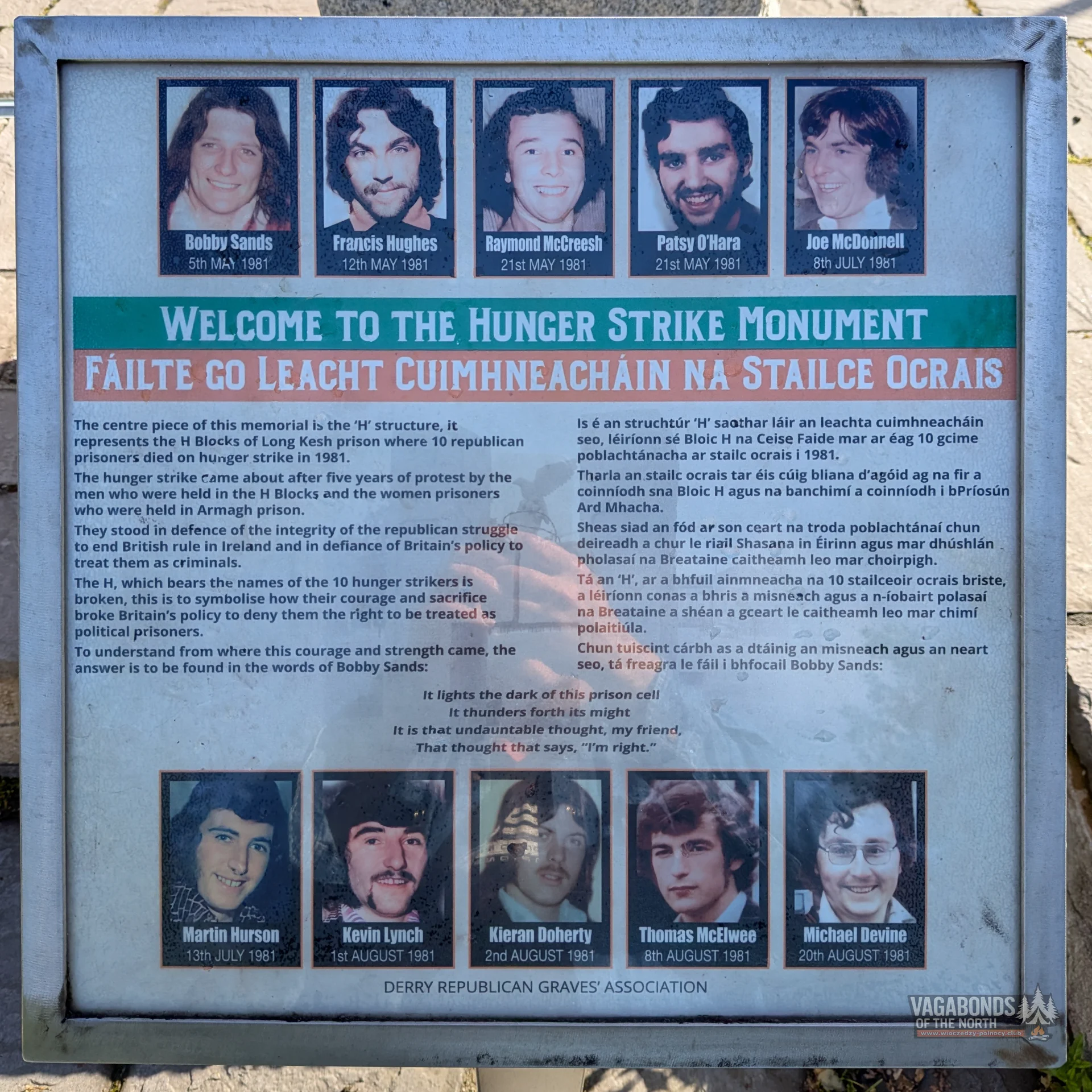
This is also a point where it is worth stopping for another reason.
The texts displayed at the memorial present events from a republican perspective.
They are not neutral museum panels, and we should not treat them as such.
They form part of the memorial itself and tell us not only about historical events, but also about how those events are remembered by the community and tradition that created this place of remembrance.
In 1976, the British government withdrew Special Category Status, which had previously given some prisoners convicted of conflict-related offences conditions resembling those of political prisoners.
Republican prisoners responded first with the blanket protest, then the dirty protest, and ultimately hunger strikes.
On 1 March 1981, Bobby Sands began his hunger strike.
Over the following months, ten prisoners associated with the IRA and INLA died.
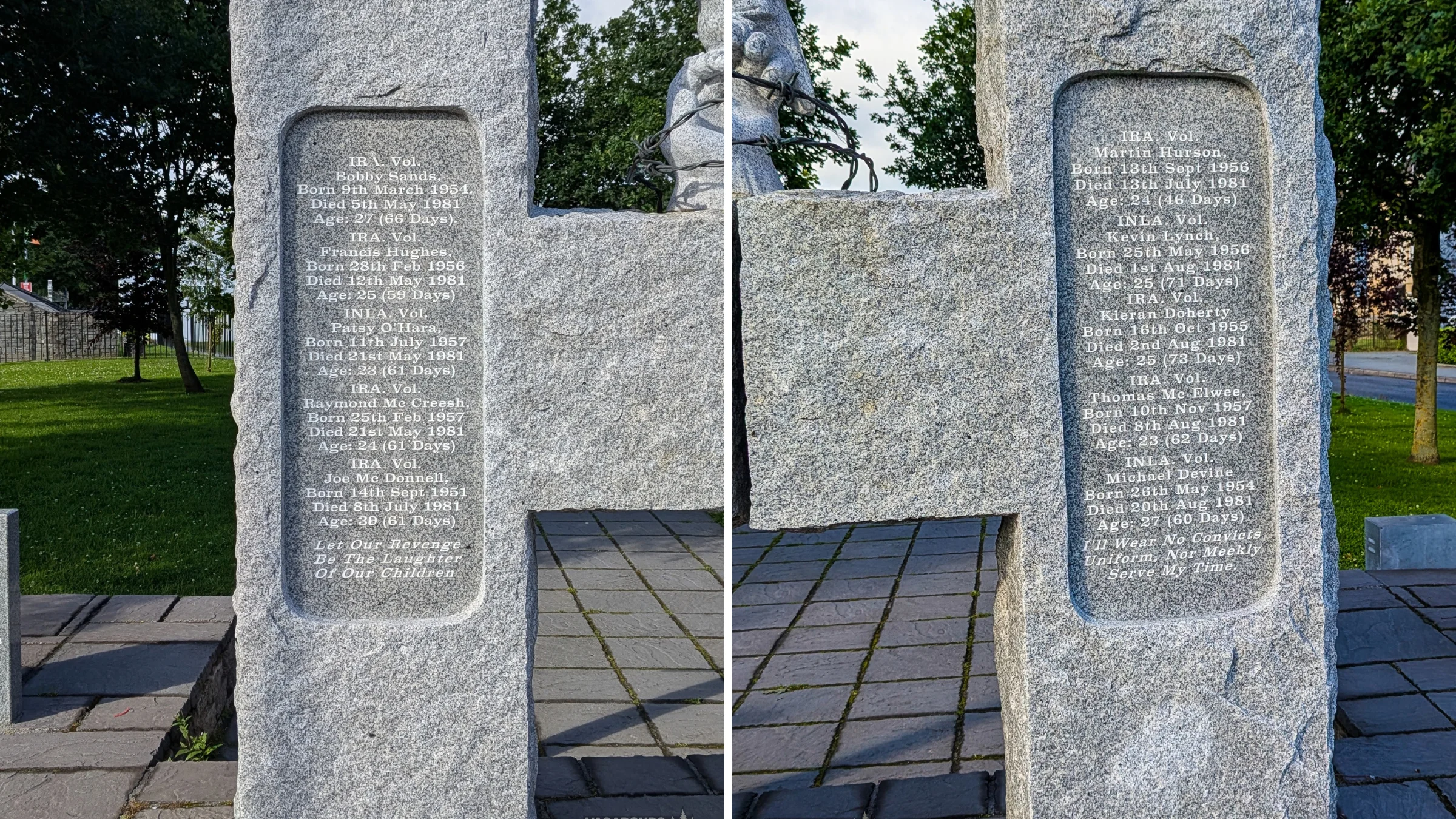
Bobby Sands.
Francis Hughes.
Raymond McCreesh.
Patsy O’Hara.
Joe McDonnell.
Martin Hurson.
Kevin Lynch.
Kieran Doherty.
Thomas McElwee.
Michael Devine.
It is here, for the first time during this walk, that I realise I am becoming less interested in photographing “memorials”.
Instead, I am increasingly reading names.
Roll of Honour
A few steps further stands another memorial.
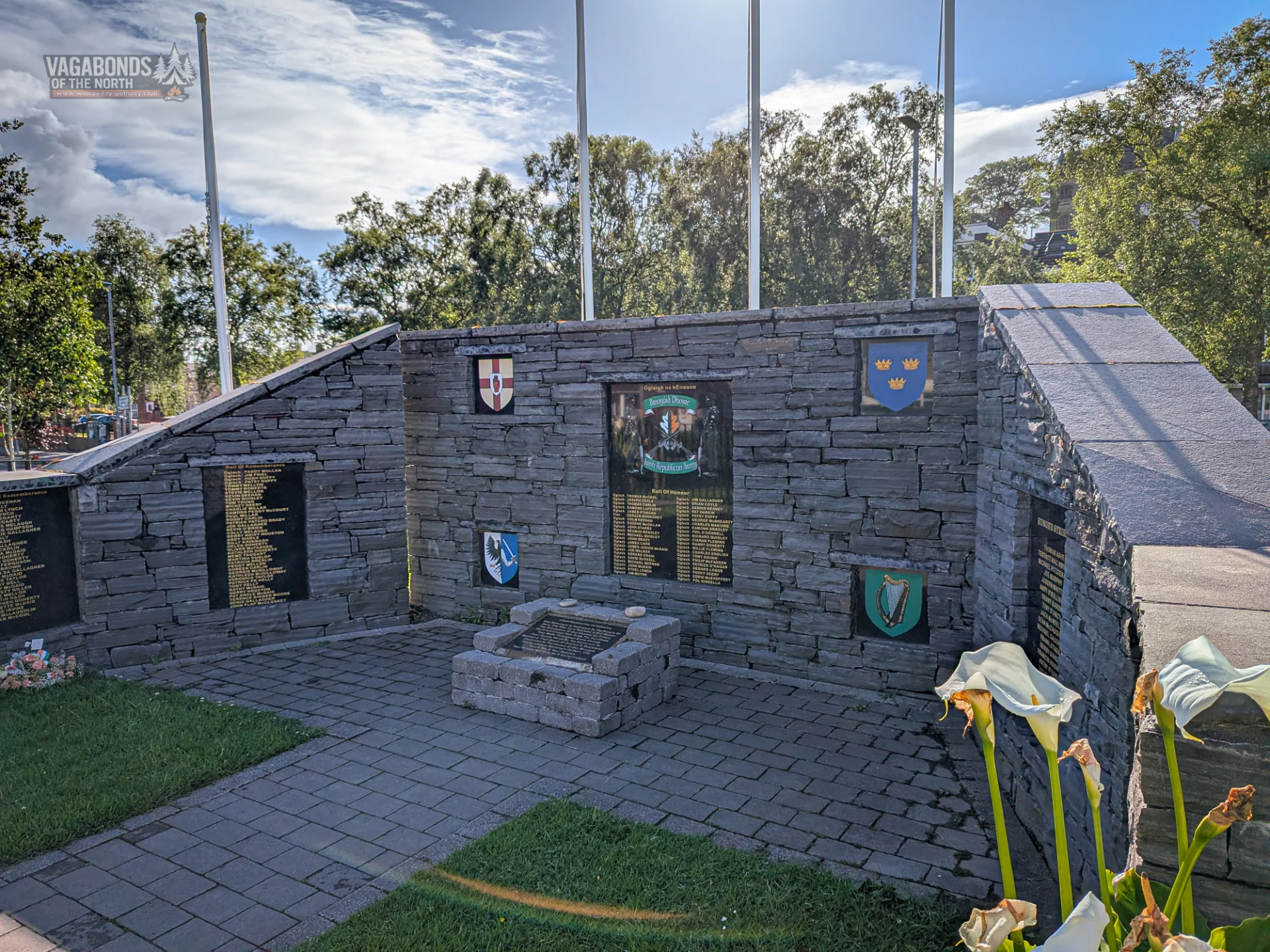
Stone walls, plaques and the emblems of Ireland’s four historic provinces.
More names.
This is a republican memorial. As with the H-Block Memorial, its symbolism and presentation of history belong to a particular political and commemorative tradition.
I am therefore not going to turn it into a neutral memorial to all victims of the Troubles.
That is not what it is.
But neither am I going to pretend it is not here.
It is part of Bogside.
Part of the history of this neighbourhood and of the way part of its community remembers the conflict.
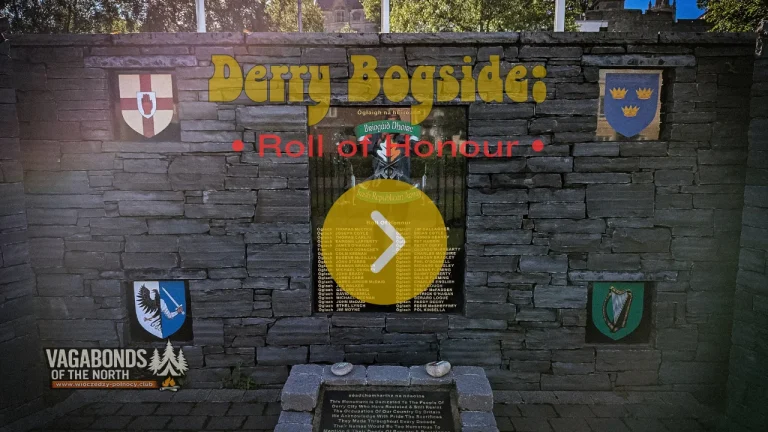
Here, instead of another series of close-up photographs, I would leave the video.
The camera moves slowly across the plaques.
No music.
No commentary.
The names are enough.
And as we move away from the memorial, the white wall of Free Derry Corner appears again in the background.
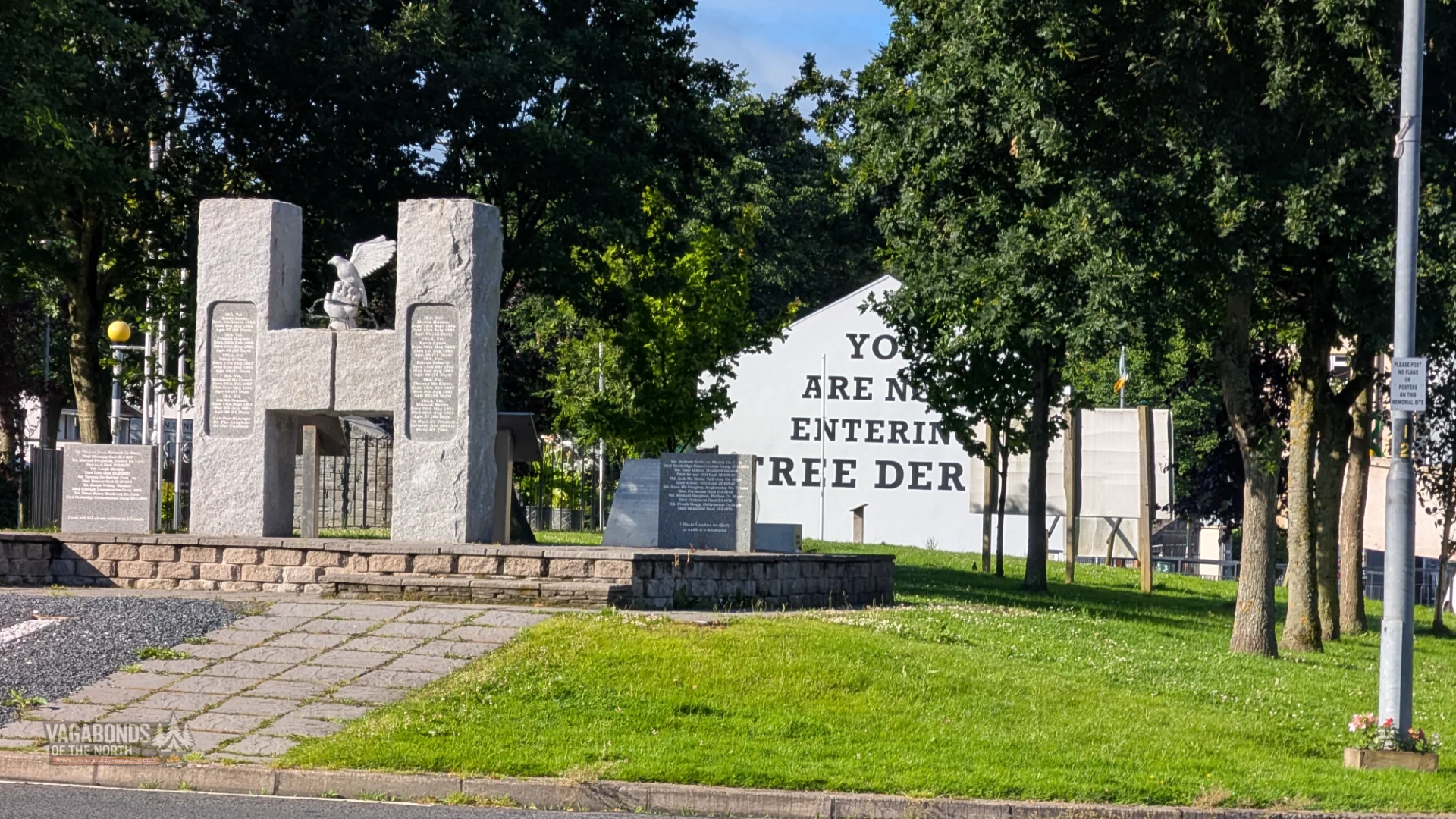
Only this view really shows how small the area is in which so many different layers of memory have been gathered.
History Did Not End with the Troubles
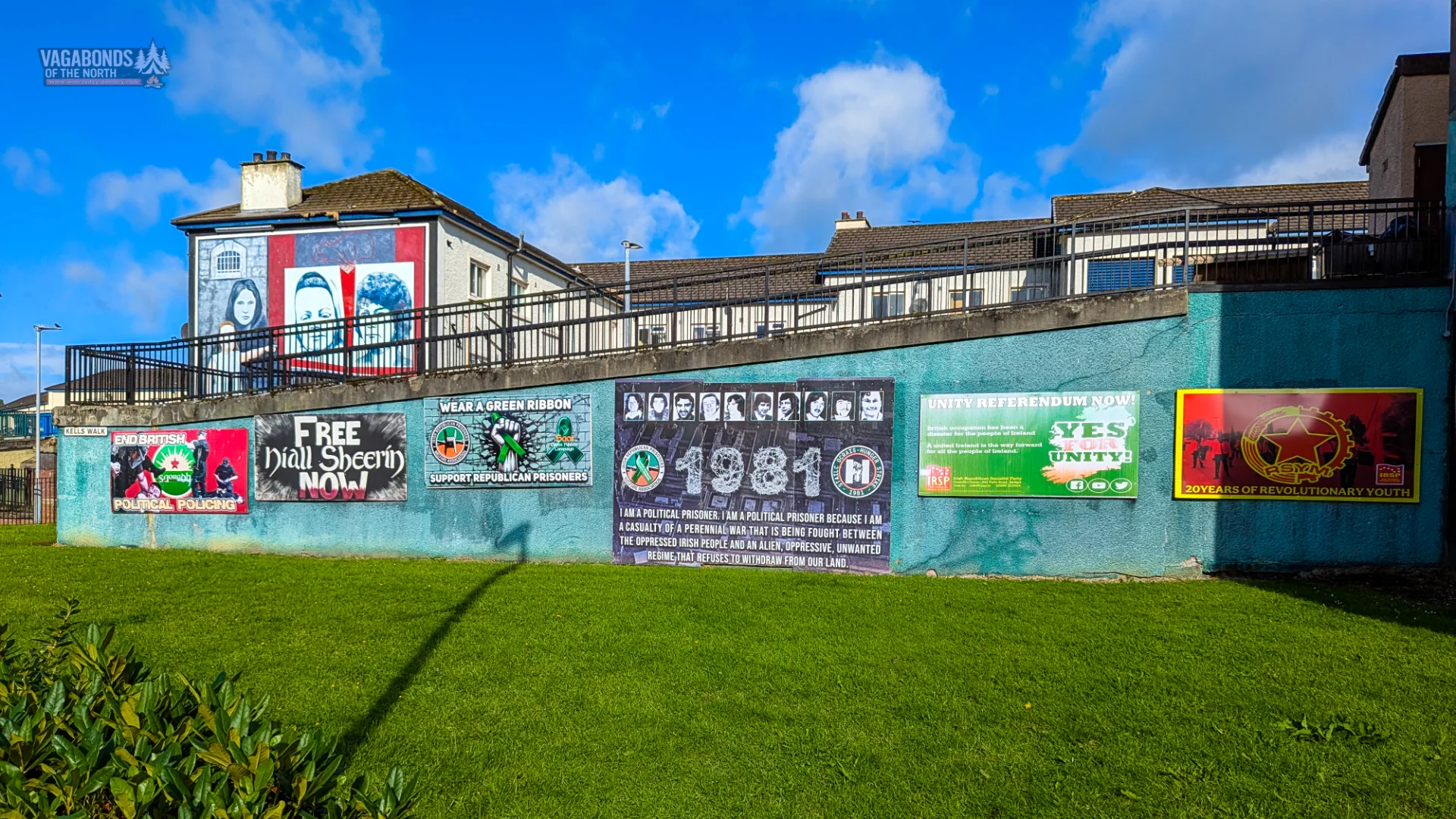
Among the murals and memorials are messages that are much more contemporary.
Republican posters.
Slogans concerning Stormont.
Palestinian flags and messages of support for Gaza.
At first, I even thought they were getting in the way a little.
You are trying to photograph a historic place, compose a frame, separate events from decades ago from the present day…
But why should I?
Bogside was not frozen in 1969, 1972 or 1981.
People still live here.
They have their own opinions, disputes, sympathies and concerns.
We may agree with them or disagree.
For our story, something else matters more:
they were here on that particular day.
And we had not come to tidy Bogside up.
We had come to see it.
As it is.
Further Along Rossville Street
This is also where we need to correct an impression that is easy to get from looking at photographs online.
The Bloody Sunday Monument does not stand within the same cluster of memorials around Free Derry Corner.
To reach it, we have to leave the small triangle near Fahan Street and continue along Rossville Street.
It is not far.
But it is far enough to feel that we are leaving one place of memory and heading towards another.
And this is exactly why I would leave this video uncut.
No music.
You can hear footsteps, the street and, of course, our crow, which apparently decided that if nobody else was going to guide us around Bogside, the responsibility had fallen to it.
The video gives us something a single photograph cannot.
Distance.
It shows how close the murals, memorials, ordinary houses and the old Walls of Derry towering above the district really are.
They are not separate exhibits.
They are one living organism.
30 January 1972
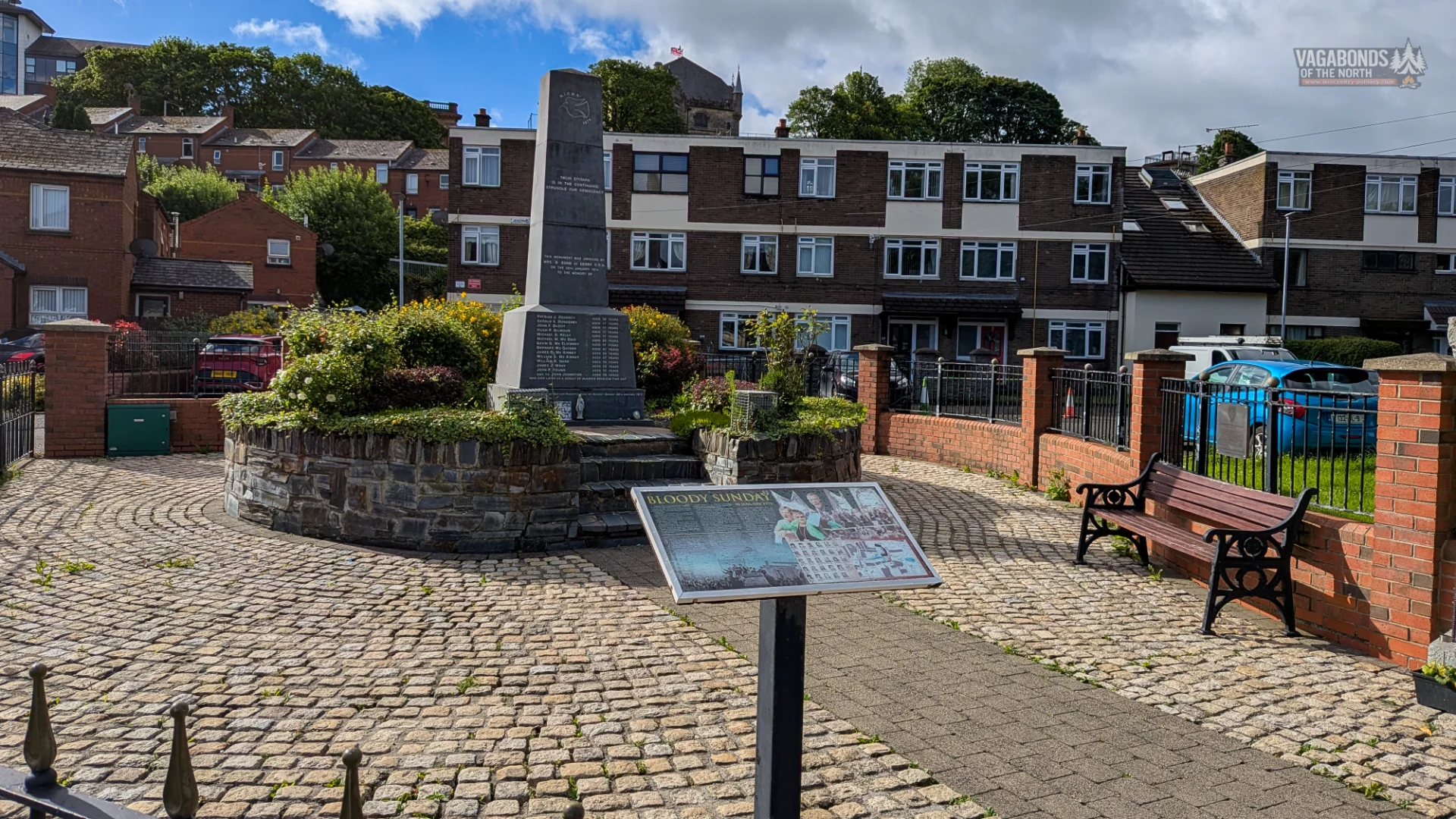
The Bloody Sunday Monument is not enormous.
It does not dominate the neighbourhood.
It stands on a small open space among ordinary houses.
A bench.
Flowers.
A few trees.
And white stone.
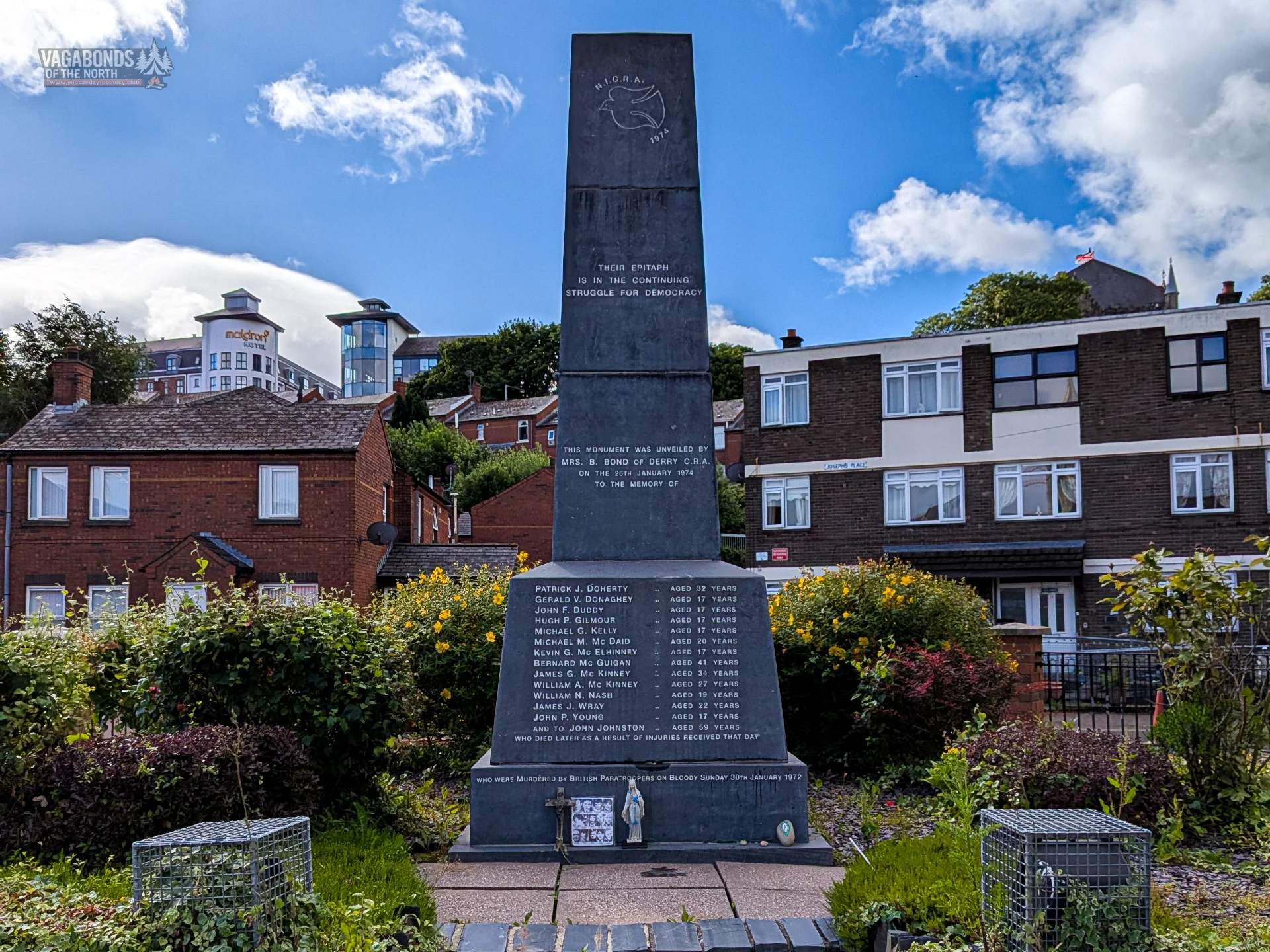
On 30 January 1972, an anti-internment march was taking place in Derry.
The planned route was blocked by the British Army, so the main body of demonstrators moved towards Free Derry Corner. Near one of the Army barriers, some young people clashed with soldiers.
Soldiers from Support Company, 1st Battalion, Parachute Regiment then entered Bogside as part of an operation to arrest rioters.
Shots were fired.
Thirteen people died that day. John Johnston, who had been shot on 30 January, died in June of the same year and is counted among the fourteen victims commemorated at the Bloody Sunday Monument.
For decades afterwards, Bloody Sunday remained one of the most painful and disputed episodes of the entire conflict.
The first official investigation — the Widgery Tribunal — was widely criticised, particularly by the families of those who had been killed.
In 1998, a new inquiry chaired by Lord Saville began.
It lasted twelve years.
Its report was published on 15 June 2010.
Its central findings were unequivocal: none of those shot by soldiers of Support Company was armed with a firearm, and the shootings were not justified.
On the same day, Prime Minister David Cameron addressed the House of Commons.
He described what happened on Bloody Sunday as “unjustified and unjustifiable.”
On behalf of the British government, he apologised.
Fourteen Names
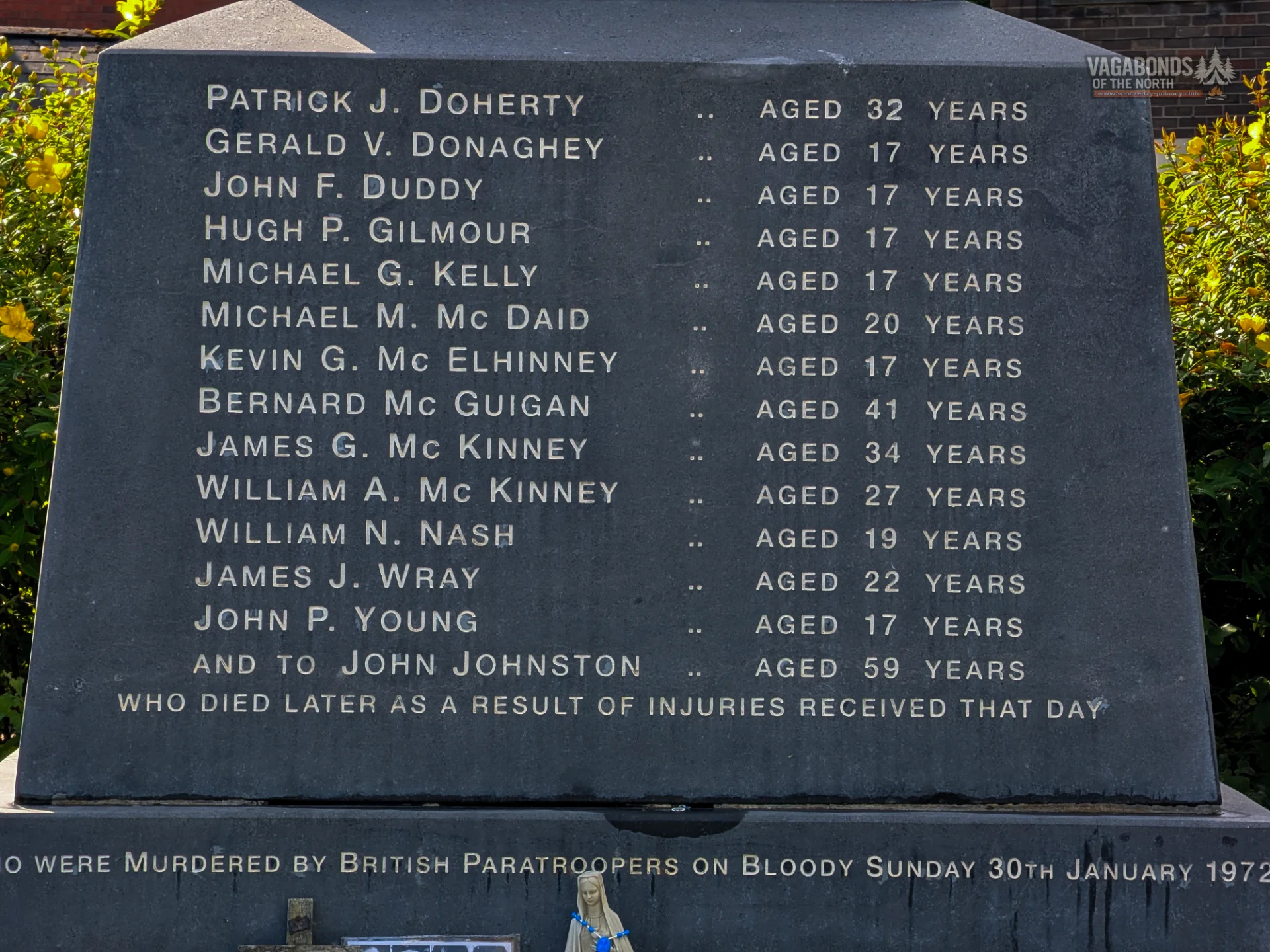
And this is probably where we can stop talking about reports, inquiries and politics.
All we have to do is step closer.
Patrick Doherty — 31.
Gerald Donaghey — 17.
John Duddy — 17.
Hugh Gilmour — 17.
Michael Kelly — 17.
Michael McDaid — 20.
Kevin McElhinney — 17.
Bernard McGuigan — 41.
Gerald McKinney — 35.
William McKinney — 26.
William Nash — 19.
James Wray — 22.
John Young — 17.
John Johnston — 59.
When we read historical accounts, we see numbers.
Thirteen killed that day.
Fourteen names on the memorial.
Thousands of pages of evidence.
Decades of dispute.
But standing here, you are no longer reading statistics.
You are reading names.
And ages.
And it was here that I caught myself thinking something completely unexpected.
I wish I had brought a candle.
At that moment, I was not thinking about who was Catholic or Protestant, republican or nationalist, unionist or soldier.
Instinctively, I said a short prayer in silence.
For the peace of those who had died.
And for the wellbeing of those who live here today.
Because when you stand in front of a memorial and read one name after another, history stops being a story about “sides” in a conflict.
For a moment, there are simply people.
The Man with the White Handkerchief
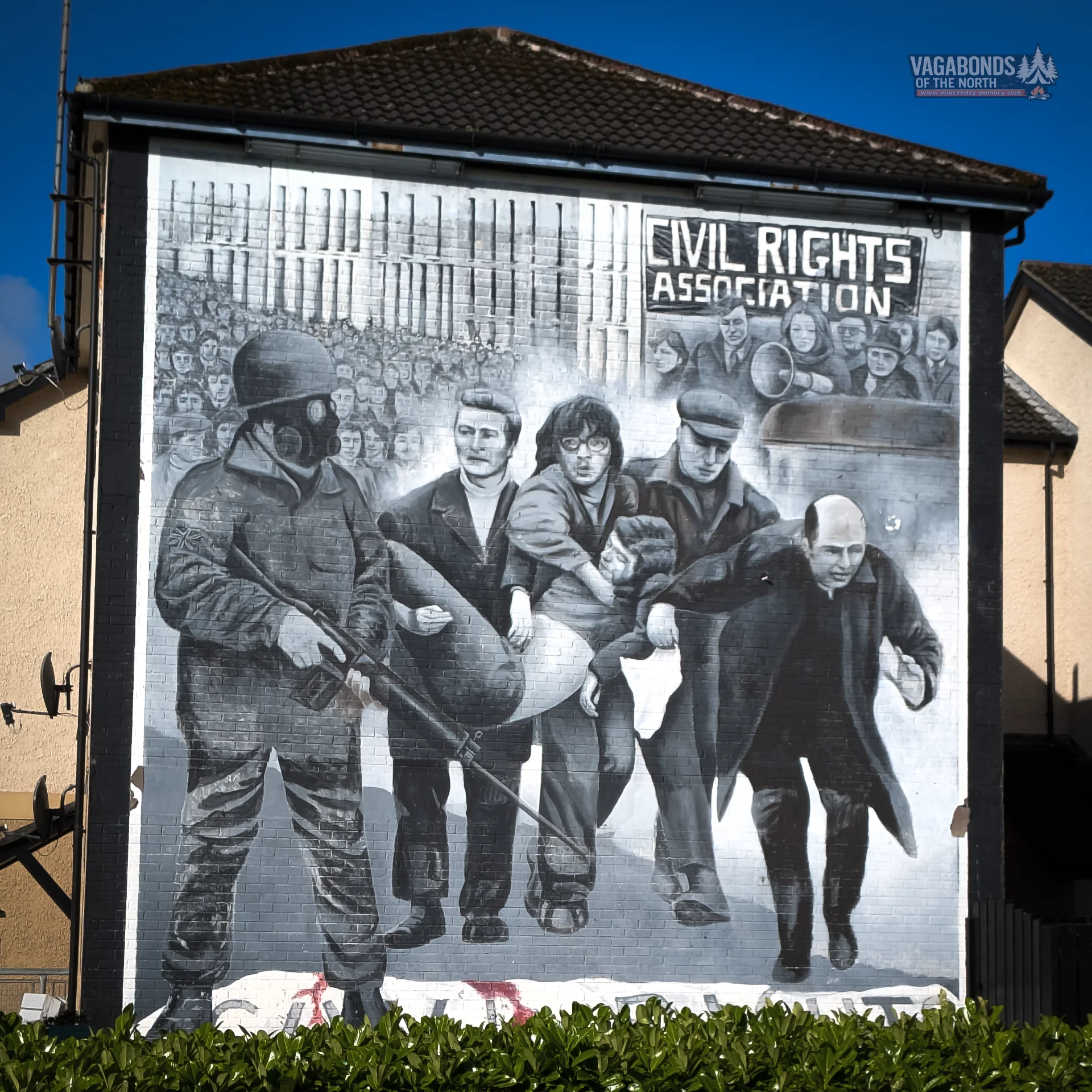
Earlier, we had passed another mural.
The scene it depicts has become one of the most recognisable images of Bloody Sunday.
A group of men carry the mortally wounded seventeen-year-old Jackie Duddy. Among them is Father Edward Daly, later Bishop of Derry, waving a bloodstained white handkerchief.
A photograph taken that day became one of the iconic images of the conflict.
The Bogside Artists transferred that scene onto a wall.
And only later, standing in front of the memorial, do I begin to understand how all these elements connect.
A mural.
A street.
A name.
An age.
A memorial.
This is no longer an event sealed inside a history book.
You can walk between its different fragments.
History That Happened Yesterday
And this is perhaps where I felt most strongly the difference between the two sides of our walk through Derry.
Up there, on the Walls, history was four hundred years old.
You could look at cannons, bastions and gates with pure curiosity.
Wonder where the defenders had walked.
Imagine the siege.
Admire the city.
Down here, history happened almost yesterday.
People who remember these events are still alive.
The families of the victims are still here.
People who grew up during the Troubles live in these houses, go shopping, take their children to school and walk these same streets.
And so the curiosity with which I had come down from the Walls began to change somewhere along the way.
First came the murals.
Then Free Derry Corner.
The H-Block Memorial.
More names.
Rossville Street.
The Bloody Sunday Monument.
And quite naturally, curiosity gave way to reflection.
Nobody needed to create that atmosphere.
Bogside did it by itself.
Look Up
At some point, though, all you have to do is lift your eyes from the memorials.
And look up.
The Walls of Derry are still there.
The same Walls we had been walking along only a short while earlier.
St Columb’s Cathedral is visible.
The fortifications are visible.
Four centuries of history fit almost within a single turn of the head.
The seventeenth century above.
The twentieth below.
And between them, an ordinary modern city.
Perhaps this explains better than anything why Derry is so difficult to tell in a single story.
History here does not arrange itself neatly into separate chapters.
Its layers overlap.
One emerges from beneath another.
Sometimes all you need to do is cross a street.
Sometimes walk down a flight of steps.
And sometimes simply turn your head.
The Silence That Remained
When we entered Bogside, it was quiet.
When we left, it was still quiet.
The same Sunday morning.
The jogger had disappeared somewhere.
The man and the little boy had gone their own way.
Cars still stood outside the houses.
The crows were still guarding their trees.
Nothing had really changed.
And yet, for me, a great deal had.
I had come here to see a place known from the history of the Troubles.
To see the murals.
Free Derry Corner.
The memorials.
To take photographs.
Record a few videos.
And yet, somewhere during that walk, it felt as though the history had soaked into me and thrown the doors wide open.
Perhaps that is why I am so glad that I saw Bogside without the crowds.
Nobody hurried me.
Nobody blocked the memorials.
I could stop beside the names.
Read.
Think.
And move on only when I was ready.
Bogside is not a place to be afraid of.
Nor is it a museum or a monument sealed in the past.
It is a living neighbourhood that was handed an exceptionally heavy burden by history and learned how to live with it.
On the Walls of Derry, I had looked down on history from above.
Here, I had to come down to street level.
And walk through it myself.
Explore Derry/Londonderry with us:
| Derry/Londonderry – A City Within a City | City Walls | Derry Bogside | Foyle Maritime Festival |
Discover with us: