
Where Is All That IRA Everyone Talks About?
A Survival Guide for Anyone Trying to Understand Belfast Through Social Media
Following the recent events in Belfast, social media has been flooded with comments such as:
- “Where is the IRA?”
- “The IRA should sort this out.”
- “The IRA will save Ireland.”
- “This must be the IRA.”
- “The UVF should step in.”
- “Sinn Féin is behind this.”
- “It’s all the Loyalists.”
After reading enough comment sections, you could be forgiven for thinking that Northern Ireland is still living in the 1970s.
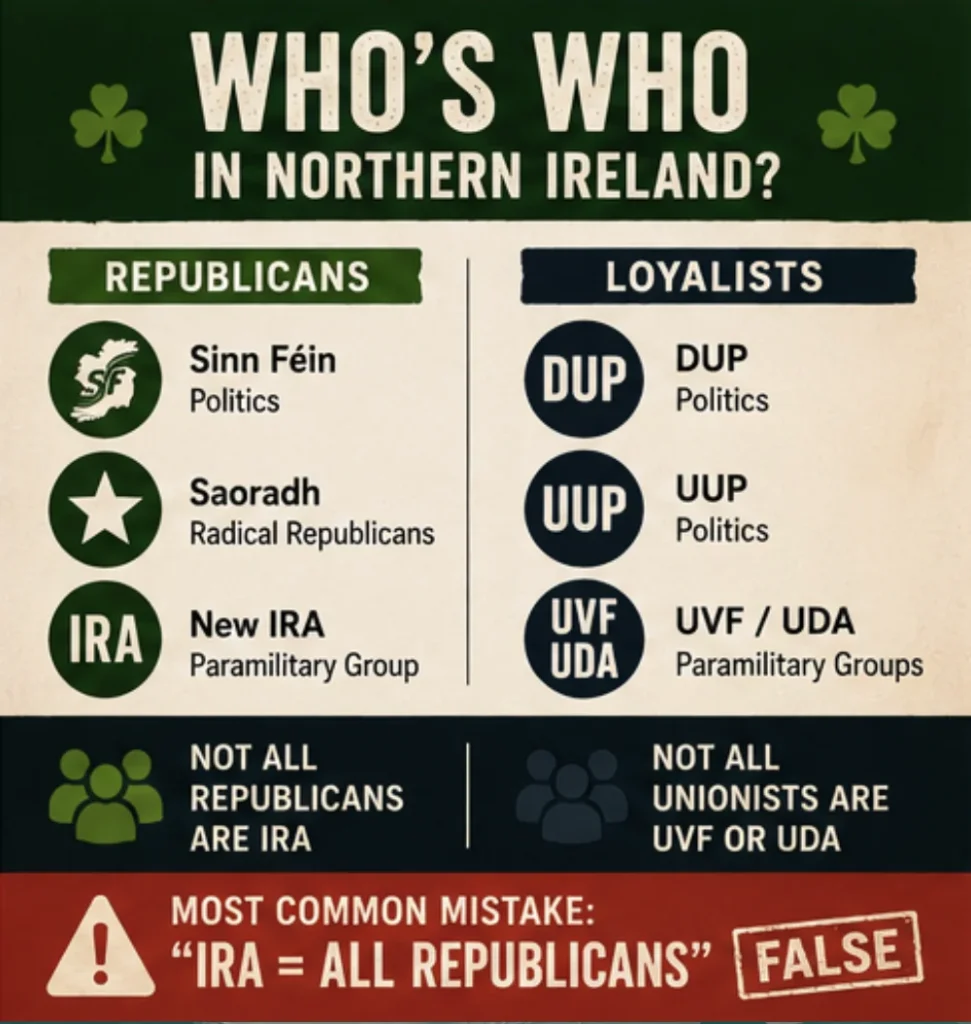
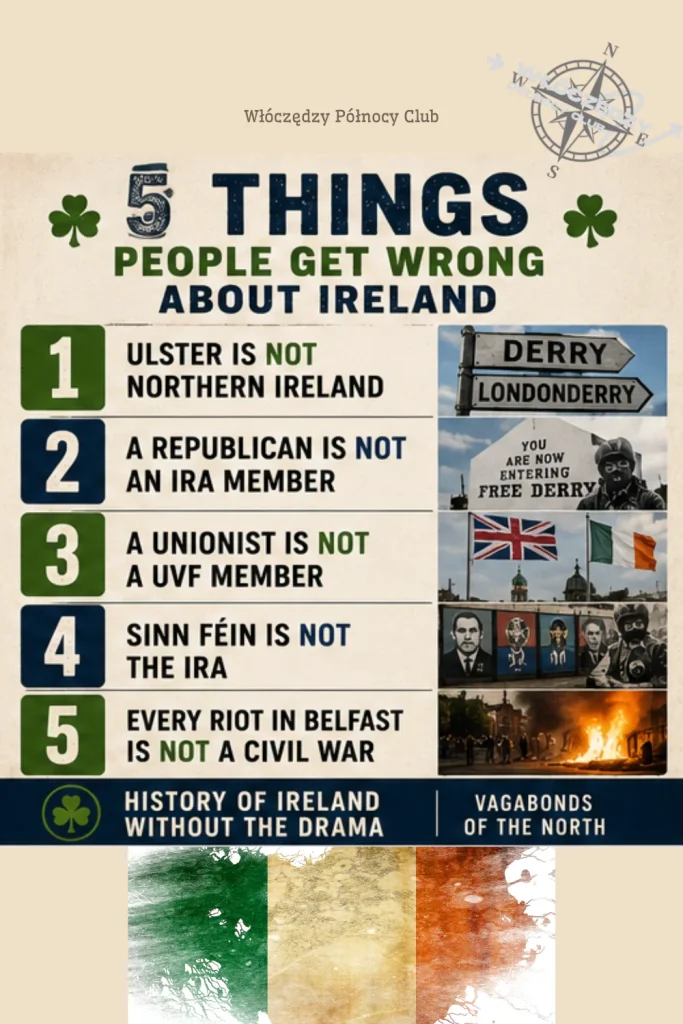
The problem is that many people use terms like IRA, UVF, UDA, Republicans, Loyalists, Unionists and Sinn Féin as if they all mean the same thing.
They don’t.
So let’s slow down for a moment and try to understand what these words actually mean.
What Actually Happened in Belfast?
Let’s begin with the facts.
A brutal knife attack left Stephen Ogilvie seriously injured.
A suspect was arrested and charged.
The victim survived, although he suffered life-changing injuries.
In the days that followed, protests took place across several towns and cities. Some remained peaceful, while others escalated into rioting, attacks on property, arson and clashes with police.
And that’s where the confirmed facts end.
Everything else quickly becomes a mixture of politics, emotions, rumours and social media speculation.
What Was the IRA?
When most people hear the term IRA, they are thinking about the organisation that operated during the conflict known as The Troubles.
The Irish Republican Army sought to end British rule in Northern Ireland and achieve Irish reunification.
For decades it carried out an armed campaign against British security forces and was responsible for numerous bombings and shootings.
To some people it was a liberation movement.
To others it was a terrorist organisation.
Regardless of political opinion, there is no denying that it was one of the central actors in Northern Ireland’s conflict.
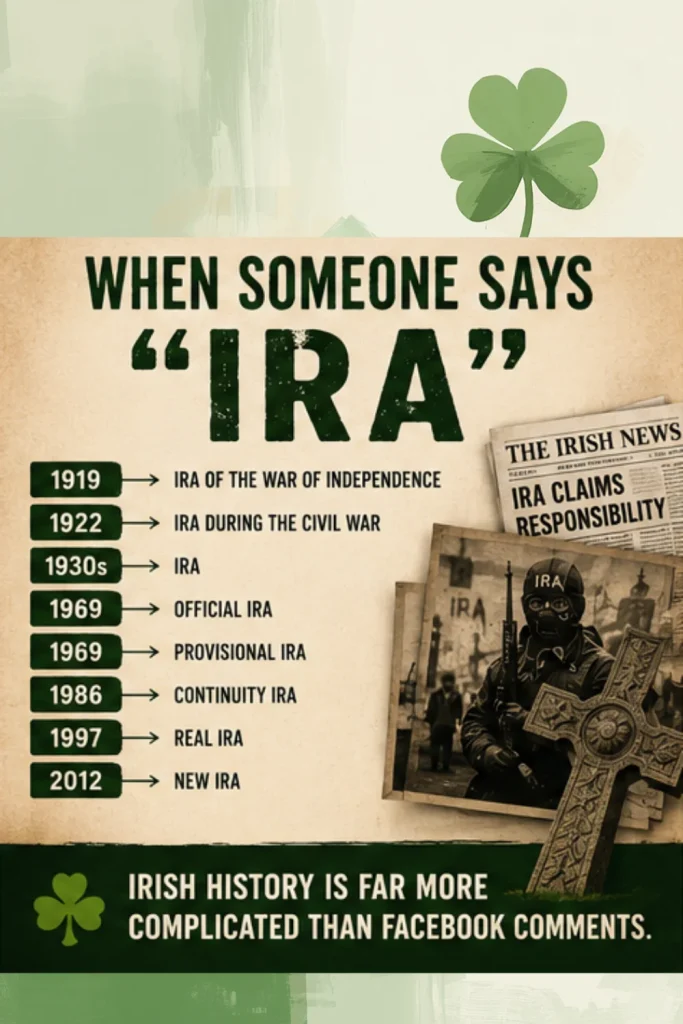
Which IRA?
This is where things become much more complicated.
Many people assume that there has only ever been one IRA.
That isn’t true.
During the Easter Rising of 1916, the main organisations involved were the Irish Volunteers and the Irish Citizen Army.
The name Irish Republican Army came into common use later, during the Irish War of Independence.
The IRA associated with Michael Collins is often regarded as the original IRA of the revolutionary period.
But after independence came:
- the Civil War,
- political splits,
- reorganisations,
- ideological divisions,
- and several different groups claiming to be the legitimate heirs of the Irish Republic proclaimed in 1916.
Over the last century there have been multiple organisations operating under the IRA name or claiming its legacy:
- IRA (War of Independence)
- Anti-Treaty IRA
- Official IRA
- Provisional IRA
- Continuity IRA
- Real IRA
- New IRA
Many of these organisations disagreed strongly with one another.
Some even fought each other.
So whenever somebody says:
“The IRA did this”
the first question should be:
“Which IRA?”
Because the answer could refer to 1920, 1972 or 2026.
And those are very different worlds.
Where Is the IRA Today?
Most people imagine that the IRA of the Troubles still exists exactly as it did decades ago.
It doesn’t.
The peace process and the Good Friday Agreement fundamentally changed Northern Ireland.
The Provisional IRA ended its armed campaign and entered the political process.
Today, a small number of dissident republican groups continue to reject the peace settlement.
However, they are far smaller and far less influential than the IRA that dominated headlines during the Troubles.
This is why asking:
“Why doesn’t the IRA step in?”
is not nearly as straightforward as many people think
Republicans Are Not All the Same
Another common misunderstanding is the belief that all Republicans belong to the same movement.
In reality, republicanism covers a wide range of opinions.
Some Republicans support political solutions only.
Others support Irish reunification but reject violence entirely.
A small number support more radical approaches.
And millions of people with republican views simply want to live normal lives.
Saying that every Republican belongs to the IRA makes about as much sense as saying every football fan plays professional football.
What About Loyalists?
The same principle applies to Loyalists.
Loyalists support Northern Ireland remaining part of the United Kingdom.
But not every Unionist is a Loyalist.
Not every Loyalist belongs to a paramilitary organisation.
And not every Protestant supports hard-line politics.
Just like republicanism, unionism and loyalism contain many different viewpoints.
Are the IRA, UVF or UDA Behind the Protests?
This is where social media often creates the greatest confusion.
After the Belfast attack, countless comments appeared online claiming that:
“The IRA should deal with this.”
or
“The UVF should take control.”
These statements sound dramatic.
The reality is much less clear.
At the time of writing, there is no credible evidence suggesting that dissident republican organizations such as the New IRA are directing the protests, riots, or anti-immigration demonstrations that followed the attack.
Likewise, the presence of individuals with republican or loyalist sympathies at protests does not automatically mean that paramilitary organisations are organizing those events.
That distinction matters.
If a Manchester United supporter attends a protest, it does not mean Manchester United organised it.
The same logic applies here.
Will the IRA Save Ireland?
The short answer:
No.
The longer answer:
The IRA that exists in many people’s imagination no longer exists in the form they remember.
Today’s republican organisations are smaller, weaker and focused on their own political objectives.
The image of thousands of IRA volunteers waiting in the shadows to save Ireland, Britain or Europe belongs more to internet mythology than contemporary reality.
Why Do People See the IRA Everywhere?
Because the IRA has become a symbol.
To some it represents resistance.
To others it represents violence.
To many people outside Ireland, it has become shorthand for everything connected to Northern Ireland.
When something dramatic happens, the IRA is often the first explanation people reach for.
The problem is that reality is far more complicated than that.
The Family’s Message
One detail that deserves attention is the response from Stephen Ogilvie’s family.
Rather than encouraging confrontation, the family appealed for calm and urged people not to use the attack as an excuse for further violence.
That reminder is important.
Tragedies often become symbols in wider political debates.
But behind every headline is a real person and a real family.
Final Thoughts
If you’ve read this article and still believe every protest, riot or act of violence in Belfast must somehow involve the IRA, we have some bad news.
Northern Ireland is not an action movie.
It is a complex place shaped by history, identity, politics and memory.
And while the IRA remains one of the most important names in Irish history, it is not the answer to every question people ask about modern Northern Ireland.
Sometimes the truth is simply more complicated than the comments section.
And that’s exactly why understanding Ireland requires more than a slogan.
Discover with us: