
Volhynia 1943 – The Road to Tragedy
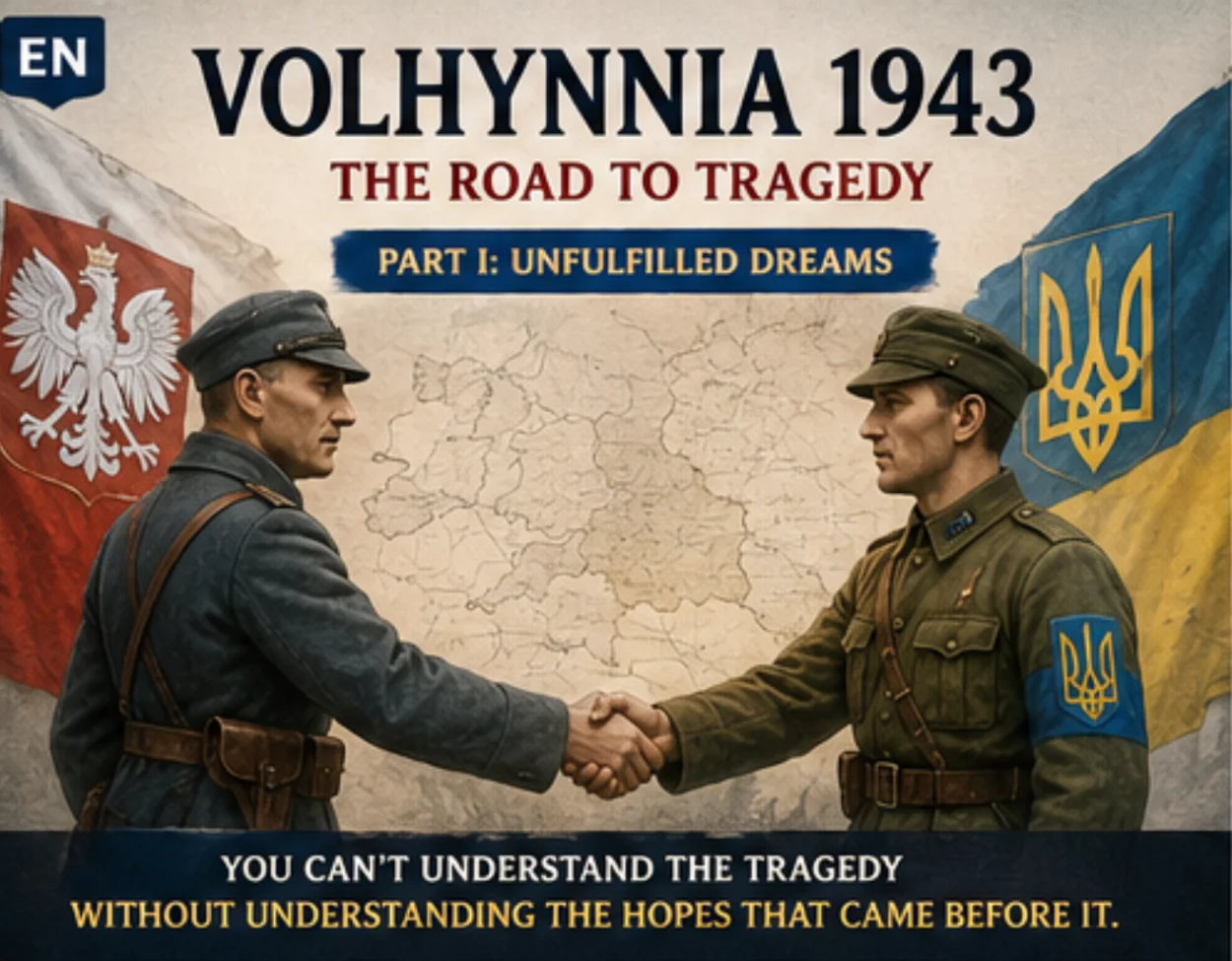
Part I: Unfulfilled Dreams
When we hear the word “Volhynia” today, we almost automatically think of the year 1943.
Of burning villages, innocent victims, and one of the greatest tragedies in the history of Polish–Ukrainian relations.
But history rarely begins on the day a tragedy unfolds.
To understand why the events in Volhynia became possible, we must travel much further back. Not to the Second World War. Not even to the 1930s.
We must return to a time when Poles and Ukrainians were both trying to find their place in a world emerging from the ruins of great empires.
The year 1918 brought enormous changes to Europe.
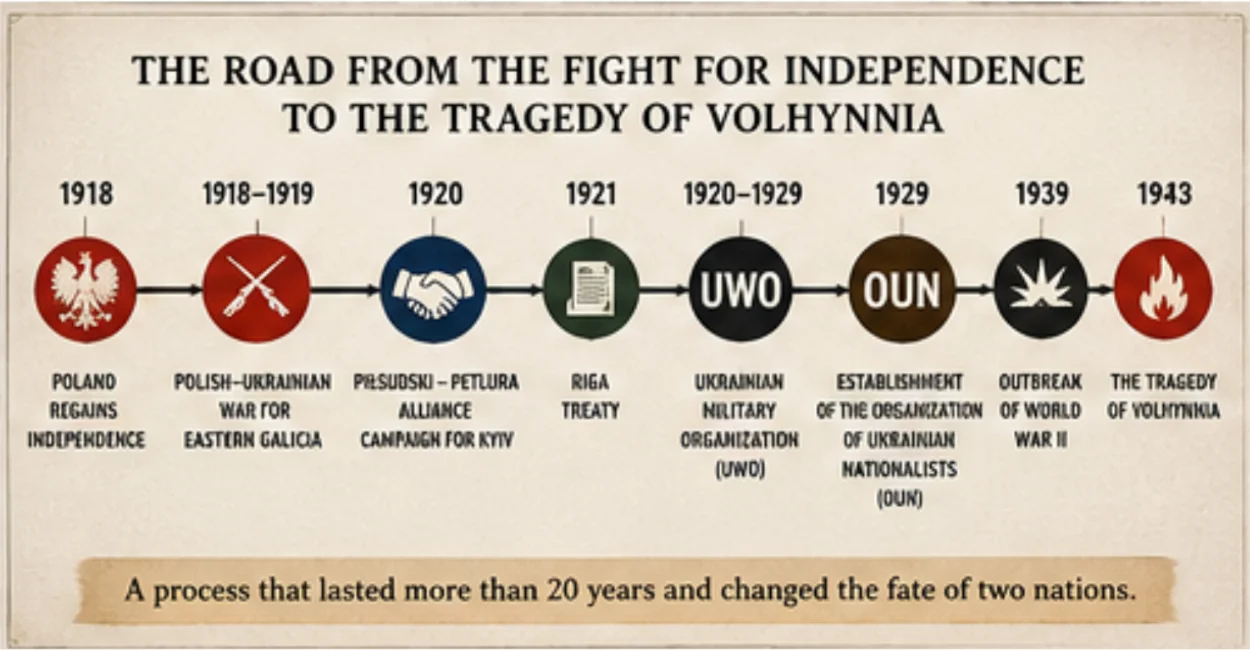
After more than a century of partitions, Poland regained its independence. For millions of Poles, it was the fulfilment of a dream cherished by generations.
Yet similar dreams existed among Ukrainians.
Following the collapse of the Russian and Austro-Hungarian Empires, political and military organisations seeking to establish an independent Ukrainian state began to emerge. One of the most famous formations was the Ukrainian Sich Riflemen, a volunteer military unit that fought during the First World War. It is closely associated with the song “Oh, the Red Viburnum in the Meadow,” which remains one of the most recognisable symbols of Ukrainian patriotism.
For many Ukrainians, the Sich Riflemen played a role similar to that of Józef Piłsudski’s Legions for Poles – a symbol of the struggle for national independence.
Among young officers and activists, there was a growing belief that the moment generations had waited for had finally arrived.
The problem was that Poles and Ukrainians often laid claim to the same lands.
Eastern Galicia, Volhynia and other territories of the former Polish–Lithuanian Commonwealth were inhabited by people of different languages, religions and traditions. For Poles, they were part of the historical heritage of the reborn Polish state. For Ukrainians, they represented a natural part of a future independent Ukraine.
Conflict was almost inevitable.
In November 1918, the Polish–Ukrainian War over Eastern Galicia broke out. Its most enduring symbol became the city of Lviv, claimed by both nations.
After intense fighting, the Polish side emerged victorious.
For Poles, it was the defence of their newly regained independence.
For many Ukrainians, it marked the beginning of a painful disappointment.
Yet history did not follow an obvious path.
Only two years later, former enemies found themselves fighting on the same side.
In 1920, Józef Piłsudski concluded an agreement with Symon Petliura, leader of the Ukrainian People’s Republic.
Today, this alliance is often forgotten, despite being one of the most remarkable episodes in the history of Polish–Ukrainian relations.
Piłsudski believed that the security of the reborn Polish state depended on the existence of independent nations between Warsaw and Moscow. Petliura saw Poland as the last ally capable of helping preserve Ukrainian independence.
In the spring of 1920, Polish and Ukrainian soldiers marched together towards Kyiv.
For a brief moment, it seemed that history might take a very different course.
Fate had other plans.
The Red Army launched a counteroffensive, beginning a conflict that threatened the very existence of Poland.
Although Poland ultimately prevailed in the Battle of Warsaw and secured its independence, the dream of an independent Ukraine remained unfulfilled.
The Treaty of Riga, signed in 1921, ended the war but left many issues unresolved.
Large areas inhabited by Ukrainians became part of the Second Polish Republic. Others were incorporated into Soviet Ukraine.
For many Poles, the treaty marked the end of a devastating war.
For many Ukrainian independence activists, it marked the beginning of a lasting sense of defeat.
The belief that a historic opportunity for statehood had been lost remained deeply rooted in their memory.
It was during this period that figures emerged who would shape the decades to come.
One of them was Yevhen Konovalets, a former military commander and one of the most influential Ukrainian nationalist activists of the interwar era.
Following the failure of Ukrainian independence efforts, he helped establish the Ukrainian Military Organization (UVO), a clandestine movement composed largely of former soldiers and officers.
For some of its members, conventional political activity no longer seemed sufficient.
The belief gradually took hold that the struggle for independence required more radical methods.
Several years later, it was from this very environment that the Organization of Ukrainian Nationalists (OUN) would emerge.
Meanwhile, the Second Polish Republic faced enormous challenges.
Almost one-third of its citizens were not ethnically Polish.
The state had to answer a difficult question: how could diverse national, religious and cultural communities be united within a single political framework?
Different visions competed within Polish politics.
Some dreamed of a multinational state built upon cooperation between its peoples.
Others believed that long-term stability required a strong nation-state with a dominant Polish cultural identity.
In practice, neither vision resolved all tensions.
Disputes concerned schools, administration, language, land ownership and political representation.
For most inhabitants of Volhynia, however, these remained distant political issues.
Poles and Ukrainians continued to live side by side, trade at the same markets, work the same fields and raise their families.
Few could imagine how dramatically this world would change.
During the 1930s, dark clouds began gathering over Europe.
Nationalist and totalitarian movements gained influence across the continent. In many countries, the belief spread that the state should primarily belong to a single nation.
Radical ideas also found fertile ground in regions inhabited by both Poles and Ukrainians.
More and more people began to see their neighbours not as individuals, but as representatives of a nationality.
It was a dangerous process.
For when people stop seeing the human being before them, history often takes a darker path.
And the worst was yet to come.
When the Treaty of Riga was signed, many future activists of the Ukrainian nationalist movement were still children.
Yet they grew up surrounded by memories of lost independence, defeated armies and unfulfilled dreams.
It was from this generation that the men who would later play a decisive role in the events of Volhynia emerged.
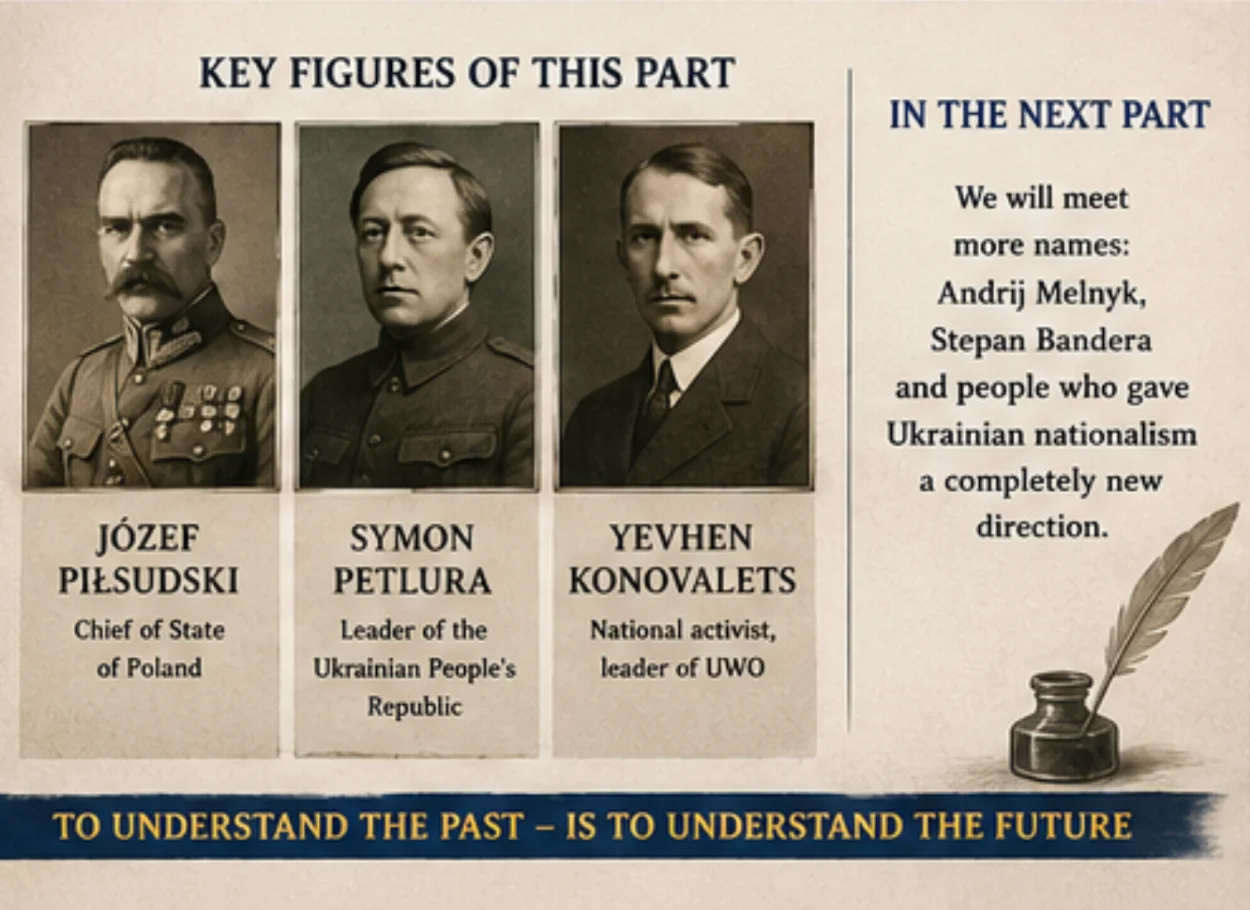
In the next part, we will examine the birth of the Organization of Ukrainian Nationalists, its ideology and the way in which the experiences of 1918–1921 shaped a generation that chose to seek answers not at the negotiating table, but on the battlefield.
Discover with us: