
History of Ireland Without the Headache #6
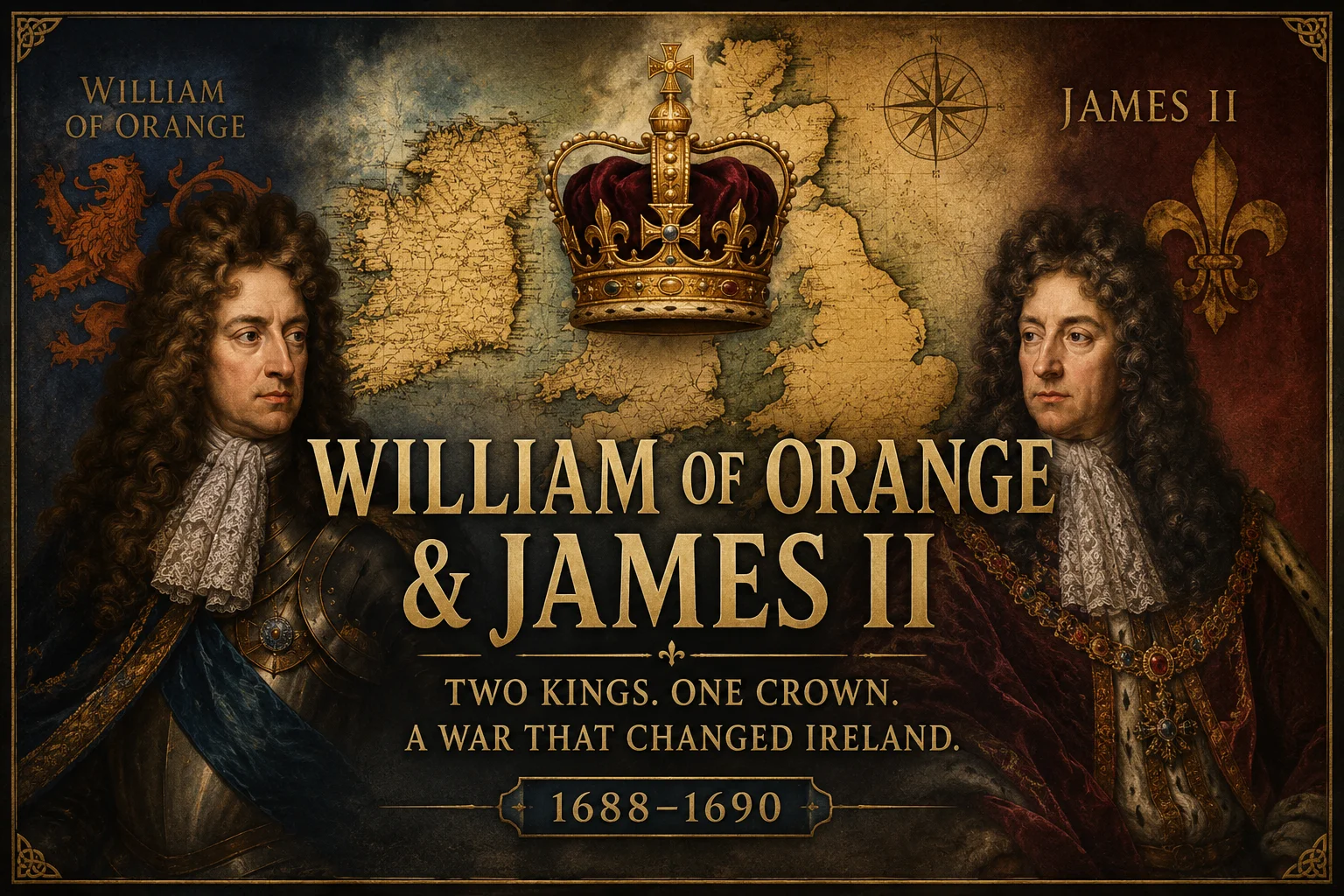
William of Orange and James II – Two Kings, One Crown and a War That Changed Ireland
In the previous chapter, we explored why the Battle of the Boyne remains important more than three centuries after it was fought.
But that naturally raises another question.
Who exactly were the two men who faced each other across the River Boyne?
Because while the conflict is often reduced to a simple struggle between Protestants and Catholics, the reality was far more complicated.
This was not merely a religious war.
It was also a battle for power, legitimacy, and the future of three kingdoms.
At the centre of it all stood two kings.
William of Orange and James II.
The King Who Lost His Throne
James II Stuart became King of England, Scotland, and Ireland in 1685.
He was an experienced soldier, a capable administrator, and the lawful heir to the throne.
Yet there was one thing about him that worried many of his subjects.
He was a Catholic.
In an age when most of England’s political elite were Protestant, many feared that James intended to restore Catholic influence throughout the kingdoms.
At first, opposition remained limited.
The situation changed dramatically when James and his wife produced a son.
Suddenly, it appeared that a Catholic dynasty might remain on the throne for generations.
For many influential politicians, that possibility was deeply alarming.
The Man Invited to Take a Kingdom
William of Orange was the Protestant ruler of the Dutch Republic.
Interestingly, he was also James II’s son-in-law.
William had married Mary Stuart, James’s daughter.
The two men belonged to the same family.
That did not stop them from becoming rivals.
In 1688, a group of influential English politicians secretly invited William to intervene.
The idea sounds extraordinary.
After all, it is not every day that political leaders invite a foreign ruler to take control of their country.
Yet that is exactly what happened.
The Glorious Revolution
In the autumn of 1688, William landed in England with an army.
Many expected a major civil war.
Instead, much of the political establishment and a significant portion of the military switched sides.
James found himself increasingly isolated.
Eventually, he fled to France.
These events became known as the Glorious Revolution.
The name suggests a relatively peaceful transition of power.
For England, that description is partly justified.
For Ireland, however, the story was far from over.
Why Ireland Said “No”
Although James had lost England, he had not lost all support.
Many people in Ireland continued to regard him as the rightful king.
This was particularly true among the Catholic majority.
To them, William was not a liberator.
He was a man who had taken the throne from its lawful owner.
France also had reasons to become involved.
King Louis XIV saw an opportunity to weaken one of his most dangerous rivals.
As a result, he offered support to James.
The struggle for the crown was about to move to Irish soil.
Two Kings, Two Symbols
More than three hundred years later, it is easy to fall into the trap of simple narratives.
William the hero.
James the villain.
Or the other way around.
History is rarely that straightforward.
For many unionists, William of Orange represents victory, constitutional stability, and the preservation of ties with Great Britain.
For many Irish nationalists and republicans, he remains a far more controversial figure.
The same applies to James II.
For some, he was the lawful king who lost his throne through political intrigue.
For others, he was a monarch whose actions created the very crisis that led to his downfall.
Over time, both men became symbols far greater than themselves.
The Road to the Boyne
By 1690, the fate of both kings would be decided in Ireland.
One sought to reclaim a lost throne.
The other intended to secure the throne he had gained.
Both arrived in Ireland.
Both commanded armies.
And both understood that the coming battle could shape the future of entire kingdoms.
At the River Boyne, two armies would meet.
But more importantly, two competing visions of the future would collide.
And that is where our next chapter begins.
Because before we can understand why the Battle of the Boyne is still remembered today, we need to understand what actually happened on that summer day in July 1690.
Coming Next
History of Ireland Without the Headache #7
The Battle of the Boyne—What Really Happened on the Banks of the River Boyne?
The armies, the crossing of the river, the decisions that shaped the battle, and the reality behind one of the most famous events in Irish history.
Discover with us