
Battle of the Boyne—Part II
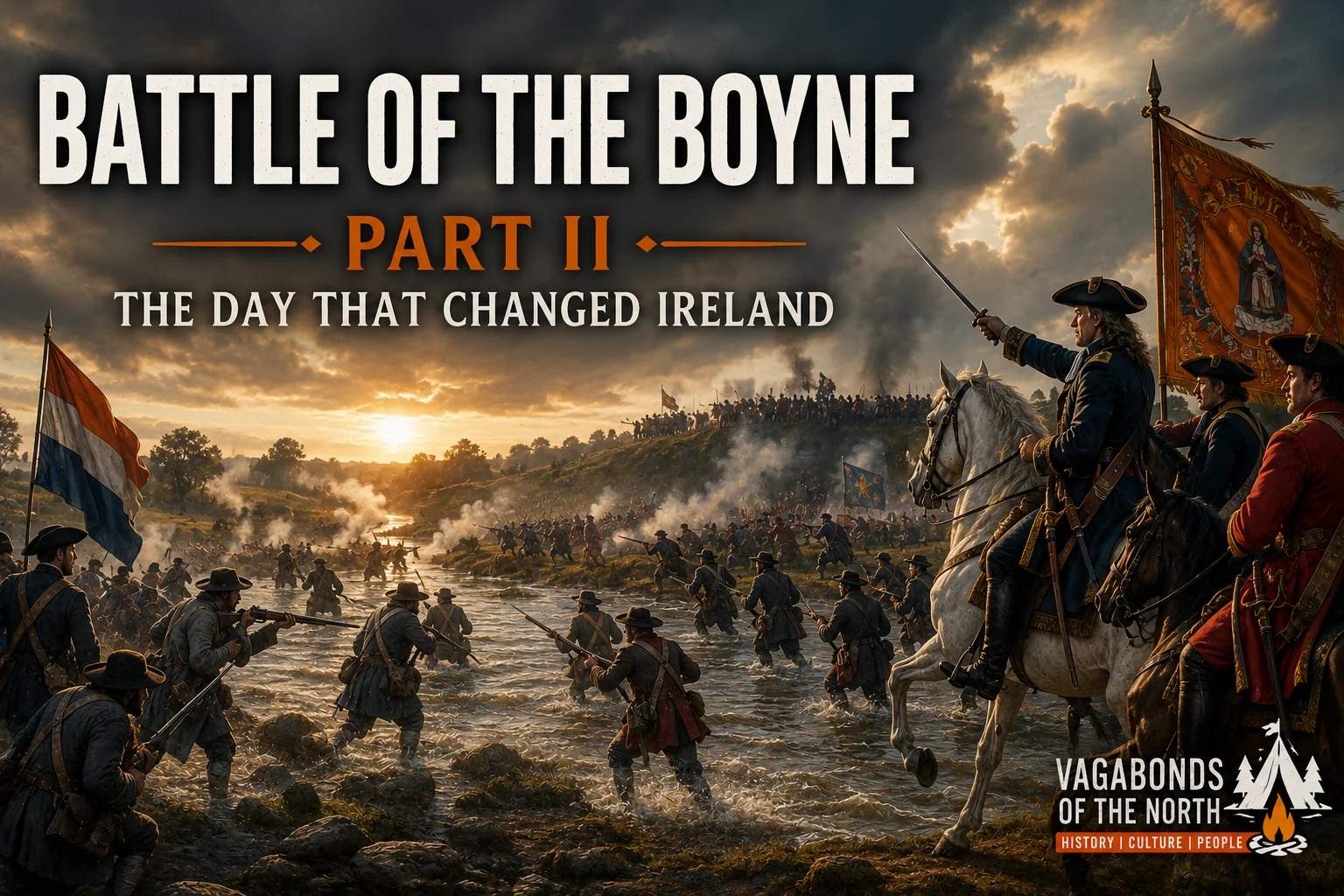
The Day That Changed Irish History
In the first part of our story, we followed two kings on a collision course toward the River Boyne.
One wanted to regain a lost throne.
The other intended to keep the crown he had won during the Glorious Revolution.
On 1 July 1690, their armies finally met.
What followed became one of the most famous battles in Irish history.
More Than an Irish Battle
The Battle of the Boyne is often presented as a clash between Irish and English forces or between Catholics and Protestants.
The reality was far more complex.
William III’s army included Dutch, Danish, German, English and Scottish troops, as well as French Huguenots.
James II was supported by Irish Catholics, French soldiers and loyalists from across the British Isles.
In truth, the Boyne was part of a much larger European conflict.
Fighting Across the River
James II chose a defensive position behind the River Boyne.
He hoped the river would slow the enemy advance and give his troops an advantage.
William responded by dividing his forces.
While part of his army distracted the Jacobite defenders, the main force attempted to cross near Oldbridge.
The battle quickly descended into confusion.
Infantry struggled through the water under musket fire. Cavalry charged across muddy ground. Commanders fought to maintain control as the situation changed from hour to hour.
A King Under Fire
One of the most famous moments of the campaign occurred when William III was struck by artillery fire and suffered a minor wound.
Although not serious, the incident became symbolic.
His supporters saw it as proof that their king shared the dangers faced by ordinary soldiers.
His enemies saw it as a missed opportunity to change the course of history.
Was It a Crushing Victory?
Not entirely.
William won the battle and forced James to retreat.
However, the Jacobite army was not destroyed. It withdrew in relatively good order and remained capable of continuing the war.
For that reason, many historians argue that the political significance of the Boyne was greater than its military importance.
The psychological impact mattered most.
The King Who Left
After the battle, James II lost confidence in his chances of regaining the throne.
He left Ireland and returned to France.
For many of his followers, that decision was devastating.
The war continued for more than a year and ended only after further campaigns and the Treaty of Limerick, but many contemporaries believed that the outcome had effectively been decided at the Boyne.
Why Does It Still Matter?
Because different communities remember the battle in different ways.
For many Protestants in Ulster, William’s victory became a symbol of religious freedom, political security and cultural identity.
For many Irish nationalists, the same event marked the beginning of a period of Protestant political dominance.
One battle.
Two memories.
Two very different stories.
Around the Vagabonds' Campfire 🔥
If you are looking for a simple story of heroes and villains, you will not find it at the Boyne.
This was not simply a religious war.
It was not simply an Irish war.
It was part of a much larger European struggle whose consequences can still be felt in Northern Ireland more than three centuries later.
In Part III, we will discover how a battle fought in 1690 evolved into parades, marching bands, flags and the annual Twelfth of July celebrations that continue to attract thousands of people across Northern Ireland every year.
Discover with us: