
History of Poland Without the Fuss
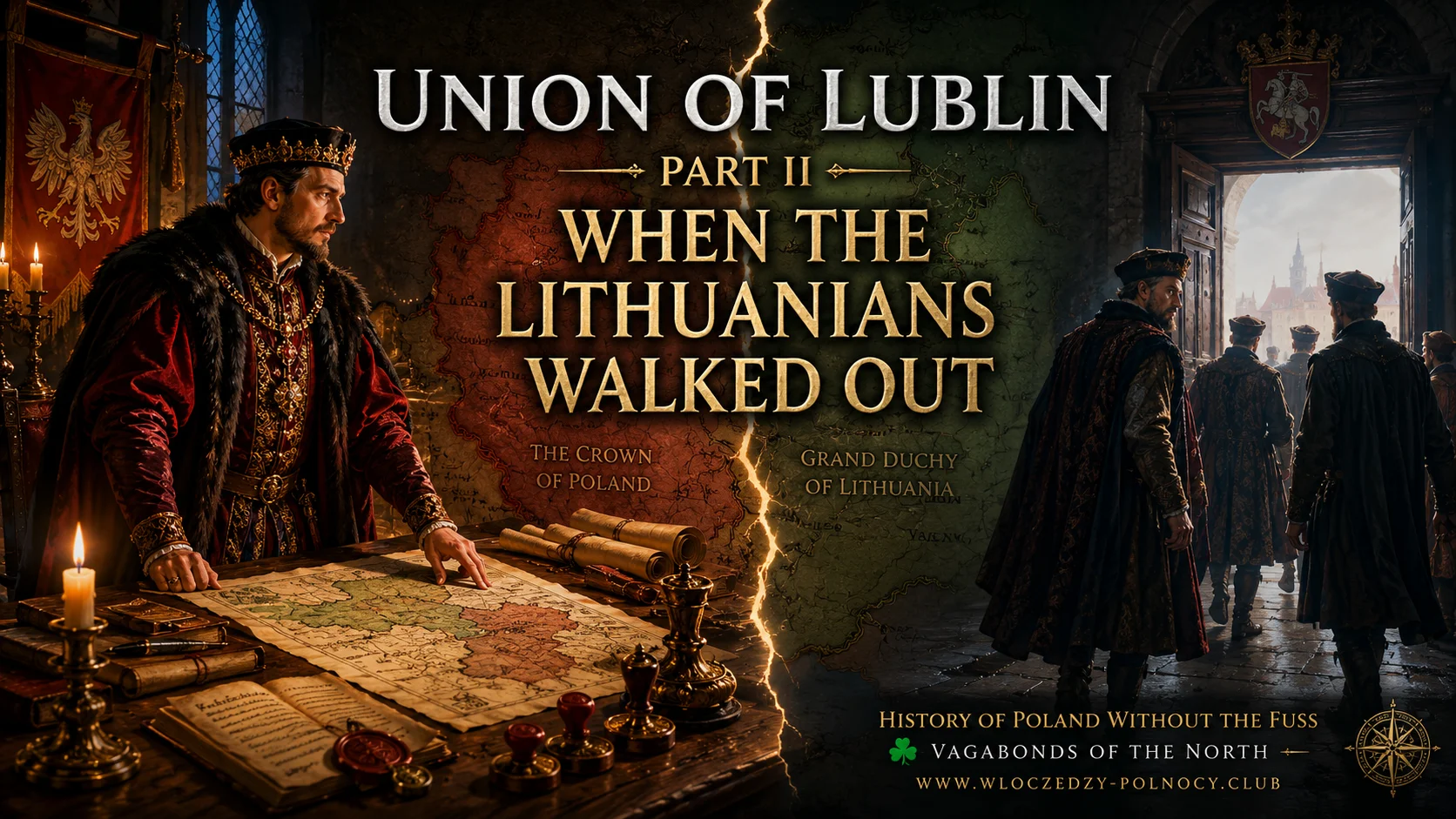
Union of Lublin – Part II
When the Lithuanians Walked Out
In the first part of our story, we explored the circumstances that brought Poland and Lithuania to the negotiating table.
Muscovy was pressing from the east.
Europe was changing rapidly.
And the last of the Jagiellonian rulers had no clear successor.
A stronger union seemed inevitable.
Reality, however, proved far more complicated.
Lublin, 1569
At the beginning of 1569 representatives of the Kingdom of Poland and the Grand Duchy of Lithuania gathered in Lublin.
The goal appeared straightforward.
To agree on the future relationship between their two states.
The problem was that each side imagined that future very differently.
The Polish delegation wanted a stronger political union.
The Lithuanians feared losing influence and independence.
From the very beginning it was clear that reaching an agreement would not be easy.
Two Different Visions
Representatives of the Polish Crown believed that Poland and Lithuania should become a single political entity.
A common parliament.
A common foreign policy.
A common monarch.
Lithuanian delegates viewed the matter differently.
They wished to preserve cooperation with Poland but retain as much autonomy as possible.
Both sides agreed that some form of union was necessary.
What they could not agree on was what that union should look like.
The Walkout
In March 1569 the negotiations reached a breaking point.
The Lithuanian delegation left Lublin and withdrew from the talks.
The message was clear:
“We cannot accept these conditions.”
For many observers it appeared that the negotiations had collapsed.
And with them, the possibility of creating a new union.
The entire project suddenly stood on the edge of failure.
Sigismund Augustus Goes All In
King Sigismund II Augustus had no intention of abandoning the project.
Rather than waiting for the Lithuanian delegates to return, he made a decision that historians still debate today.
Several territories were incorporated directly into the Polish Crown:
- Podlachia,
- Volhynia,
- the Kyiv Voivodeship,
- the Bracław Voivodeship.
These were vast lands inhabited by hundreds of thousands of people.
For the Crown, it meant significant territorial expansion.
For Lithuania’s political elite, it was a shock.
Pressure Builds
The situation changed dramatically.
Lithuania suddenly found itself under intense political pressure.
Further resistance risked the loss of even greater influence.
At the same time, the threat from Muscovy had not disappeared.
If anything, it continued to grow.
Slowly it became clear that compromise might be less costly than continued confrontation.
Back to the Negotiating Table
In the months that followed, Lithuanian representatives returned to Lublin.
This did not mean complete agreement.
Nor did it mean complete trust.
Both sides continued to defend their interests.
Yet for the first time there was a realistic chance of reaching a settlement.
The final phase of negotiations had begun.
A phase that would shape the future of Central and Eastern Europe for centuries.
What Comes Next?
When the delegates returned to Lublin, the hardest decisions still lay ahead.
How could two states be united?
How could Lithuania preserve its distinct identity?
How could a common state be created without destroying its individual parts?
The answers would emerge in the next chapter.
The signatures would be placed.
And a new political power would appear on the map of Europe:
The Polish–Lithuanian Commonwealth.
🍀 To be continued…
In 1569, not everyone was pleased with the decisions made in Lublin. History rarely gives everyone what they want. Sometimes, however, it offers something far more valuable—a shared future.
Vagabonds of the North
Discover with us: