
BATTLE OF THE BOYNE EXPLAINED
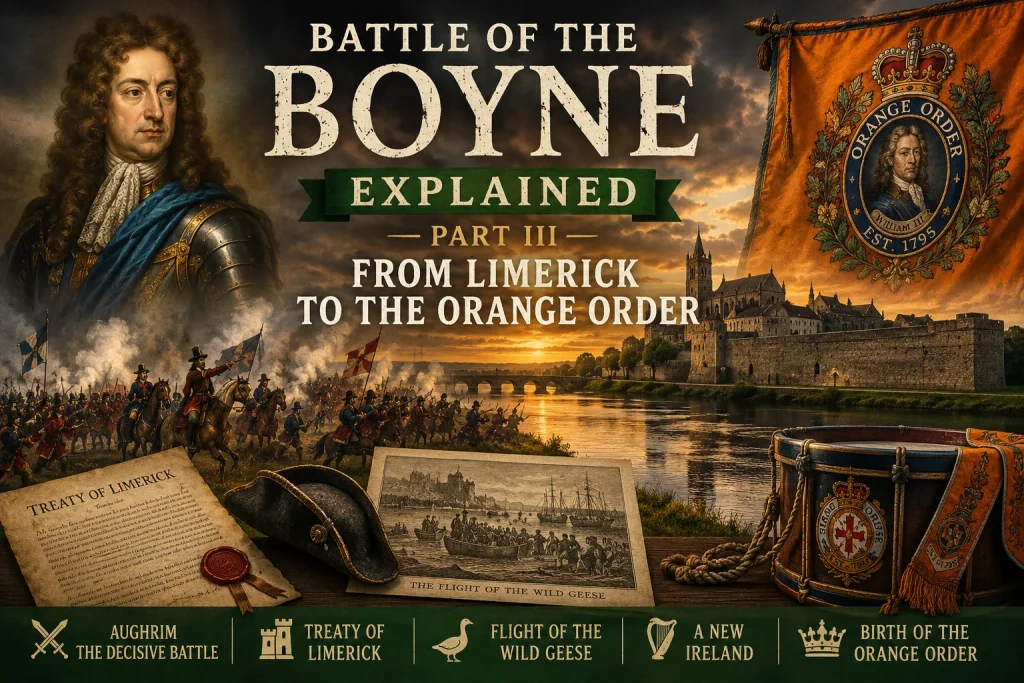
Part III – From Limerick to the Orange Order
Introduction
For many people, the story of the Battle of the Boyne ends on 1 July 1690, when King William III defeated the forces of King James II on the banks of the River Boyne.
In reality, the battle was not the end of the war.
Although James fled the battlefield and later returned to France, large parts of Ireland remained under Jacobite control. The conflict would continue for another year, bringing more battles, sieges and political decisions that would shape Ireland for generations.
If Part I explored the road to the Boyne and Part II examined the battle itself, this chapter focuses on a different question:
What happened after William’s victory?
The War Was Not Over
The victory at the Boyne was an important political and psychological success for William III, but it did not immediately end the Williamite War in Ireland.
Jacobite forces remained active throughout much of the country and continued to resist Williamite advances.
Military commanders on both sides understood that the campaign would ultimately be decided elsewhere.
The decisive phase of the war was still to come.
Aughrim – The Decisive Battle
While the Battle of the Boyne is the most famous engagement of the war, many historians regard the Battle of Aughrim, fought on 12 July 1691, as the conflict’s true turning point.
The Jacobite army suffered a devastating defeat. Thousands of soldiers were killed, wounded or captured, and the death of the French commander, the Marquis de St. Ruth, contributed to the collapse of the Jacobite position.
After Aughrim, hopes of reversing Williamite victories became increasingly unrealistic.
For that reason, some historians argue that Aughrim was militarily more significant than the Boyne itself.
Limerick and the End of the War
The final major chapter of the conflict unfolded at Limerick.
The city had already gained a reputation for its determined resistance during an earlier siege, but by 1691 the strategic situation had changed dramatically.
Following the disaster at Aughrim, Jacobite leaders recognised that continued resistance was unlikely to succeed.
Negotiations began, and on 3 October 1691 the Treaty of Limerick was signed.
The Williamite War in Ireland was officially over.
The Treaty That Became a Symbol
The Treaty of Limerick promised certain protections and rights for Irish Catholics who accepted the new political order.
On paper, it offered a basis for reconciliation after years of conflict.
However, many of its provisions were later restricted, ignored or interpreted narrowly by subsequent governments.
As a result, the treaty occupies a complicated place in Irish historical memory.
For many Irish nationalists, it became a symbol of promises made and promises broken.
The Flight of the Wild Geese
One of the most famous consequences of the treaty was the departure of thousands of Irish soldiers from their homeland.
Under the agreement, many Jacobite troops were allowed to leave Ireland and enter French service.
This event became known as the Flight of the Wild Geese.
Over the following decades, Irish regiments would serve in the armies of France, Spain, Austria and other European powers.
Their story became part history and part legend, representing exile, loyalty and the enduring connections between Ireland and continental Europe.
Even today, the phrase “Wild Geese” remains one of the most recognised expressions in Irish history.
A New Political Order
The end of the war marked the beginning of a new era.
Political and economic power increasingly came under the control of the Protestant elite aligned with the Crown.
Historians often refer to this period as the Protestant Ascendancy.
This did not mean that every Protestant enjoyed privilege or that every Catholic lived in poverty.
However, access to political influence, land ownership, public office and education became significantly easier for some groups than for others.
Over time, a series of Penal Laws further restricted the rights of Catholics and reinforced existing inequalities.
The legacy of this period would influence Irish politics and society for generations.
Why Was the Boyne Still Remembered?
More than a century after the battle, people were still talking about William III and the events of 1690.
Why?
The answer lies in the power of memory and identity.
For many Protestants, the Boyne represented the defence of constitutional monarchy, religious liberty and loyalty to the Crown.
For many Catholics, the same events symbolised the beginning of a period of political exclusion and lost influence.
Gradually, the Battle of the Boyne became more than a historical event.
It became a symbol.
The Battle of the Diamond and the Birth of the Orange Order
By the late eighteenth century, tensions between Protestant and Catholic communities had intensified in parts of County Armagh.
Competition for land, employment and local influence often led to conflict.
On 21 September 1795, a violent confrontation took place near Loughgall.
Known as the Battle of the Diamond, it involved Protestant groups known as the Peep o’ Day Boys and Catholic Defenders.
Although small compared to the great battles of the seventeenth century, its consequences were significant.
Following the clash, a group of Protestant participants met at a nearby inn and established a new organisation.
That organisation became the Orange Order.
Its founders chose to honour William of Orange, whose victory at the Boyne had become a powerful symbol of Protestant identity and loyalty to the Crown.
More than one hundred years after the battle itself, the memory of the Boyne continued to shape events in Ireland.
Campfire Reflections 🔥
The Battle of the Boyne lasted a single day.
Its consequences lasted for centuries.
The war continued through Aughrim and Limerick. It produced the Flight of the Wild Geese, helped shape the era of the Protestant Ascendancy and influenced the creation of the Orange Order.
For some, it represented victory.
For others, it marked the beginning of a difficult chapter in Irish history.
Yet regardless of perspective, one fact remains undeniable.
Few battles fought more than three hundred years ago continue to influence identity, memory and public life as strongly as the Battle of the Boyne.
Coming Next
In the final chapter of our series, we leave the battlefields behind and step into the modern world.
How did a seventeenth-century battle become the inspiration for parades, bonfires and the annual celebrations known as The Twelfth?
Join us as we explore one of the most distinctive traditions in contemporary Northern Ireland.
Discover with us: