
History of Poland Without the Fuss
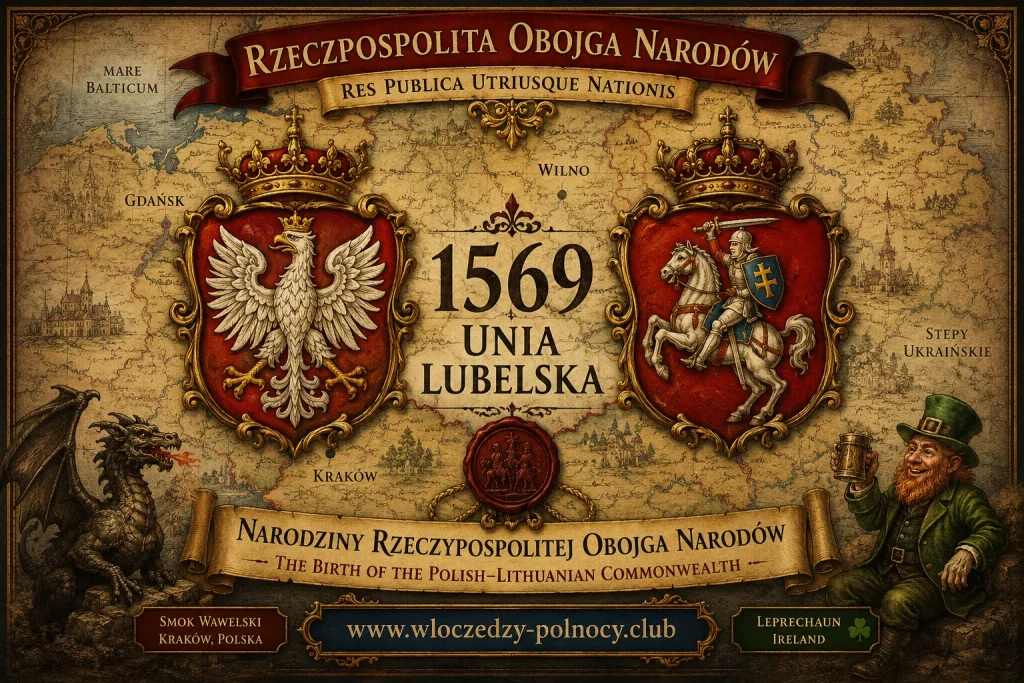
The Union of Lublin – Part III
The Birth of the Polish–Lithuanian Commonwealth
July 1st, 1569 – A Day That Changed Europe
After months of negotiations, political manoeuvring, heated arguments and diplomatic bargaining, an agreement was finally reached in the city of Lublin.
On 1 July 1569, the Kingdom of Poland and the Grand Duchy of Lithuania signed the Union of Lublin, creating a new state that would become one of the largest and most influential powers in Europe.
For contemporaries, however, this was not the triumphant end of a story. It was the beginning of a new chapter filled with opportunities, challenges and uncertainty.
The Polish–Lithuanian Commonwealth had been born.
What Was Actually Created?
The Union of Lublin did not dissolve Poland or Lithuania.
Instead, it created a unique political structure unlike almost anything else in sixteenth-century Europe.
The two nations agreed to share:
- a common monarch,
- a common parliament (Sejm),
- a common foreign policy,
- and a common currency.
At the same time, Lithuania retained:
- its own administration,
- its own treasury,
- its own army,
- and its own legal system.
While many European rulers were centralising power and building increasingly absolute monarchies, Poland and Lithuania chose a different path: cooperation between two political communities within a single state.
One of the Largest States in Europe
The newly formed Commonwealth stretched across vast territories that today belong to:
- Poland,
- Lithuania,
- Belarus,
- Ukraine,
- and parts of Latvia.
Covering almost one million square kilometres at its height, it became one of the largest states in Europe.
Travellers arriving from Western Europe often described the Commonwealth as a land of enormous distances, prosperous cities, religious diversity and political freedoms rarely seen elsewhere on the continent.
A Commonwealth of Many Peoples
One of the most remarkable features of the Commonwealth was its diversity.
Its inhabitants included:
- Poles,
- Lithuanians,
- Ruthenians,
- Germans,
- Armenians,
- Jews,
- Tatars,
- and many others.
Different languages, cultures and religions coexisted within the same political framework.
This did not mean the absence of conflict. No state of such size and diversity could avoid tensions.
Yet for centuries, the Commonwealth represented a rare attempt to build a political community based on cooperation rather than uniformity.
Was Everyone Happy?
Certainly not.
Many Lithuanian magnates believed they had sacrificed too much.
Some Polish nobles felt that Poland had given away more than it gained.
On the eastern territories, concerns emerged regarding local traditions, identity and religious autonomy.
Debates about the true legacy of the Union of Lublin continue even today.
What some view as a visionary political partnership, others regard as a source of future disputes.
History, as always, is rarely simple.
Why Does the Union of Lublin Matter?
Because it created a state that would shape the history of Central and Eastern Europe for more than two centuries.
The Polish–Lithuanian Commonwealth became a centre of trade, culture, scholarship and political thought.
Its political system, based on the concept of noble liberty, was admired by some and criticised by others, but it was undoubtedly unique.
The Commonwealth was not perfect.
It solved some problems while creating others.
It experienced periods of prosperity as well as decline.
Yet it proved that two distinct nations could attempt something extraordinary: the creation of a shared political future without abandoning their separate identities.
That alone makes the Union of Lublin one of the most fascinating political experiments in European history.
Vagabond’s Reflection
🐉 The Wawel Dragon, Kraków, Poland
“After months of negotiations, arguments and political manoeuvres, Poland and Lithuania created one of Europe’s greatest states.”
🍀 The Leprechaun, Ireland
“Impressive. On our island, borders often divided people more than they united them.”
🐉
“It did not end all problems.”
🍀
“History rarely does.”
🐉
“But it marked the beginning of something remarkable.”
🍀
“And that is why, more than four centuries later, we are still talking about it.”
"In 1569, not everyone welcomed the decisions made in Lublin. History rarely grants every wish. Sometimes, however, it offers something far more valuable — a shared future."
Vagabonds of the North
Discover with us: