
Part I: Europe at a Crossroads – The Road to Lublin
Introduction
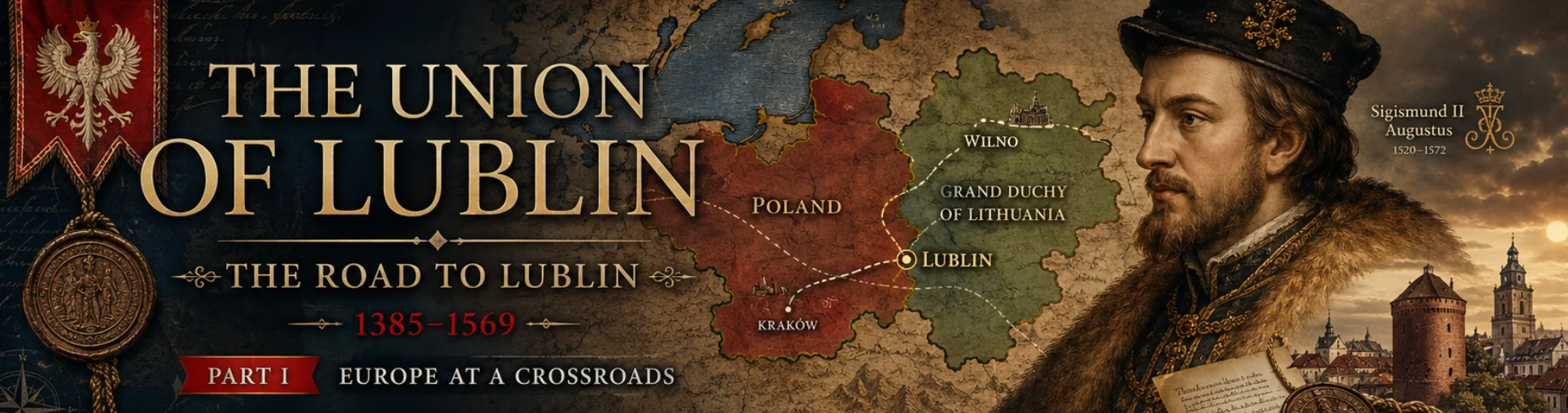
On 1 July 1569, a document was signed in the city of Lublin that would reshape the map of Europe for more than two centuries.
The state that emerged from this agreement was so unusual that historians still debate what it truly was. A kingdom? A federation? A political union? Or perhaps something centuries ahead of its time?
Before the nobles gathered in Lublin placed their signatures on the Act of Union, Poland and Lithuania had spent nearly two hundred years trying to answer a fundamental question:
To understand the answer, we must travel back almost two centuries.
Two Powers, Two Worlds
In the fourteenth century, the Kingdom of Poland and the Grand Duchy of Lithuania were among the largest states in Europe.
Poland belonged firmly to the Western Christian world. Its cities expanded, trade flourished, and universities attracted scholars from across the continent.
Lithuania was a very different political organism. It stretched across territories that today belong to Lithuania, Belarus, and Ukraine. Its population included Lithuanians, Ruthenians, Tatars, Jews, and many other communities.
By land area alone, Lithuania ranked among the largest states in Europe.
The problem was that both countries shared the same enemies.
The First Step – The Union of Krewo
In 1385, an agreement known as the Union of Krewo was concluded.
Grand Duke Władysław Jagiełło accepted Christianity, married Queen Jadwiga of Anjou, and became King of Poland.
Thus began the Jagiellonian dynasty.
A united state did not yet exist.
What emerged was something much simpler: a shared monarch.
Common Enemies
The greatest threat remained the Teutonic Order.
Polish-Lithuanian cooperation eventually led to victory at the Battle of Grunwald, one of the most significant battles in medieval Europe.
Yet defeating the Teutonic Knights did not eliminate all dangers.
A new power was rising in the east.
Moscow.
The Rise of a New Rival
During the fifteenth and sixteenth centuries, the Grand Duchy of Moscow gradually unified the Ruthenian lands under its control.
Moscow’s rulers increasingly portrayed themselves as heirs to the legacy of Kyivan Rus’.
This meant that territories controlled by Lithuania became natural targets for expansion.
For Lithuania, this was an existential challenge.
For Poland, it was becoming one as well.
The War That Changed Everything
In 1558, the Livonian War erupted.
Tsar Ivan IV the Terrible launched a major campaign aimed at securing access to the Baltic region.
Lithuania increasingly felt the strain of prolonged warfare. It lacked manpower, resources, and military strength sufficient to face Moscow alone.
The old model of cooperation was no longer enough.
Many Lithuanian nobles began to recognise that without a deeper political relationship with Poland, maintaining such a vast state might prove impossible.
A King Without an Heir
At the centre of these events stood Sigismund II Augustus.
He was the final ruler of the Jagiellonian dynasty.
He had no legitimate heir.
His death threatened to bring an end to nearly two centuries of dynastic union between Poland and Lithuania.
For many statesmen, this was a warning sign.
If a new form of political relationship was not created, everything that had been built could collapse.
Europe Before a Great Decision
By the late 1560s, the situation was becoming increasingly clear.
Moscow pressed from the east.
The Ottoman Empire expanded in the south.
Tatar raids repeatedly devastated border regions.
The Jagiellonian dynasty was approaching its end.
Poland and Lithuania faced a choice: remain separate states connected only by a monarch, or create an entirely new political entity.
The answer would be decided in Lublin.
And not everyone was prepared to accept it.
“Great states do not endure through force alone, but through the agreement of those who build them.”
Vagabonds of the North
In the Next Part
We will travel to Lublin in 1569.
We will witness how Lithuanian delegates dramatically left the negotiations, why the king took one of the most controversial decisions of his reign, and how Volhynia, Podlasie, Kyiv, and Bracław became the centre of one of the most important political disputes in European history.
Discover with us: