THE LONG WOMAN OF COOLEY
And why some Irish legends never stop watching the horizon
“Ireland has a remarkable talent for creating stories about those who never returned.”
Vagabonds of the North
Some legends begin with great battles.
Others with dragons.
And then there’s the Cooley Peninsula.
A place where somebody once apparently looked at a massive stone tomb and casually decided:
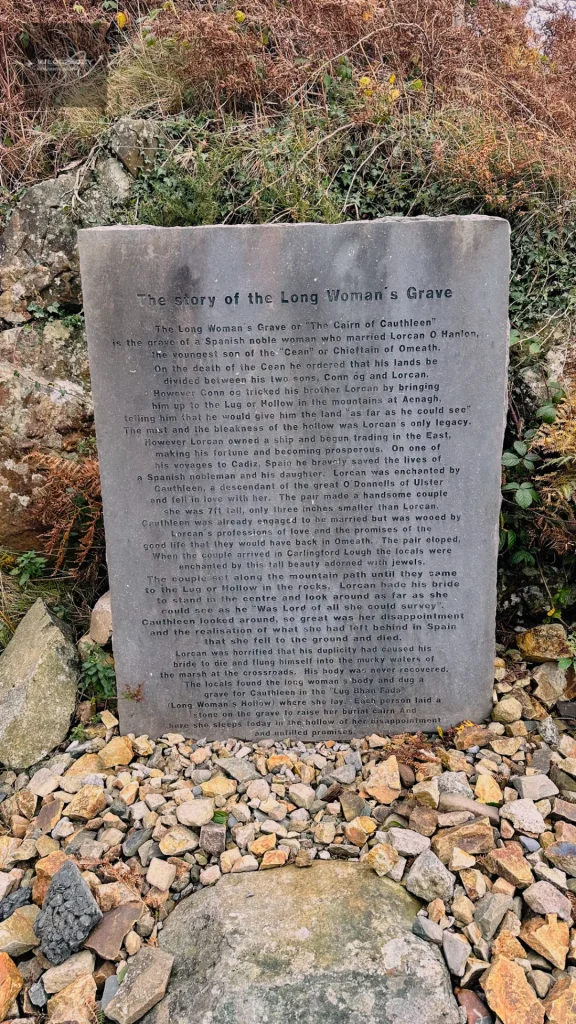
“Yes. That is definitely the grave of a Spanish giant woman.”
🤣🔥
And honestly?
The deeper you go into Irish folklore, the less ridiculous that starts to sound.
Because beneath the legend, something far more human begins to emerge.
The Woman Watching the Sea
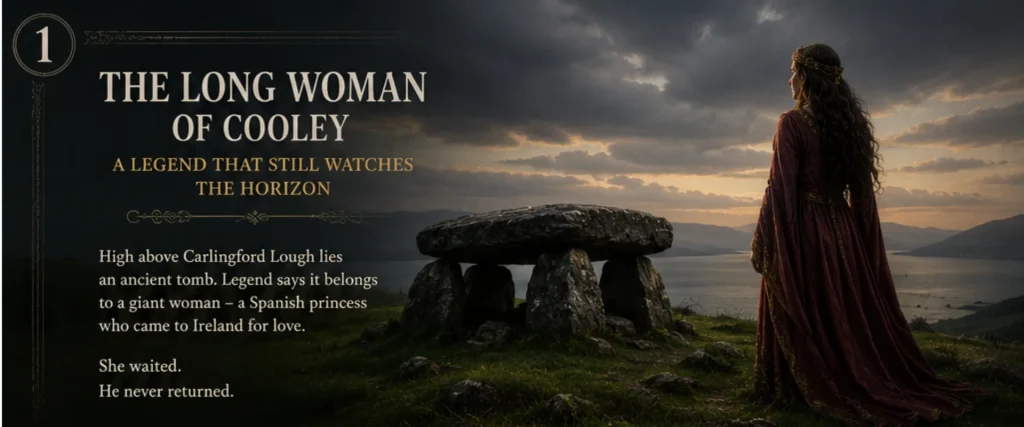
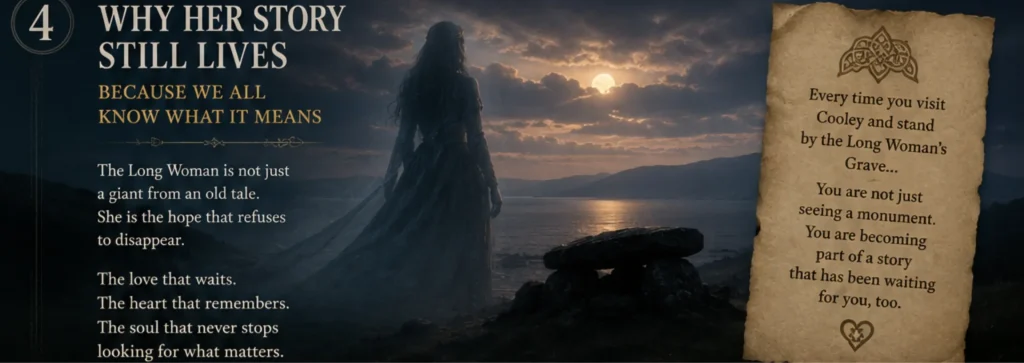
High above Carlingford Lough lies an enormous stone tomb.
Today it is known as:
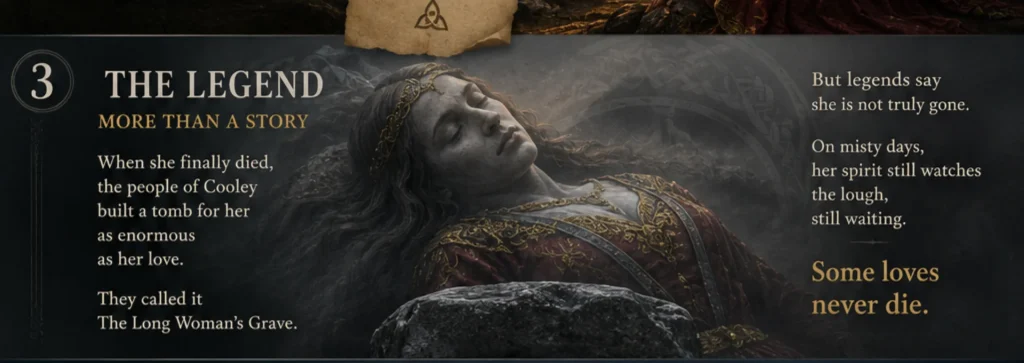
The Long Woman’s Grave.
Which already sounds like the kind of story that requires at least one Guinness before discussion properly begins.
🍺😄
The legend speaks of a woman.
Not an ordinary woman.
A giant.
Sometimes described as Spanish.
Sometimes as mysterious.
Sometimes almost supernatural.
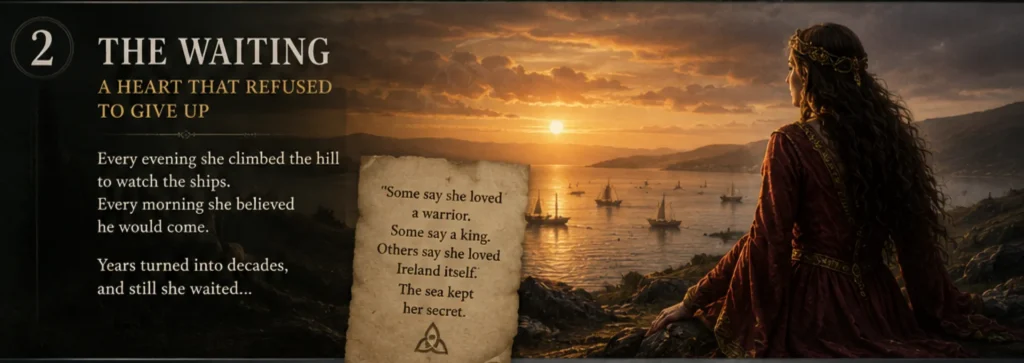
In certain versions she waits for her lover returning across the sea.
In others she waits for a warrior.
A husband.
A king.
Or simply someone who promised to come back.
And as often happens in Irish stories…
the sea remained silent.
“In Ireland, even stones sometimes look like they’re trying to remember something.”
Vagabonds of the North
Family Tragedy or Something Older?
This is where the story begins to split into different paths.
Because Irish folklore has a wonderful habit of producing:
- three versions of every story,
- five competing interpretations,
- and at least one theory invented after the third Guinness.
🤣🔥
Some versions speak of:
⚔ betrayal
⚔ family conflict
⚔ political intrigue
⚔ brother against brother
Others focus less on conflict and more on:
🌫 loss
🌫 waiting
🌫 longing
And that is where the legend becomes fascinating.
Because the Long Woman slowly stops being “a giant.”
And starts becoming:
A symbol.
Ireland and the People Who Never Returned
The deeper you explore Irish mythology…
the more often you encounter the same emotional pattern.
Someone leaves.
Someone disappears.
Someone is separated by war, sea or history.
And somebody else waits.
Sometimes for a lifetime.
Perhaps that is why this story survived.
Because Ireland spent much of its history knowing:
- emigration,
- separation,
- lost families,
- heroes who never returned,
- people vanishing beyond the horizon.
And suddenly a woman watching the sea no longer feels strange.
It feels painfully human.
“Perhaps that’s why the Long Woman still watches the bay. Because hope is the hardest thing to bury.”
Vagabonds of the North
Sleeping Heroes and Those Who Will Return
There is another ancient idea hidden beneath stories like this.
One that appears all across Europe.
The Legend of:
The hero who never truly died.
Instead he:
- sleeps,
- hides,
- waits,
- and will return when most needed.
King Arthur.
Sleeping kings.
Hidden warriors.
Mahdi legends.
Myths of return.
Ireland has its own versions too.
And perhaps that is why the Long Woman resonates so strongly.
Because it is not simply a story about death.
It is a story about:
Hope refuses to disappear.
Poles, Irish People and Stories Told Around Tables
This is where the story unexpectedly became personal for us.
The more time we spent listening to Irish legends, the more often we found ourselves thinking:
“This feels strangely familiar.”
☘️🇵🇱
Poland and Ireland are far apart geographically.
But both nations learned to preserve memory not only in books or official history.
They also preserved it:
- in stories,
- legends,
- songs,
- pub conversations,
- and in those strange moments where two people meet and immediately produce three theories and one local myth.
🤣🔥
Perhaps that is why Irish folklore feels unexpectedly close to people from Eastern Europe.
Different languages.
Different landscapes.
Very similar emotions.
“Some legends survive because people still need hope.”
Vagabonds of the North
Meeting the Long Woman
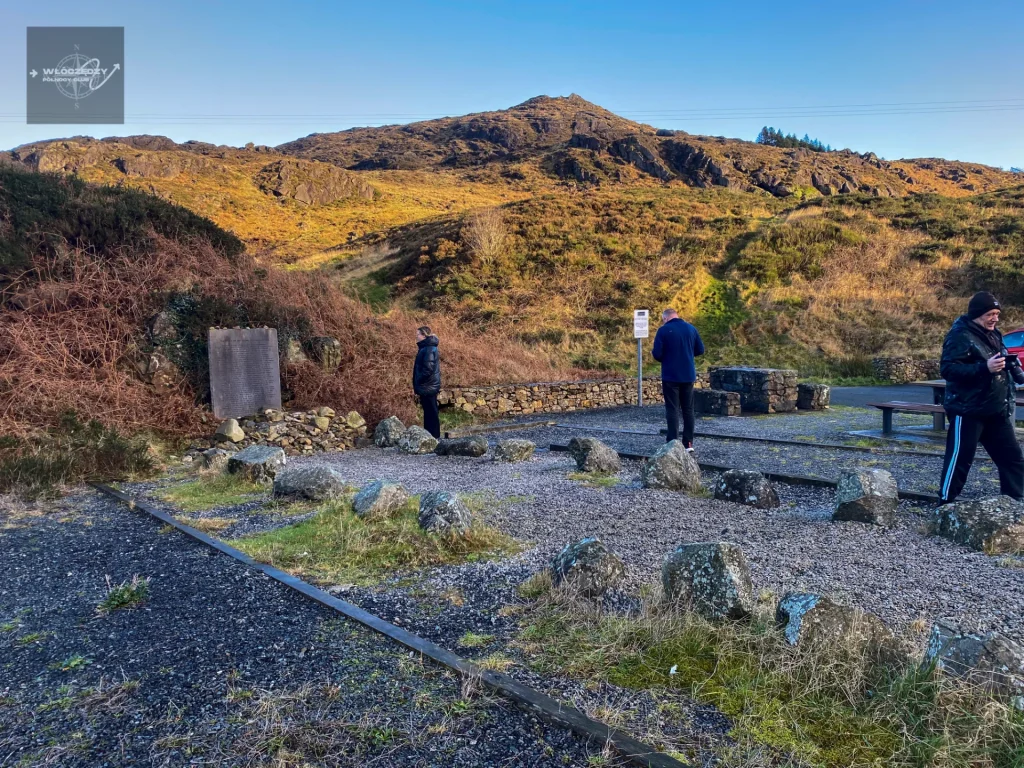
And then you finally stand there yourself.
Wind rolling in from the lough.
Stone beneath your hands.
Silence.
And suddenly the question changes.
You stop asking:
“Is this legend true?”
Instead you begin wondering:
“What happened in people’s lives that made them create a story like this?”
🌫☘️
And that is exactly what the Cooley Peninsula does so brilliantly.
It slowly dissolves the line between:
- history,
- folklore,
- memory,
- and emotion.
Epilogue
Maybe the Long Woman never existed.
Maybe she was only a story.
Or maybe — like so many Irish legends — the story began with something real.
Someone’s loss.
Someone’s waiting.
Someone’s sea.
Because in Ireland, even stones sometimes look as if they are trying to remember something.