
THE BROWN BULL OF COOLEY
How Ireland’s greatest mythological war began with a marital asset comparison
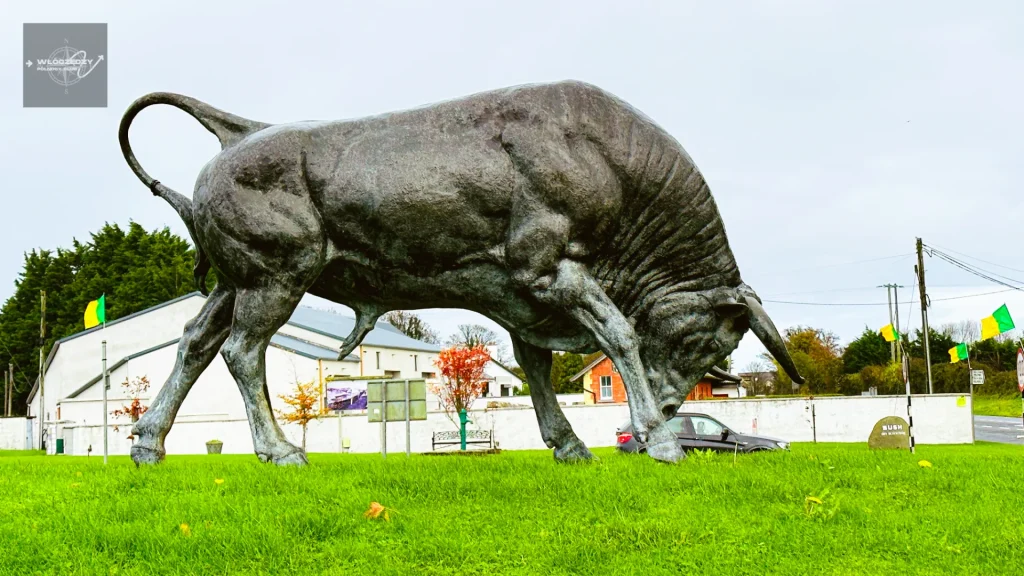
“Every marriage has its issues. Very few end in a full-scale war over cattle.”
Vagabonds of the North
There are many ways for royal marriages to go wrong.
Some collapse over politics.
Some over alliances.
Some over betrayal.
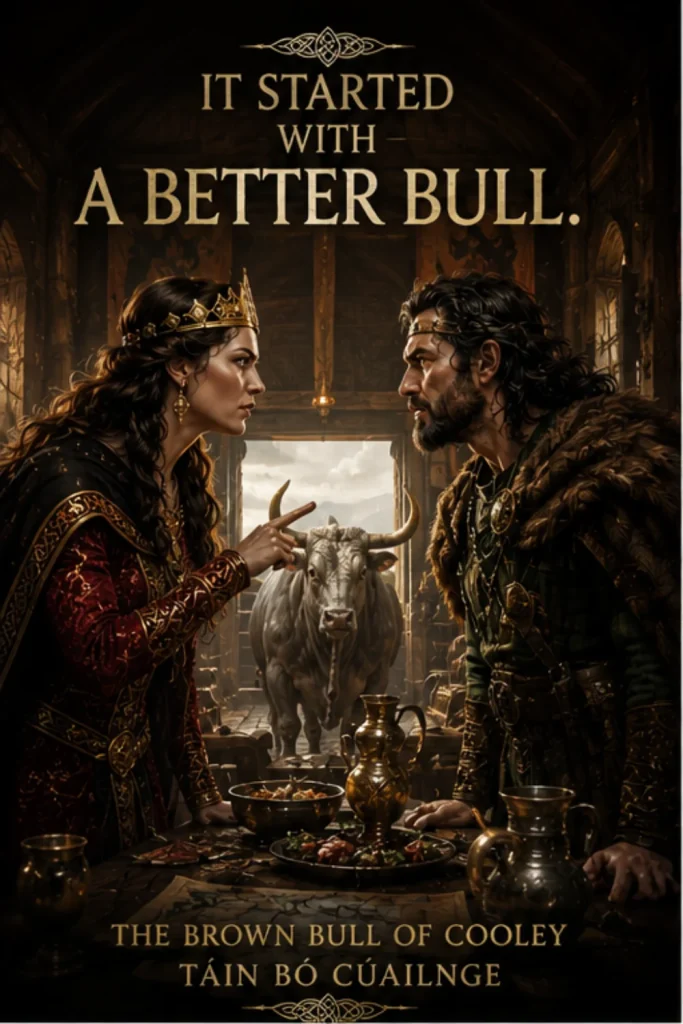
And then there’s Queen Medb of Connacht, who effectively launched one of Ireland’s greatest mythological wars because her husband owned a better bull.
Yes.
That is where this begins.
And somehow…
it only gets more gloriously insane from there.
ACT I — The Great Marital Audit of Connacht™
Every relationship has its awkward conversations.
Money.
Children.
Division of responsibilities.
Who left the wet towel on the bed.
Perfectly normal.
Then there’s the royal version:
“Let’s compare our total wealth.”
Which, frankly, rarely ends well.
One day, Queen Medb and her husband Ailill decided to conduct a full accounting of their possessions.
And initially?
Everything looked balanced.
Gold?
Check.
Silver?
Check.
Land?
Plenty.
Servants?
Of course.
Weapons?
Naturally.
Status?
Enormous.
Royal ego?
Wildly healthy on both sides.
🤣
And then…
They reached livestock.
Because among Ailill’s assets stood something extraordinary:
Finnbhennach.
The White-Horned Bull.
Not ordinary cattle.
Not farmyard background decoration.
This was prestige.
Power.
Status.
The mythological equivalent of discovering your spouse secretly owns a private fighter jet.
And suddenly the balance shifted.
Because technically…
Ailill now possessed something Medb could not match.
Which meant:
He was richer.
Now.
This would not have bothered every queen.
But Medb?
Medb did not strike historians as a woman especially fond of losing.
Particularly not over livestock.
Vagabond diagnosis:
Some marriages end in therapy.
This one escalated to military logistics.
🤣🔥
ACT II — Medb decides she needs her own monster
Fortunately for royal pride, a solution existed.
In Ulster.
On the Cooley Peninsula.
There lived another beast.
One every bit as formidable as Finnbhennach.
Perhaps even more so.
Donn Cuailnge.
The Brown Bull of Cooley.
And no — this was not merely an unusually muscular farm animal.
This creature existed in legend as something far larger.
A force.
A symbol.
A mythological heavyweight.
A walking declaration of dominance.
Which made it exactly what Medb required.
At first, to be fair, she attempted diplomacy.
Messengers were sent.
Offers were made.
Negotiations opened.
In modern terms:
“Hello. Lovely bull. We would like to arrange a mutually beneficial acquisition.”
Entirely reasonable.
And by some miracle…
It might actually have worked.
Until alcohol entered the chat.
Because according to tradition, Medb’s envoys — after enjoying a strategically questionable amount of drink — began boasting that if negotiations failed…
The Queen would simply take the bull by force anyway.
Which is, in fairness, a spectacularly effective way to destroy peaceful negotiations.
The bull’s owner heard.
Trust collapsed.
Diplomacy died.
And when the news returned to Medb?
She did not say:
“Perhaps we should apologise.”
She did not suggest:
“Let’s reopen discussions.”
No.
She effectively said:
“Mobilise the army.”
🔥🐂⚔️
And that is where things stop being merely ridiculous…
…and become epic.
ACT III — Queen Medb chooses escalation
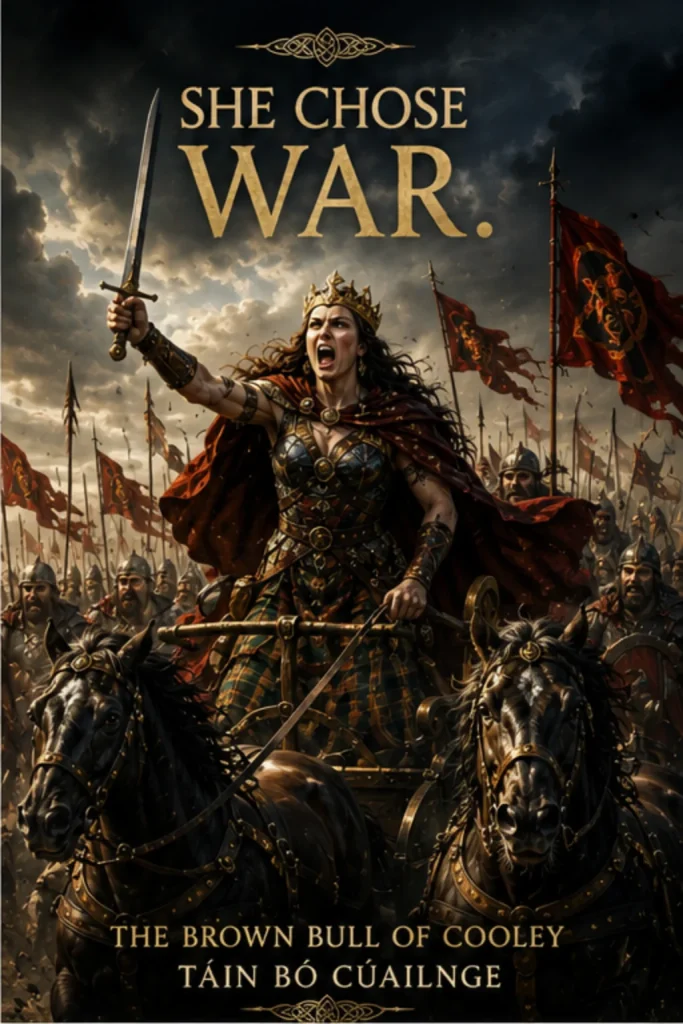
“This was never really a story about bulls. It was a tragedy wearing horns.”
Vagabonds of the North
There are people who respond to failed negotiations with patience.
Reflection.
Another meeting.
Perhaps a calmer diplomatic approach.
And then there is Queen Medb.
Once diplomacy collapsed, subtlety was officially dead.
This was no longer about polite acquisition.
This was war.
Not a small retaliatory raid.
Not a symbolic show of force.
A real campaign.
Standards raised.
Warriors armed.
Chariots assembled.
Allies summoned.
Steel prepared.
Entire military logistics activated.
All…
For a bull.
🤣🤣🤣
And somehow, this only improves the story.
Because myth thrives on disproportionate reactions.
And Medb specialised in those.
But to be fair…
Medb was not merely impulsive.
She was dangerous because she was strategic.
This was not emotional chaos.
This was organised chaos.
A very different thing.
And much harder to stop.
Her forces grew.
Allies joined.
Momentum built.
The invasion of Ulster began.
And then Irish mythology did what Irish mythology always does:
It made things much weirder.
ACT IV — The Curse of Ulster
Because while Medb was preparing for full-scale war…
Ulster had a problem.
A spectacular one.
A curse.
Yes.
A curse.
According to tradition, the men of Ulster had been afflicted by an ancient magical punishment.
At critical moments, they would become physically incapacitated by agonizing weakness often described in ways distinctly comparable to labor pains.
Which is objectively one of mythology’s most creative strategic disadvantages.
The timing, naturally, was terrible.
As Medb’s army advanced, Ulster’s warriors were effectively useless.
Fallen.
Broken.
Unable to fight.
Which meant Medb had picked exactly the right moment.
Almost.
Because mythology always leaves one exception.
“Irish mythology has a remarkable talent for turning property disputes into apocalyptic events.”
Vagabonds of the North
ACT V — Cú Chulainn enters the chat
And then comes him.
Cú Chulainn.
Which, if we’re simplifying aggressively, makes him something between:
- a legendary warrior,
- a teenage killing machine,
- and a mythological one-man military crisis.
Because while Ulster’s warriors lay crippled by the curse…
Cú Chulainn stood alone.
One young warrior.
Against an invading army.
Completely normal mythology.
And naturally, he did not approach this modestly.
Single combat challenges.
Ambushes.
Heroic confrontations.
Strategic slaughter.
General psychological inconvenience for Queen Medb.
At times, he effectively became an entire military department by himself.
Which is deeply inconvenient when you’re trying to steal legendary livestock.
But important clarification:
This is not Cú Chulainn’s story.
Not today.
Because while he delays Medb…
Something much older is stirring beneath the main conflict.
Something that predates all of them.
ACT VI — The truth about the bulls
Because here is where the myth quietly changes scale.
If you think Donn Cuailnge and Finnbhennach were merely unusually aggressive cattle…
Absolutely not.
Irish mythology does not think that small.
The bulls carried history.
Ancient history.
In older mythic traditions, these beings are linked to previous incarnations.
They had existed before.
In other forms.
Other lives.
Other rivalries.
Depending on the version, they appear as:
- swineherds,
- shape-shifting beings,
- magical adversaries,
- Supernatural rivals carrying grudges across transformations.
Which means:
This conflict did not begin with Medb.
Medb merely accelerated it.
The hatred between these forces was older than kingdoms.
Older than armies.
Older, perhaps, than memory itself.
And now…
They were approaching one another again.
In bovine form.
Vagabond thought:
Imagine two ancient magical rivals carrying a cosmic feud across centuries…
…and eventually deciding to settle it as extremely dangerous cattle.
Peak Irish mythology.
Medb succeeds
Against all odds…
Medb gets what she wanted.
The Brown Bull is taken.
Prestige restored.
Royal pride repaired.
Mission accomplished.
At least temporarily.
Because the moment Donn Cuailnge senses the presence of Finnbhennach…
The human war becomes irrelevant.
Now comes the real ending.
ACT VII — when the monsters recognise each other
Queen Medb had done it.
The invasion had happened.
Blood had been spilled.
Ulster had suffered.
Cú Chulainn had personally ruined the schedules of half an army.
And finally…
Donn Cuailnge had been taken.
Mission accomplished.
Story over.
Right?
Absolutely not.
Because then…
The Brown Bull sensed him.
Finnbhennach.
And at that exact moment, this stopped being a war between humans.
It became something much older.
Much darker.
Much bigger.
Imagine the silence before a storm.
Air heavy.
Animals are restless.
The strange tension that makes people instinctively step backwards.
And then…
The first roar.
Not:
“moo.”
No.
Something far worse.
A sound rolling across hills and valleys like a warning.
Horses panic.
Birds erupt from the trees.
Warriors, stop talking.
Because two beings carrying a feud across lifetimes have just found one another again.
“Before fantasy gave us dragons, Ireland gave us war cattle.”
Vagabonds of the North
ACT VIII—War of Giants
And then…
all hell breaks loose.
🐂🌩🔥
Not a fight.
Not a scuffle.
Not aggressive farm behaviour.
WAR
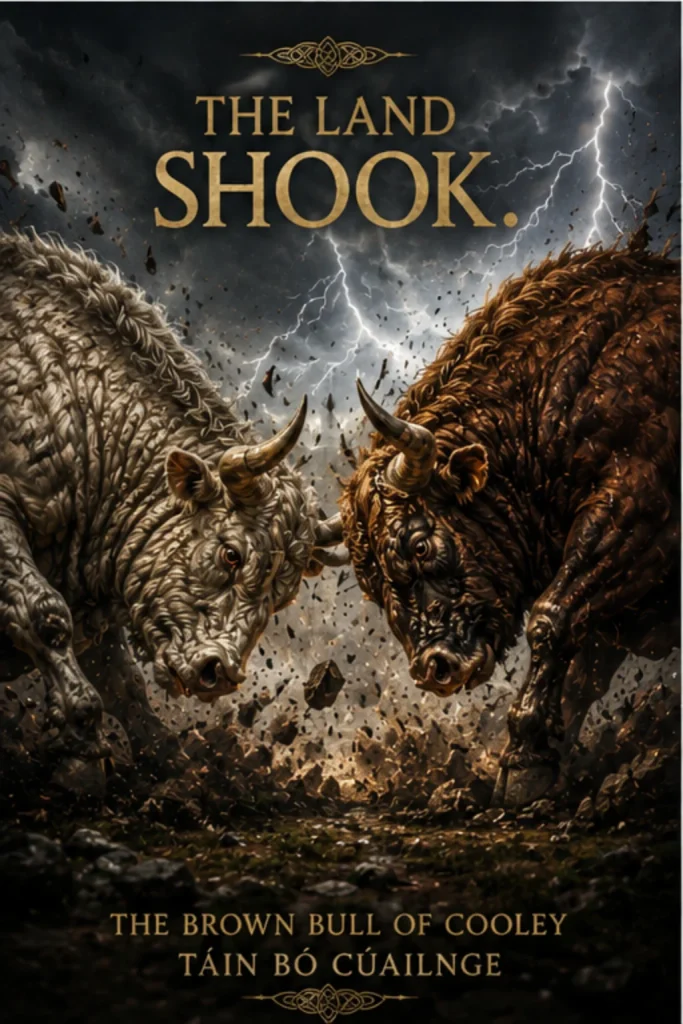
Donn Cuailnge charges.
Finnbhennach answers.
The collision is described in myth with the kind of force modern cinema would assign an irresponsible special effects budget to.
Horns slam together.
The earth shakes.
Men scatter.
The landscape itself seems too small for what’s happening.
This is not livestock.
This is mythological armor-plated fury with hooves.
Donn.
Brown.
Massive.
Relentless.
Finnbhennach.
White.
Equally monstrous.
Equally ancient.
Equally furious.
They crash across the land like weaponized weather systems.
And this is where the whole story suddenly stops being funny.
Because now the myth fully reveals itself as tragedy.
No heroes cheering.
No clever victory speeches.
No audience-safe ending.
Just violence.
Old violence.
The kind mythology reserves for beings that were never meant to coexist.
Vagabond translation:
Imagine two ancient sorcerers settling unfinished business…
…as armored battle cattle.
🤣🔥☘️
Finnbhennach falls
Eventually…
The White Bull breaks.
Defeated.
Destroyed.
The ancient score appears settled.
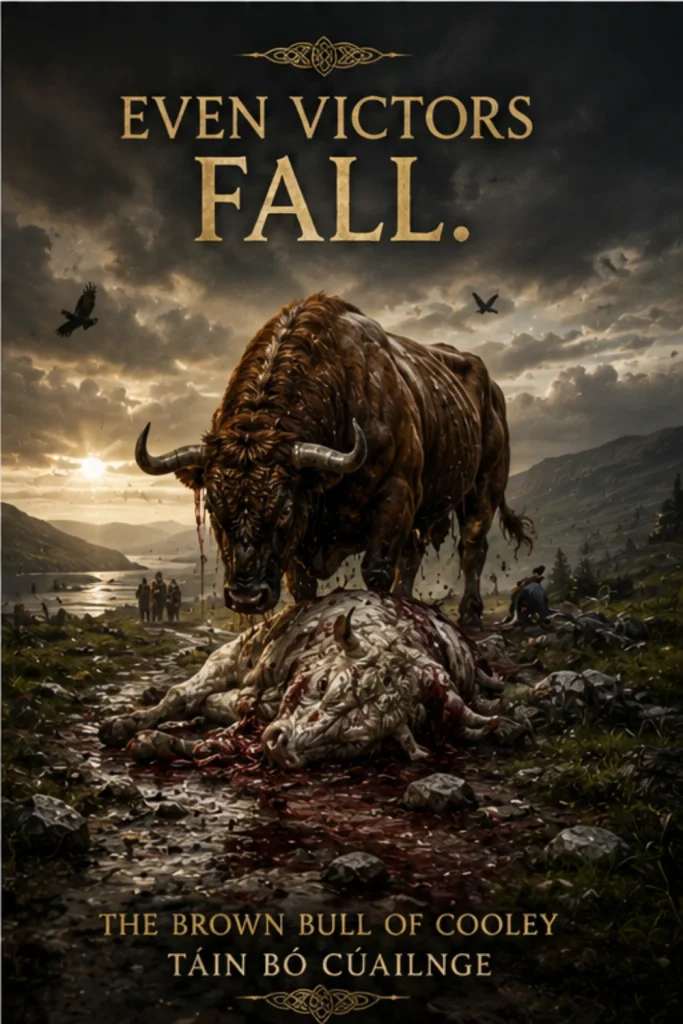
Donn wins.
But victory in old myths is rarely clean.
And Donn does not simply walk away.
ACT IX—The Road Home
Because this is where Irish mythology becomes magnificently strange.
The Brown Bull returns home.
But not alone.
🔥
According to tradition, Donn Cuailnge carries the remains of Finnbhennach with him.
Yes.
Exactly as gloriously grim as that sounds.
And as he travels…
the fallen White Bull is said in folklore to leave traces across the land.
Bones.
Fragments.
Body parts.
Echoes.
Some traditions link local place-name stories to this bizarre mythic journey.
As always with oral tradition, versions vary.
But the image?
Absolutely unforgettable.
Picture it.
A victorious beast.
Bloodied.
Exhausted.
Half broken.
Dragging the evidence of its enemy across Ireland.
That is not a cheerful ending.
That is myth in its oldest form.
ACT X—The Death of the Winner
I w końcu…
Donn wraca do Cooley.
Do domu.
Do miejsca, skąd wszystko się zaczęło.
Wygrywa.
Odnajduje swój teren.
Domyka konflikt.
I wtedy…
Pada martwy.
Silniejszy wygrał.
Ale nie przeżył zwycięstwa.
I właśnie dlatego ten mit działa tak dobrze.
Bo to nie Marvel.
Nie ma triumfalnej fanfary.
Nie ma napisu:
“Bull will return in sequel.”
Jest klasyczna mitologiczna prawda:
Czasem zwycięstwo kosztuje wszystko.
Epilog — czego ta historia właściwie nas uczy?
And finally…
Donn Cuailnge reaches home.
Back to Cooley.
Back to where all this madness began.
He has won.
The enemy is gone.
The ancient feud is over.
And then…
he collapses.
Dead.
No sequel tease.
No heroic music.
No:
“The Bull will return.”
🤣🔥
Just the oldest truth mythology knows:
sometimes victory costs everything.
Epilogue — what was this story really about?
A marital argument about livestock?
Technically…
Yes.
But also:
Ambition.
Pride.
Status.
Possession.
War.
Ancient hatred.
Cycles of conflict.
The illusion of control.
And the deeply human habit of turning ego into catastrophe.
Because myths are never really about what they first appear to be.
This is not a cattle story.
It’s a tragedy wearing horns.
Final line
And that is how one of Ireland’s greatest mythological wars began because a queen discovered her husband owned the better bull.
Honestly?
That feels magnificently Irish.