
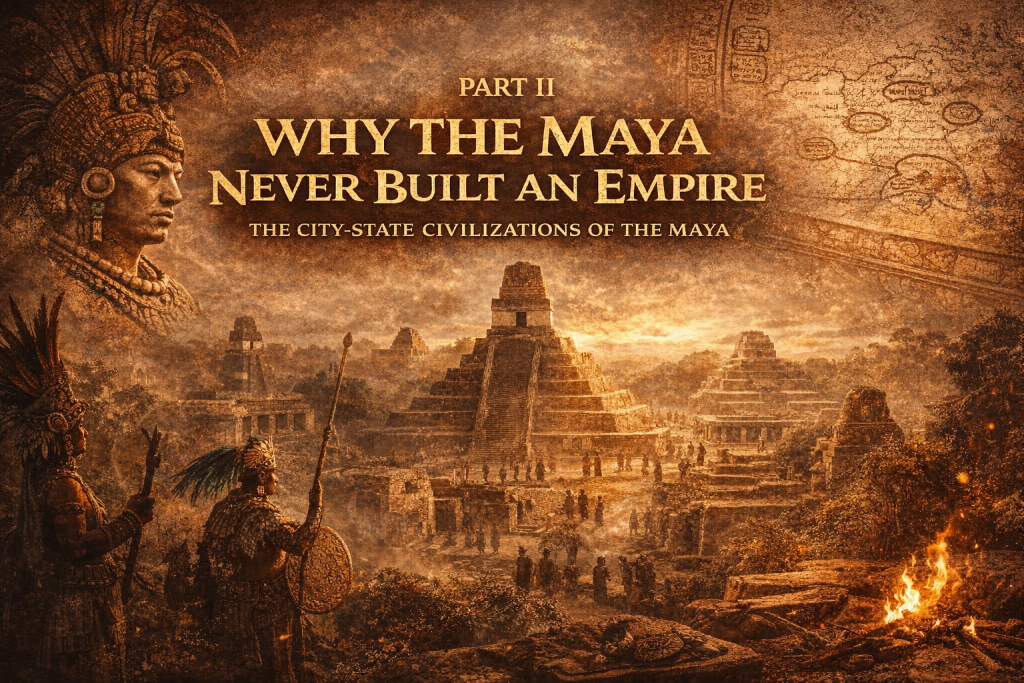
Why the Maya Never Built an Empire
“The Maya built magnificent cities and mapped the movement of the stars… yet they never created a single empire.”
Vagabonds of the North
Why the Maya Never Built an Empire
When walking through the ruins of ancient Maya cities such as Chacchoben, Tikal or Palenque, one question naturally appears.
How could a civilization capable of building massive pyramids, developing writing and creating incredibly precise astronomical calendars never unite into a single empire?
Why did the Maya world look so different from the empires of the Aztecs or the Incas?
The answer lies in the unique political and cultural structure of Maya society.
A World of City-States
The Maya civilization was not a unified country.
Instead, it was a network of hundreds of independent city-states spread across modern Mexico, Guatemala, Belize and Honduras.
Each city had:
its own ruler
its own dynasty
its own temples
its own army
Cities such as Tikal, Calakmul and Copán competed constantly for influence.
Victory over another city meant more than territory.
It meant prestige and divine legitimacy.
Politics Instead of Empire
Many civilizations eventually formed large centralized empires.
The Maya took a different path.
Their world was shaped by alliances, rivalries and shifting political influence.
Powerful cities sometimes dominated weaker ones.
But domination rarely meant direct control.
Subordinate cities still kept their rulers and their traditions.
In many ways, the Maya world resembled medieval Europe more than a centralized empire.
“The Maya created one of the most advanced civilizations of the ancient world. Yet instead of one empire, they built a world of competing cities.”
Vagabonds of the North
Why an Empire Never Emerged
Several factors explain why the Maya never united under a single ruler.
Geography
The Maya world was geographically complex.
Dense jungles, mountains and wetlands made travel difficult.
Communication and control over vast territories were challenging.
Religion and Local Power
Maya rulers were more than political leaders.
They were spiritual mediators between humans and gods.
Their authority was deeply tied to local traditions and rituals.
This made centralized power difficult to establish.
“In the Maya world, power was not only political. It was sacred.”
Vagabonds of the North
Rival Elites
Maya noble families were highly ambitious.
Instead of submitting to one supreme ruler, they competed with each other for power.
Archaeological inscriptions describe battles, captured rulers and political victories.
The Maya world was not only about astronomy and temples.
It was also about politics and war.
Daily Life in Maya Cities
Maya cities were vibrant and complex urban centers.
Their streets were filled with:
merchants trading jade and cacao
artisans producing pottery and sculptures
priests preparing ceremonies
farmers bringing crops from surrounding fields
Cacao was so valuable that it was sometimes used as a form of currency.
Chocolate, prepared as a bitter ceremonial drink, was reserved mainly for elites.
A Civilization That Lasted for Centuries
The Maya civilization flourished for more than 1500 years.
Cities rose and fell.
Dynasties disappeared and new ones emerged.
Yet throughout this long history, one thing remained constant.
The Maya never built a single empire.
And that is precisely what makes their civilization so fascinating.
“The Maya mapped the stars and built pyramids in the jungle… yet their world never had a single emperor.”
Vagabonds of the North
Fascinating Facts About the Maya Civilization
1️⃣ Cacao Was Currency
Cacao beans were so valuable that they were used as money.
A few beans could buy food.
Hundreds could buy much more.
2️⃣ Chocolate Was a Sacred Drink
Maya chocolate was very different from the modern version.
It was a bitter drink made from cacao, chili and spices.
Mostly consumed by elites.
3️⃣ Skull Shaping Was a Beauty Ideal
In many Maya regions, children’s skulls were intentionally shaped using wooden boards.
An elongated head was considered beautiful and noble.
4️⃣ Their Calendar Was Extremely Accurate
The Maya calendar was incredibly precise.
They could track the movement of Venus with remarkable accuracy.
5️⃣ Some Maya Cities Were Huge
Cities like Tikal and Calakmul were among the largest cities in the ancient world.
Some had populations exceeding 50,000 people.
Part III Preview
The history of the Maya changed forever when people from another world appeared on their lands.
People in steel armor.
With weapons the Maya had never seen before.
This will be the story of the meeting of two civilizations.
👉 Part III: When Two Worlds Met
Discover with us: