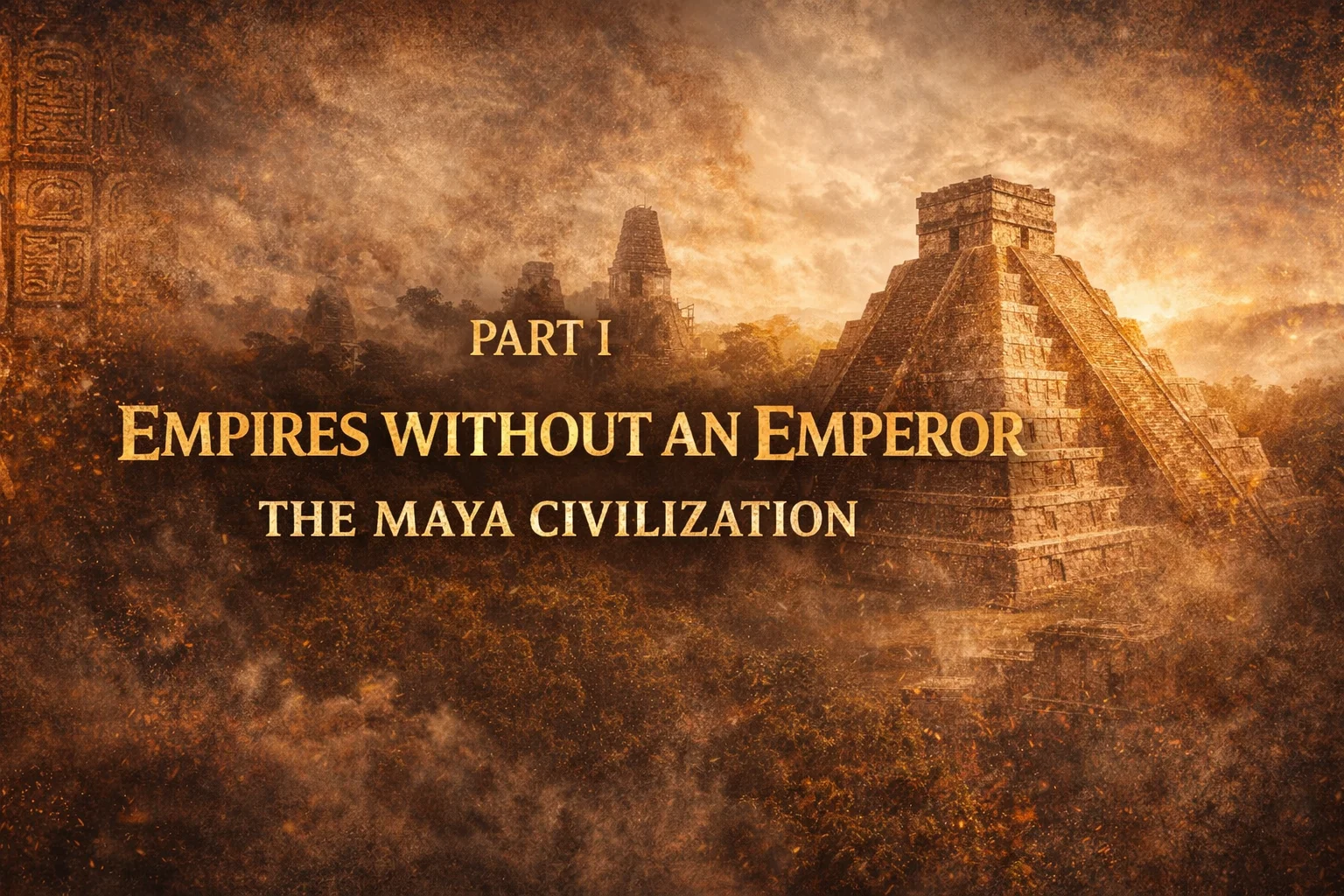
Empires Without an Emperor
The World of the Maya Before the Europeans Arrived
Empires Without an Emperor—What the Mayan World Really Looked Like
When Europe was busy fighting over crowns, thrones and pieces of land, something remarkable was happening deep in the jungles of Central America.
Cities of stone were rising.
No emperor ruled them.
No single empire controlled them.
No central throne held the world together.
And yet the Maya built pyramids, mapped the stars and created one of the most fascinating civilizations in human history.
An Empire That Was Never an Empire
When people hear the word civilization, they often imagine an empire.
Rome.
Egypt.
China.
One ruler.
One army.
One center of power.
But the Maya world worked differently.
It was not one empire.
It was a network of city-states.
Each city had its own ruler, its own ambitions and sometimes its own enemies.
Sometimes they traded.
Sometimes they formed alliances.
Sometimes they went to war.
In many ways it looked a bit like medieval Europe – just hidden inside tropical jungle.
Cities in the Jungle
Today Mayan pyramids often appear as lonely ruins surrounded by thick forest.
But once they were thriving cities.
Imagine this:
Stone plazas filled with people.
Temples rising above the canopy.
Palaces of rulers.
Markets full of traders and craftsmen.
Ball courts where ritual games were played.
Cities like Chacchoben or Tikal once held tens of thousands of inhabitants.
At a time when many parts of Europe still consisted of small villages.
Kings, Priests and the People
Mayan society had a clear structure.
At the top stood the rulers.
But they were not only kings.
They were believed to be intermediaries between the human world and the world of the gods.
Below them stood the priests – guardians of rituals, calendars and astronomical knowledge.
Then came craftsmen, traders and farmers – the people who kept the entire system running.
And at the bottom of the ladder were captives of war and slaves.
In other words, their society was complex, layered and surprisingly familiar compared to many other ancient cultures.
Astronomers of the Jungle
One of the most impressive achievements of the Maya was astronomy.
They had no telescopes.
No computers.
No modern instruments.
And yet they calculated the cycles of Venus with astonishing precision.
Their calendars were so accurate that modern researchers still study them with admiration.
In many cities temples were aligned with the sun so that during specific days of the year sunlight appeared exactly where the architects intended.
It was not magic.
It was mathematics.
Why Did They Shape Children’s Skulls?
One of the strangest customs of the Maya concerned beauty.
For them, beauty looked very different from our modern standards.
Parents often intentionally shaped the skulls of infants, gently pressing boards against the head during early childhood.
The result was an elongated skull.
Why?
Because it symbolized nobility and high status.
In a way, it was the ancient equivalent of elite fashion.
The Cities That Vanished
And here comes one of the greatest mysteries of history.
Around the 9th century many major Maya cities suddenly declined.
They were not destroyed by massive invading armies.
They were not burned to the ground.
People simply left.
To this day historians debate why.
Possible reasons include:
long droughts
overpopulation
warfare between city-states
exhausted farmland
Most likely it was a combination of all of them.
Civilizations rarely collapse for only one reason.
And then the Europeans Arrived
When the Spanish reached Central America in the 16th century, the great Maya civilization had already changed.
Many ancient cities were abandoned.
But the culture, language and traditions of the Maya people were still alive.
And they remain alive today.
Conclusion
When you stand beneath a Mayan pyramid, it is easy to see only ruins.
But once you understand the story behind them, the stones begin to speak.
This was a world of scientists, rulers, farmers and astronomers.
Not a single empire.
Yet one of the most remarkable civilizations humanity has ever produced.
And this is only the beginning of the story.
Because in the next chapter we will ask even bigger questions.
Why did the Maya never create a unified empire?
Why did complex civilization stop in Mesoamerica and not expand northward?
And what truly happened when Spanish ships appeared on the horizon?